Award winners, judges question what good translation is

The winners of the 47th Modern Korean Literature Translation Awards pose for a photo during an award ceremony at Lotte Hotel in downtown Seoul, Friday. From left are juror Brother Anthony; Commendation Award for fiction winner Kim You-jeong; Korea Times President-Publisher Lee Chang-sup; KB Financial Group Managing Director Shin Hong-seob; Lee Gil-sung on behalf of Commendation Award for fiction winner Stella Kim; and Commendation Award for fiction winner Steve Capener. / Korea Times photo by Shim Hyun-chul
By Kwon Mee-yoo
The winners of the 47th Modern Korean Literature Translation Awards by The Korea Times were honored at an award ceremony at Lotte Hotel in downtown Seoul, Friday.
Organized by The Korea Times and sponsored by KB Financial Group, the award recognizes budding translators of Korean literature into English who support Korean literary works to reach a wider audience and transcend the language barrier.
There was no Grand Prize winner for either fiction or poetry this year, but three Commendation Award winners in the fiction category.
Steven Capener won for his translation of Kim Young-ha's "Oppa Came Back.” Capener, a professor in the Department of English Language and Literature at Seoul Women's University, said he is a fan of author Kim and he thought the novel was worth introducing in English.
The team of Kim You-jeong and Amy Russ translated Hwang Jeong-eun's "Where No One Had Ever Been." Kim and Russ met at the School of International Affairs at Georgia Tech and this is their first translation work. Russ was unable to attend the ceremony due to her job in the U.S.
"We wanted to conclude the translation, so we went through recent winners of literary awards to find the short story that appeals to us and could be expressed in English," Kim said. "We are so excited to receive this award, but we really enjoyed the moments discussing the translation sentence by sentence together."
Lee Gil-sung attended the ceremony on behalf of Stella Kim, who received the Commendation Award for her translation of "Denture" by Choi Jeong-hwa.
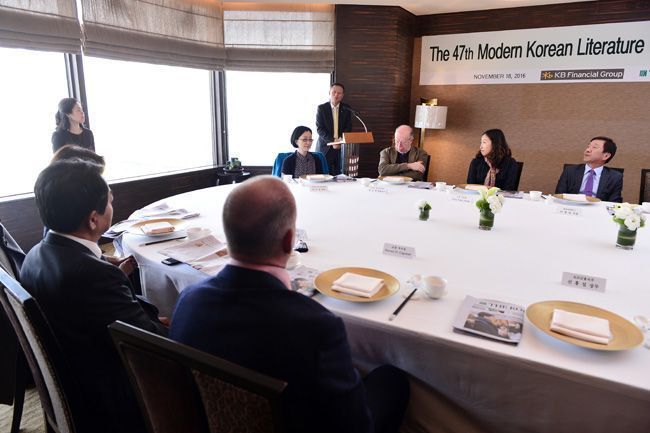
KB Financial Group Managing Director Shin Hong-seob speaks during the award ceremony of the 47th Modern Korean Literature Translation Awards at Lotte Hotel in downtown Seoul, Friday. / Korea Times photo by Shim Hyun-chul
The Korea Times President-Publisher Lee Chang-sup said the award was established on Nov. 1, 1970, as an attempt to introduce Korean literature internationally, inspired by Japanese author Yasunari Kawabata winning the Nobel Prize for Literature in 1968.
"This is the only kind of award recognizing translation of Korean literature hosted by Korean media,” Lee said. “It began to nurture Korean literature to go abroad and support Korean authors to win the Nobel Prize, but no one has been awarded yet. Automated translation has been under development, but literary translation remains indigenous to human beings. We will concentrate efforts to take part in promoting Korean literature overseas."
KB Financial Group managing director Shin Hong-seob praised the history of the award. "This is the first year KB sponsored this award and we look forward to contributing to the expansion of Korean literature to the world through good translation," Shin said.
Sogang University professor emeritus Brother Anthony, Ewha Womans University professor Jung Ha-yun, and Seoul National University professor Min Eun-kyung served as judges.
Judge Jung said the results came after a long discussion, following an explosion of interest in translation of Korean literature triggered by Han Kang and Deborah Smith's winning of the Man Booker Prize.
"We welcome the increased awareness on translation, but also worry about the craze as experts,” Jung said. “We always think of what good translation is and it should tell the story of Koreans in the voice of Koreans to readers from different cultures, while smoothly read in the English-speaking world," Jung said. "All three winners had distinctive goals and achieved their aims, but it did not embrace the other qualifications. We don't want to point out the shortcomings but to encourage them to develop into better translators."