Upholding integrity of Korean food

Yun Mi-wol is CEO of the Michelin two-star Korean restaurant Yunke in Ginza, Tokyo. / Courtesy of Yun Mi-wol
By Kim Ji-soo
CHANGWON, South Gyeongsang Province — In the busy commercial Sangnam market district in this southeastern city is Sugeumjae, a fine-dining Korean restaurant. There seems to be a slight mismatch between the neighborhood and the high-end food served in the restaurant. Sugeumjae was created by Yun Mi-wol, CEO and chef of a Michelin two-star restaurant called Yunke in Tokyo, and a kimchi master.
As I stepped inside Sugeumjae, I found white-walled dining areas where multi-course meals and a la carte lunch dishes are served, such as “bibimbap,” or Korean rice with vegetables, “galbitang,” or short rib soup, and “sundubu jjigae,” or soft tofu stew. As a solitary eater, I chose to dine a la carte and ordered Korean herb bibimbap priced at 18,000 won.
The bibimbap featured a variety of marinated greens and was served with a raw egg in the center and side dishes of cabbage kimchi, pickle kimchi, a small vegetable pancake and soybean stew with a small piece of crab. Hungry and tired after the three-hour train ride from Seoul, I found the rice in the dish soft and comforting, and with a dash of red chili pepper sauce, the bibimbap went fast. But it was admittedly the cabbage kimchi and pickle kimchi that stood out for me; I could hear the crunchy sound as I munched on the kimchi, “asak, asak,” or “crunch, crunch.”
“The secret lies in how you salt the cabbage, the pickle,” Yun, 59, said about making kimchi that good, in an interview with The Korea Times. Yun travels between Japan and South Korea — with the help of her son — cooking and directing at Yunke in Japan, and directing the menu at Sugeumjae in Korea. Her kimchi factory is also in Korea.
While Sugeumjae is a more affordable fine Korean restaurant, Yun’s Yunke in Tokyo is one of much more finesse and the reason Yunke has maintained the two stars for three straight years since 2014. Yun said the Michelin recognition keeps chefs on their toes in their journey to maintain the integrity of the food they cook. The Michelin Guide has been around for over a century but will be arriving in Korea only this coming Monday.
“Earning Michelin stars is an honor, but it is also a huge pressure,” she said. “It’s a lonely struggle to keep up the work that I believe is a recognition of the quality of Korean food.”
Yun said when the Michelin Guide Seoul edition comes out, more chefs can carry the burden of responsibility that is upholding the integrity of Korean food.
Yun worked as a singer in the 1980s and then left for Japan, where she worked in the Korean yakiniku restaurant business for 12 years before opening Yunke in 2013. She wanted to show that Korean cuisine, even its simple dishes, can be fine dishes. “I have poured a huge amount of effort into introducing that as a standard part of Korean meals and into ridding the bias that Korean food is only about hot, salty and spicy,” she said.
“After many years, decades, I see that customers appreciate that my food is kind and soft, what is called ‘yasashii’ in Japanese; interestingly, customers from around the world say that about Yunke’s food.”
For several decades, Yun said her life has been about breaking down the perceptions the Japanese and other foreigners have about Korean food. “It is not easy,” she said, adding that it does not get easier as she rises from one level in the fine dining world to another.
Yun’s life story has been featured in the media so many times that she can be easily recognized. Born in the region that is now the central Chungcheong provinces, she started a career as a singer in Seoul. She fell in love with a man and had two children with him, only to find out that he was already married. She then went to Japan to work as a singer as a member of a team from time to time, a financially difficult time during which she picked herself up.
“When a person encounters a difficulty, shock or devastating experience, one’s heart drops to the rock bottom .... I picked myself up because I was a mother,” Yun said. “When hard times come, you focus your energy and rely on it to rebound.”
Her hard work, in particular at the yakiniku restaurant Kiri in Tokyo, where she worked 12 to 13 hours a day for 12 years, enabled her to save a lot of money. It was also during that time that she entered the kimchi business as an advisor to a company, before founding her kimchi company, Gunshik Trading, in 2000. She also delved into the homemade Korean food industry but was dissatisfied with its inability to demonstrate the high quality of Korean food.
She made a bold move and decided to introduce Korean food from the top down, starting in Ginza, the premier commercial area in Tokyo.
“So much passion and work went (into the Ginza restaurant) so that our customers could feel the genuine flavor of the Korean pancake or the ‘samgyetang’ ginseng chicken soup,” she said. “For example, with the ginseng chicken soup, I use 2.8 kilograms of top-quality chicken and simmer it in milk vetch roots, Phellinus linteus mushrooms, garlic and other good Korean spices. With the samgyetang, I noticed that people usually could not concentrate on the taste because they were busy dissecting the bones, so (now) I debone, so the customers can savor the pure taste of a good chicken.”
That pre-separation of the bones for the Korean ginseng chicken soup has never been attempted, but in September, the Korean Food Foundation presented a similar version of Yun’s chicken broth when it announced the Top 10 Korean Foods as the country gears up for the arrival of foreign guests for the 2018 PyeongChang Olympic Games.
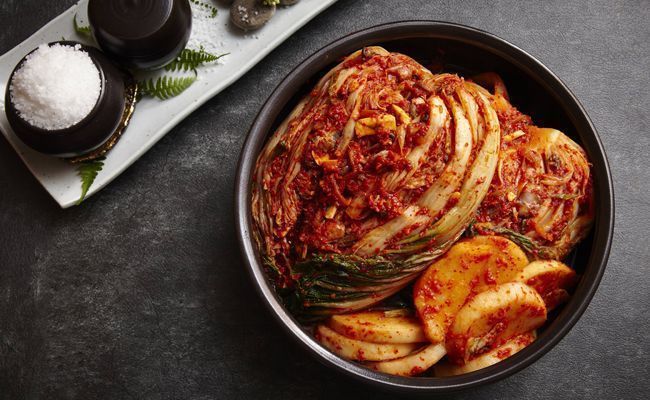
Yun recently launched Sungchimchae, a high-quality kimchi, through Hyundai Home Shopping.
Yun’s kimchi repertoire is also inseparable from her identity. In Japan, she is known as the “kimchi mama,” and in her home country, she received acknowledgment from the agriculture ministry for her kimchi recipes.
“I have made demonstrations of how to make kimchi, how to salt the cabbage, to dab the other ingredients, and the culture behind kimchi making, and those efforts eventually earned me the nickname, I guess,” she said.
Japanese appreciation of kimchi oddly spurred her to show the right way to prepare the dish.
“With the vegetables, it is all in how you wash them, how you salt them, how you mix them,” she said. She also uses salted yellow corvina, separating its body, head and bone and condensing the latter two into a soup to be used for the fermentation process. Yun learned about food from her mother and grandmother and through hard work. “Accreditations or chef licenses are not necessary,” she said. “The person you are is the qualification (to be a chef).”
First coming across to me as a disciplined, Japanese-style businesswoman, Yun grew passionate during the interview when she talked about food.
“When I cook, I make sure to empty my brain and concentrate solely on the ingredients and food making and enjoy the process,” Yun said. “Cooking, it is not an easy task, as everybody’s palate differs, yet you have to satisfy each and every one.”
The complete immersion into food making prompts her to sing or hum a melody or a song, Yun said.
As a CEO and restaurateur, Yun admits that her life has been about work. “Sometimes I wonder if my passion burned too bright, and I charged ahead without, how to say, calculations,” she said. She realized that she may have over-paced herself in the initial days of the Ginza restaurant. “The patrons said the food was delicious, but they did not return,” she said. “And when only a few sought out Yunke in the early days, I did feel a slight sense of frustration. I may come across as very strong, but those were lonely days.”
How does she strike a balance between work and life these days? “I don’t know, perhaps in finding happiness in the moment when I am having the food and drink I enjoy,” she said.
The response of the diners at Yunke is also her reward. “I see them first step into the restaurant a little excited, and then their faces soften midway through the multi-course meal, and then they completely relax after the dinner. That is my reward, in knowing that the customers have received my heart, my intention to create comforting food for them.”
In that vein, she urged chefs to find their distinctive food identity rather than become dependent on outside recognition, including the Michelin star. She also urged the Korean government to develop a system where the right food supplies for Korean food can be found at the right time and where makers of Korean food demonstrate its true qualities.
“It is very hard to find fresh ingredients in Korea these days,” Yun said. “We talk of the globalization of Korean food, and a lot of efforts are under way. You can say the festivities have opened, but if we do not attend to the shortcomings to providing quality Korean food, these festivities may never re-open.”
Recently, she launched Sungchimchae Kimchi, in partnership with Hyundai Shopping. “I want to give Koreans the option of having quality kimchi that can be eaten by itself as a dish and that is made with good ingredients using abalone, salted yellow corvina, pear and chestnuts,” she said.
Running a kimchi enterprise means dealing with vegetables that are vulnerable to weather, price fluctuations and even geopolitical issues, and these concerns keep her awake at night. Yun is, however, a believer that the difficulties only mean steps toward how to best please the customers’ palates. “(Making food) is about creating, expressing tastes, flavors that will be pleasing to the customers,” Yun said.