Pansori master looks to create 'zeitgeist' work

Ahn Sook-sun, 66, is considered the foremost leader in pansori or traditional Korean music. / Courtesy of Ahn Sook-sun
By Kim Ji-soo
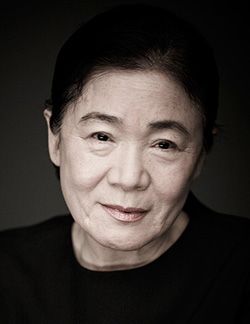
Pansori master Ahn Sook-sun
After performing with cellist Chung Myung-wha at Gyechon Village in eastern Gangwon Province last Friday, Ahn Sook-sun was getting some rest at her home in a leafy southern Seoul neighborhood Monday.
At 66, the master and designated cultural asset in pansori, a traditional genre of Korean narrative music, said she is willing to collaborate with other artists across genres to spread the music that has been her life. Officially, Ahn is designated National Intangible Cultural Asset No. 23 in gayageum (12-string Korean zither) sanjo, a style of gayageum solo performance, and in gayageum byeongchang, or singing pansori to gayageum.
“What I do, my sound, it is the sound of 300, 400 years and more. I hope to spread the artistic spirit that it was created in and familiarize the public with it,” Ahn said. At such an advanced phase in her career, Ahn doesn’t shy away from the stage, even as she embraces bigger responsibilities as a senior leader and teacher.
She also performed to commemorate solo artisans, on the first anniversary of the death of the traditional dancer Lee Mae-bang (1927-2015). “He had often said he would only dance to my sound,” she said, fondly remembering him.
Even as she holds on to the traditional spirit, these days Ahn wants to craft an artistic work that will encompass the spirit of today.
Asked what she means by “today’s spirit,” she said, “Oh you know, we now drive, eat hamburgers and jajangmyeon. While the traditional works require knowledge in Chinese characters, history and geology, I am envisioning an original work in which the United States may appear as the background and where pure Korean language may be used.”
It’s an ambitious, optimistic dream that one may or may well not expect of a pansori master who is often called a “living treasure of Korea.”
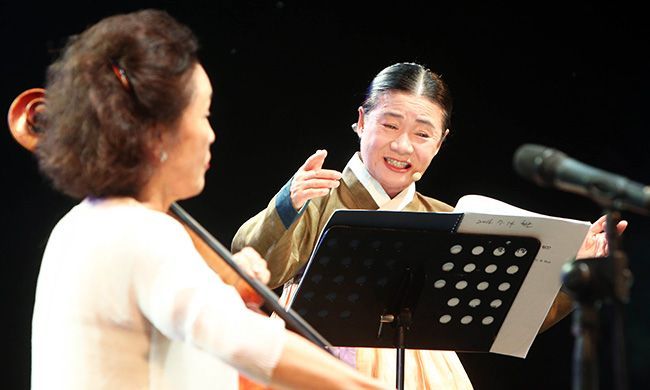
Ahn Sook-sun, right, performs with cellist Chung Myung-wha in Gyechon, Gangwon Province. / Yonhap
Among the 12 pansori works, only five remain in performance — “Chunhyangga” (“Song of Chunghyang”), “Shimcheongga” (“Song of Simcheong”), “Heungbuga” (“Song of Heungbu”), “Sugungga” (“Song of Underwater Palace”) and “Jeokbyeokga” (“The Battle of the Red Cliffs”). Watching her perform these works, her strength is in how she captures the feeling each work contains. For example when she sings “Sarangga” (“Song of Love”) in “Chunhyangga,” one feels the happiness or love.
“I believe in expressing each of the feelings — the happiness, rage, love and joyfulness — in the works,” Ahn said. The traditional musical storytelling of pansori is more than about “han,” that singular Korean sentiment that translates into regret.
Also, the five works entail the duties that people should fulfill in their lives: in “Chunghyangga,” the fidelity of a woman; “Heungbuga,” the love between siblings; “Simcheongga,” filial piety; “Sugungga,” the wisdom of humility despite talent; and “Jeokbyeokga,” the tale of heroes. Ahn is known for her full performances of these works, each of which can last several hours.
But ultimately, pansori is “a play with vocal sounds,” she said, sounds that express feelings or depict a scene, for example even that of a bird flying away.
These days, she loses sleep over how to best capture the feelings in the pansori works or how to express her own feelings that she hopes to embody in her own yet-to-materialize creative endeavors.
“It just gets harder by the year; you’re never satisfied with your performance,” Ahn said.
“These days, I feel like taking some time off to focus on creating that original pansori work, but then again, I have performances that I need to do, and also spend time on nurturing future pansori masters, just like how my teachers taught me.”
Like many stellar traditional artists, Ahn hails from the southwestern region; she was born in Namwon, South Jeolla Province. Her hometown of Namwon in particular is well known for “gugak” or traditional Korean music.
But her voice has always stood out, even as a child. She began singing at age nine, and she studied under masters including Kim So-hui. Her family on her mother’s side had artisans galore. The singer, who is married and has three grown children, was always singing, and, but it wasn’t until 1979, when she joined the National Changgeuk Company, that she turned serious about pansori.
“I got on the stage at the company, and I got more serious,” she said. Up to that time, she performed in theaters, or under kerosene lamps at outdoor provincial sites, she said. Her husband and her mother-in-law for a while also ran a small restaurant while she stood on night stages at hotels too.
Now, people respect the traditional art of pansori and believe it needs to be preserved; in 2003, UNESCO designated it a Masterpiece of the Oral and Intangible Heritage of Humanity.
It was not always that way, Ahn said. “And I kept practicing and studying to fight the biases and my own perceived sense about what sound should be,” she said.
In her mid-30s, she also realized that she was merely belting out her voice, rather than expressing the sounds. “It was a wakeup call,” she said.
She practiced up to 10 hours a day when she was younger. Now she keeps to one-hour daily practice, to “hold onto the sound.”
She has actively performed overseas, including in North Korea for a music festival in 1998. These days, she said she finds it difficult to travel more than seven hours by plane.
Listening to her talk during the interview was like listening to a whispered narrative phrase in a pansori work. She caught your attention, and you wanted her to continue talking and to listen to her.
Ahn, however, is considering multiple options like taking certain amount of time off or creating her own work.
“I would like to take a certain amount of time off to be able to consider each sound and what they mean with leisure,” Ahn said.
“Yet it is, at the same time, scary to begin my creative work in earnest for the fear of not getting that sound right. Now I see that the flowers are pretty and all, and the question is, can I best express that with my sound? In that vein, there is no end (to pansori).”