'English-language news helps break down barriers'
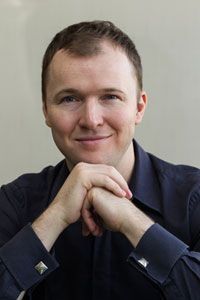
Alex Jensen
British radio anchor seeks to spark dialogue, deepen understanding of Korea
By Lee Ji-hye
At the crack of dawn every weekday, a familiar voice hits the radio airwaves, transmitted from a studio on Mt. Nam in central Seoul to the surrounding area.
What separates Alex Jensen’s voice from the multitude of others on local radio, is that the 34-year-old anchor does not deliver the morning news in Korean.
Like most programs on TBS eFM, "This Morning," is broadcast in English.
While being an English-language newscaster comes with its own set of challenges, Jensen says that it brings many opportunities too; namely, the chance to engage in dialogue that could become mired in conflicting ideologies if it was held in Korean.
"This country has been rapidly opening up to the rest of the world, and it’s important that the media here reflect that by meeting domestic and foreign demand for English-language options,” Jensen said during a recent interview at TBS eFM’s offices.
“I’ve noticed that using English can break down certain barriers when discussing sensitive issues.” He added: "I feel completely energized by Korea.”
In the first hour of the program, Jensen delivers the morning’s top headlines.
In the second hour, he invites guests to analyze and digest the news, informing listeners on key issues as they begin their day.
"It's a fantastic challenge at a time of day when listeners really rely on radio as part of their morning routine," he said.
"When I was a listener in London growing up, breakfast-time radio was very important because it catches people mostly when they're in their cars on their way to work ㅡ a particularly important and a more demanding time than any other."
Jensen worked as a television and radio presenter back in the United Kingdom, including stints with ESPN and popular London-based station LBC.
He has covered Korean affairs since 2011 with TBS and as a freelancer for other foreign media outlets such as the BBC, Sky News, and Al Jazeera.
Reporting for both domestic and international platforms on the peninsula’s hottest topic ㅡ inter-Korean relations ㅡ Jensen sees the North Korea issue as more of a humanitarian problem than a political one.
“We have this very bizarre situation where one ethnicity has been divided by a demilitarized zone, and it’s the big elephant in the room in many conversations," Jensen said.
“And yes, there are political aspects to it, but first and foremost for me it’s a human disaster.”
The host believes that his work does not end when his show goes off the air each day.
"This job comes with both the responsibility and opportunity to be a force for change, hopefully for the better," he said, calling it a "gateway of opinions."
Jensen sat down with the Korea Times to discuss his career as a newsman in Seoul.
.jpg?w=728)
/ Courtesy of TBS eFM
Q: What inspired you to become a news presenter?
A: I studied history at university and was considering my post-graduate options, which were pointing in a legal direction. But then I did a radio demo and everything changed. I was restless and felt like doing something completely out of left field. It really wasn’t that surprising though, because my grandfather and father were both radio presenters. My education continued in a hectic London radio newsroom, where I earned the “broadcast journalist” title. It’s been ten years overall now, and I see myself as a communicator as well as a journalist.
Q: Tell us about how you settled here in Korea. What attracted you the most about this place?
A: If I felt I would prefer to be in London or New York or Tokyo for that matter, I would be in one of those places! I live in Seoul because it feels like home, and it’s great for raising a family in a low-crime, low-aggression environment. But the thing is, I did not actually choose Korea. My wife and I were drawn to each other, and the geography was initially secondary. Everything was secondary.
All we cared about was getting to know each other, and I was freelance at the time so could spare some time in Korea. What then happened was I also fell in love with the country and am very grateful to be able to build a career here. My family helps show me what real life is like in Korea, guiding my work in turn.
Q: What are some difficulties you face as a journalist in Korea?
A: There are language barriers when covering domestic affairs, but they can’t be avoided. Occasionally I’ve encountered some challenges as a “foreigner,” but not at the radio station at all, and honestly I embrace those as part of the whole experience.
I feel much greater sympathy for migrant workers forced into brutal conditions somewhere out of the public eye, for example, than for reporters in Korea. Frankly, this place is rich with stories, and that’s even before one considers a certain northern neighbor.
.JPG?w=728)
/ Korea Times photo
Q: What was your most memorable report?
A: It was very recently; my most life-changing report was when we visited a children’s home. That took the ground from under my feet and I certainly hope I never forget the experience. I’m grateful to those kids for showing me a love that I didn’t feel I deserved, and I cannot help but feel compelled to return the favor. The experience brought me further into Korea’s underbelly, but above all it was a raw human encounter - the kind anyone would be inspired to act upon.
Also the stories on homelessness in Seoul, women being forced out of the workplace, young people struggling to get jobs, even younger people saturated with education and starved of sleep and leisure. Any story that offers raw human experiences that force us to respond in a real way.
Q: On to a more current issue, what was your initial reaction to the constitutional court's ruling for the Unified Progressive Party's disbandment?
A: My first reaction was that it was a real disappointment for democracy. I wanted the country to pass judgment on this party in the next elections; I wanted the UPP to be buried by their own policies, which I find to be distasteful. I certainly cannot understand anybody growing up in South Korea with a preference for North Korea.
Q: Who has been your most interesting interviewee?
A: I would say Noam Chomsky or Slavoj Zizek. The interviews were interesting but also very difficult because both of them are not afraid to be contrary. I felt pressure when interviewing them, so they stand out in my memory. Honestly, there have been dozens of interviews that have really left a lasting impact on me and actually influenced my viewpoint or lifestyle choices.
Q: What do you feel can be improved within Korea’s English-language media culture?
A: Every media outlet should always seek improvement, to stay alive with passion and to keep grounded on what matters or what entertains. That process should incorporate listener, viewer or reader interaction. People won’t accept an out of touch media. It always has to be real. It’s something I know we strive for in the “This Morning” team and TBS eFM as a whole. There are already some great options there, and I’m honored to be a part of that. But could we go even further? To dignitaries and visitors when they arrive in hotels, for example, where is our 24-hour English language TV rolling news channel? That would be something, and done in the right way, it could further bolster Korea’s international appeal.
Q: What are your future plans?
A: I love Korea and want to be successful here. I’m very ambitious but I feel those ambitions can be met in this country. I don’t see why I should move to another country when we have millions of people here that are thirsty for information and thirsty to improve society. I’d like to contribute as much as I can to that thirst, while supporting my family at the same time.