Al-Hosany represents unknown sides of UAE
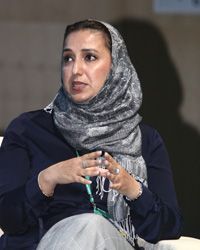
Nawal Al-Hosany, the director of sustainability at Masdar, speaks during a discussion at the Global Green Growth Summit in Songdo, Incheon, June 11.
By Kim Da-ye
An interview with Nawal Al-Hosany, the female director of sustainability at Masdar, reveals two things about the United Arab Emirates (UAE) that non-Emiratis may not be familiar with. While known as an oil-rich Middle Eastern state, the country strives to be a leader in clean energy and seeks to empower women.
Masdar, also called the Abu Dhabi Future Energy Company, is a “commercially driven” renewable energy company initiated by the government. Based in Abu Dhabi, Masdar has its own graduate education and research institution ― Masdar Institute of Science and Technology ― and an investment arm that manages two clean technology funds worth $540 million.
The company also operates wind farms or solar power plants in the Seychelles, Tonga, Afghanistan and Mauritania. To the outside world, it is best known for Masdar City, a futuristic zone powered entirely by renewably energy.
Al-Hosany is in charge of developing Masdar’s sustainability standards and policies.
“The UAE wants to maintain leadership not only in the oil industry and in the energy sector. Renewable energy is one of the fastest growing sectors. The country definitely doesn’t want to miss leadership in the growing sector,” Al-Hosany said in an interview during her visit to Korea in early June for a summit held by the Global Green Growth Institute (GGGI).
Al-Hosany stood out from the pool of panelists at the summit because she was among the few female experts.
Al-Hosany herself has an unusual background. She earned a doctorate degree in architecture from Newcastle University in the U.K. In 2007, before joining Masdar, she became the first-ever female deputy director in the Abu Dhabi Police. Abu Dhabi Magazine named her in 2011 as one of the 40 most influential Emiratis who have helped shape the country.
When asked what contributed to her advancement, she cites support from her family and her personal will. But she said that the “main element” was the country’s “political leadership to empower women.”
According to Al-Hosany, it is legally mandated that the boards of all state-run companies include women. Almost half of government officials and nearly 40 percent of university students are women, she said.
The UAE is ranked 40th in 2012 in the rankings of Gender Inequality Index by the United National Development Program while Korea came at 27th. Only Israel and Libya were ranked higher than the UAE from the Middle East and Africa regions.
“On the day the country was established in 1971, the women’s union was formed. Because our country is relatively young, women’s rights are built into the system,” she said. “Men and women have equal rights in the UAE.”
Al-Hosany added that gender issues occurred to her when she started traveling abroad. She said that in most of the meetings she attended in the U.S., she was the only female senior member.
“A lot of people look at the veil and think women are subject to discrimination. Women dress the way they want to be dressed,” said Al-Hosany, clad in a tweed jacket and a dark blue veil,
In 2010, the director at Masdar and her friend became the first two Emirati women to climb Mt. Kilimanjaro, the highest peak in Tanzania and the African continent.
“We are privileged by having lots of luxury around us and plenty of resources. Climbing a mountain basically gets you to challenge yourself more than anything else ― physically and mentally,” said Al-Hosany.
“After we went, lots of women got inspiration. Many women since then climbed Kilimanjaro. A group of only female students recently climbed the mountain. There is a lot of motivation right now.”