'Enthusiasm is key to good memory'
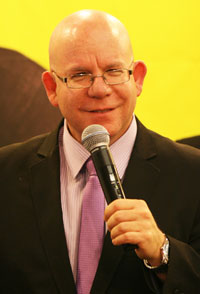
Eran Katz, Guinness World Records holder in memory stunts, talks about his secrets to improving memory on Monday. / Korea Times
By Yun Suh-young
There are no magic methods for dramatically improving one’s memory, but determination and a habit of organizing helps, according to Eran Katz. The Israeli record holder in memory stunts in the Guinness Book of World Records was in Seoul to promote the release of his new book, “Five Gifts for the Mind,’’ and shared tips on how to memorize.
Those who were expecting dramatic, brain-manipulating secrets to absorb and preserve information would have been disappointed: Katz summarized his solutions as enthusiasm, organization, association and lots of practice.
"Do you know why we don’t remember things we see every day? Because we never paid attention to it. Then when do we pay attention? When we're interested, when it's unusual, different and when we have a point of reference, as in associated to something else,’’ he said at the Israeli Culture Center in southern Seoul on Monday.
"When we were young, everything was new and exciting. We used to ask amazing questions like `Why is the sky blue?’ But now the question became ‘Who is your lawyer?’ We've seen, heard, and know about a lot of things that nothing is as exciting in vast intensity as in our youth.”
Being enthusiastic about something indeed gives us the best chance for remembering it.
"Be enthusiastic in your daily life. But can we seriously be enthusiastic about everything? Yes. And maybe a little artificial motivation would help. Also, moving, exercising and walking help improve our memory,” said Katz.
“Categorization and association also helps memorization. Try dividing things into bulks and categories when you go to a supermarket. With numbers, try associating them with words that our brain can understand. For instance, try turning your passport number into a sentence. It will make you easily remember it.”
Katz did offer a few skills. For example, he turns every two digits into a word. He demonstrated how he does it by instantly memorizing a 30 digit number he wrote on the board. As for a random list of 10 items, he told the audience to “use the imagination,” think of “ridiculous images.” When he tested the audience, it worked.
Katz began memorizing things as a hobby since his high school years. He recalls he wasn’t an A-grade student but wanted to excel in school and in life, which made him start memorizing things.
“It was around age 14 or 15 that I started memorizing. I wanted to be successful at school but without giving up other activities like going to the beach, playing basketball. I wanted to remember twice as much in half the time,” said Katz in a separate interview. “It definitely helped for the exams.”
When Katz worked at a cowshed, he remembered all the names of cows and when he was in the military as a radar operator, he memorized all the frequencies. He received the Guinness record by memorizing a 500 digit number in one shot.
“I'm not a genius. I just have technique. I'm an average person. My memory is auditory which means I have to listen to remember. No one has photographic memory, but only visual memory. Visualizing can help,” he said.
“It doesn’t matter what IQ you have. Motivation is what matters.”
Katz also said erasing things from our brain was also a good way to move forward.
“Another great gift that we have is the gift to erase our previous knowledge. Sometimes previous knowledge is a handicap. With the carriages of the past, we cannot go anywhere. So sometimes we need to reformat our brains and change the way we think,” he advised.
“What I learned from the Jews is that they move on from mistake to mistake, problem to problem, and failure to failure without losing enthusiasm. Put the past aside. Good memory is an efficient tool; good forgetfulness is for our well being.”