Identity crises are greatest source of conflict
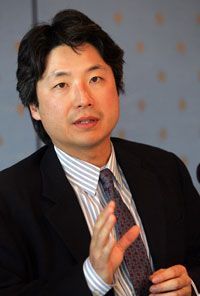
Prof. Lee Chang-rae
By Kwon Ji-youn
Princeton University professor Lee Chang-rae said he came to write his novel, “A Gesture Life,” because he was shocked by Japan’s mobilization of women as sex slaves during World War II.
“I was devastated by the very idea of using women in such an organized and mechanistic way, and of course by how many Korean women were conscripted,” Lee told The Korea Times in an email interview.
“A Gesture Life,” published in both English and Korean in 1999, is Lee’s second novel. It tells the story of Franklin “Doc” Hata, a Korean-born Japanese-American who lives in a small American town. The novel goes back and forth between his current and past life, as he recalls when he served in World War II.
“Initially it was the breathtaking moment of learning about what had happened to these many thousands of women in Korea and across Asia,” Lee said, when asked what inspired him to write his novel.
“This story became something else than what I originally conceived, transforming from a focus on the victims of the crime to the story of one of its perpetrators,” he added.
His use of the words “crime” and “perpetrator” is somewhat surprising, considering the yielding characterization of his protagonist, Hata, a Japanese-American.
Another facet of the story is how identity plays into the experiences of people with hyphenated ethnicities.
The fact that Lee is Korean-American makes it all the more compelling. At three, Lee immigrated to the United States. He attended prestigious schools, graduating with a degree in English from Yale, and a master’s of fine art (MFA) from the University of Oregon. He is currently a professor of creative writing at Princeton.
Of concern to many is the fact the women are often referred to as “comfort women” and not “sex slaves.” On this, Lee has a definite stance.
“In the end, I think everyone can agree that they were sex slaves, no matter what they were called, and by whom,” he said.
According to Lee, only 15 percent of his book is based on facts.
The protagonist of the novel is of three identities, which Lee says “compels (Hata) to question himself and look back at his actions and beliefs.” There is something poignant about the fact that Hata is neither Japanese nor Korean.
Lee himself experienced identity crises, as “most people do.” He said he believed identity crises to be the “greatest source of question and conflict.”
This conflict is inherited by his daughter and grandson, who are both of mixed races.
“‘Mixed heritage’ is of course something that is usually imposed by others on the person in question,” said Lee about his Asian-American protagonist. “It’s ultimately just a mental construct, because if you get right down to the essentials, we’re all mixed in some ways.”
Being Asian-American, Lee said he has “always been conscious of the many possibilities of identity, and what those possibilities sometimes initiate, in terms of human beliefs and actions.”
The crisis Hata experiences is rooted in his past, when he fell in love with a Korean sex slave while he served in the Japanese army. That companion brought out the Korean in him, and he struggles with his Japanese self as the two identities come face-to-face.
“Problems arise when certain groups believe they are purer, more divine, more destined for greatness than others who are supposedly ‘mixed’ or ‘unsure,’” Lee said.