'KOICA model for donors'
By Chung Min-uck
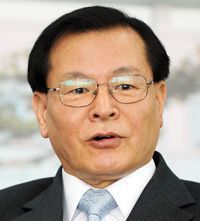
Park Dae-won, president of the Korea International Cooperation Agency (KOICA)
In the left corner of the name card of Park Dae-won, president of the Korea International Cooperation Agency (KOICA), is a catchphrase in a font that appears handwritten: “Appreciative Korea, KOICA goes together.”
“It’s our motto to help the countries that shed blood for us when we were at the lowest point during the Korean War (1950-53),” said Park in a recent interview. “Our country has developed rapidly and it’s time for us to extend a helping hand. KOICA has been and will be at the forefront of providing help to these countries.”
He said such a spirit of giving back to the people that fought for freedom during the Korean War is making its way into developing countries.
Reflecting that spirit, KOICA, the state-run international aid agency, last year invited 300 descendants of Ethiopian war veterans here for a job training program which runs until 2014.
Ethiopia is one of the 21 countries that dispatched troops to South Korea during the Korean War. The African country deployed over 6,000 soldiers. Nearly 100 lost their lives on the battlefields with more than 500 injured. Ethiopia is the only African country that contributed troops to the U.N.-led multinational force.
The program marks the first time the aid agency has invited descendants of Korean War veterans for training.
“The Ethiopian training program is only the beginning. We plan to have more of such, giving back what we have received,” Park said.
KOICA implemented an integrated rural development project in a district in Ethiopia between 2010 and 2012.
By transferring South Korea’s advanced technologies in agriculture and livestock, Arsi Zone, a small rural village in the Oromia State of Ethiopia, has become a model in the African nation’s economic development.
Park says KOICA’s aid is basically humanitarian and seeks to transfer skills and technology to the beneficiary countries.
“The trainees were surprised to see the economic development of Korea when they arrived here,” said Park. “Korea has changed drastically compared to what their grandparents told them about. As the only country to have achieved such rapid economic development, South Korea has become a role model for many developing nations in the world. We want them to follow in our footsteps to prosperity.”
In 2009, South Korea became a member of the OECD Development Assistance Committee (DAC) further fostering its position as a “donor nation.”
“South Korea is the only country to shift from aid recipient to donor nation,” said the diplomat-turned-KOICA head. “We have our own aid model of teaching how to fish rather than catching fish for them. We are implementing the model through training programs and dispatching experts to countries in need.”
Asked whether such a model could be applied to North Korea, the former diplomat said North Korea’s attitude was the problem.
“Instead of providing aid through the Ministry of Unification, it would be more effective if KOICA does it since we have the know-how accumulated since the agency began working in 1991,” Park said. “The problem is North Korea’s attitude. It should be more receptive and open to receiving our aid.”
Transparency is the main pre-condition for the provision of aid, which is unfortunately gravely lacking in the Stalinist regime.
Park is a career diplomat who joined the foreign ministry in 1974, serving as ambassador to Algeria and as consul-general in Toronto, Canada, before leading KOICA from 2008.