Living legend in Korea-US trades
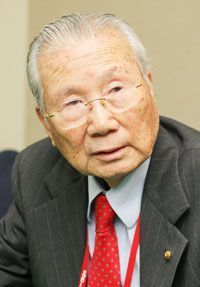
Chang Woo-sang, chairman of the World Federation of Overseas Korean Traders Association (OKTA)
By Kim Tae-gyu
When Chang Woo-sang founded and took the chairmanship of the World Federation of Overseas Korean Traders Association (OKTA) in April 1981, it had a modest membership of 101 people from 16 countries.
Over the next three decades, the entity has become the world’s largest organization of overseas Korean business leaders whose number amounts to around 19,000 from 119 branches in 64 nations.
A total of 14 people oversaw the fast development of the World OKTA from 1981, but inaugural Chairman Chang played the biggest role in the growth process.
“When we started the World OKTA in the early 1980s, we never imagined that it would be such a big organization that has more than 100 offices around the world,” the 86-year-old said in a recent interview with The Korea Times.
“My fellows and successors have put forth great efforts to chalk up the outstanding growth of the World OKTA.”
Chang crossed the Pacific in 1970 to start his own business engaged in trade between Korea and the United States. He was one of the earliest emigrants to the U.S. as at the time when there were less than 10,000 Koreans resident in the US, a far cry from the current figure of 1 million.
After struggling in the early stages he eventually had a breakthrough. He was motivated by the level of solidarity displayed by Chinese traders and entrepreneurs in the US helping each other. Therefore he decided to pioneer the creation of a similar network that would bring together ethnic Koreans on foreign soil.
“A trade fair was scheduled in Seoul in early 1981. Under the belief that it could be momentum to establish the World OKTA, I asked my compatriots outside Korea to convene in Seoul,” he recollected.
“It was a tall task because they were hard to reach back then. I usually used letters and telexes to communicate with them because faxes were not available.”
Chang said that things have changed so much over the past quarter century.
“When we created the World OKTA, it was quite difficult to sell made-in-Korea items abroad because consumers did not appreciate their quality. Retailers just tried to cut prices as much as possible,” he said.
“Now, Korean products are top-tier ones, which end consumers want to buy despite their relatively high price tags. Plus, the status of ethnic Koreans has substantially improved.”