Blame the trees, not the flowers: How to survive spring pollen allergies
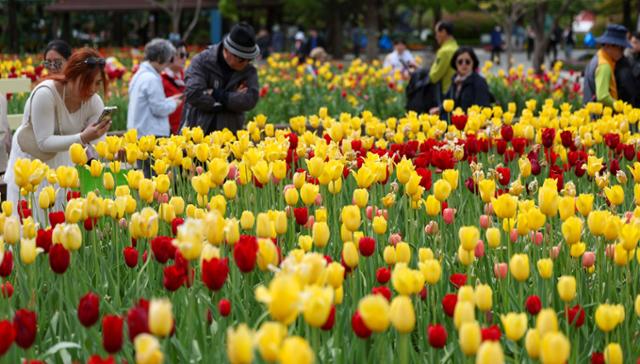
Visitors enjoy floral displays at the 2025 Goyang International Flower Exhibition held at Ilsan Lake Park in Goyang, Gyeonggi Province, Sunday. Newsis
As the temperatures rise with spring, so too does the pollen count. Pollen disperses more widely on clear and sunny days, requiring extra caution during outdoor activities.
Pollen allergies occur when airborne pollen is inhaled, triggering an overreaction of the immune system. Because the symptoms are similar to those of a cold, pollen allergies are often mistaken for viral infections. However, while colds usually resolve naturally within a few days, pollen allergy symptoms can persist as long as exposure continues, making proper diagnosis and management crucial.
"Unlike a cold, pollen allergies typically do not cause fever, symptoms last for more than two weeks and they tend to recur at the same time each year," explained professor Park Il-ho from Korea University Guro Hospital’s otolaryngology department.
Pollen allergies commonly cause allergic rhinitis, conjunctivitis, dermatitis and, in severe cases, bronchial asthma. Allergic rhinitis, with symptoms like a runny or stuffy nose, is the most common. According to the Health Insurance Review and Assessment Service, the number of conjunctivitis patients was about 33 percent higher in spring, from March to May 2024, compared to winter, from December 2023 to February 2024. Conjunctivitis presents with itching and redness, along with symptoms like watery eyes, sensitivity to light and sticky discharge from the eyes. Exposure to pollen can also cause allergic dermatitis, leading to red, itchy skin. Severe cases may trigger bronchial asthma.
Interestingly, the main culprit behind pollen allergies is not flowers, but trees. "Among trees, birch pollen is a particularly strong allergen, whereas pine pollen rarely causes allergic reactions," said professor Kwon Hyuk-soo from Seoul Asan Medical Center's allergy department. Spring flowers like forsythia and cherry blossoms also have little effect on allergies, he noted.
In addition to tree pollen, weeds like ragweed and mugwort can also trigger allergies, especially from August to October, meaning individuals affected by spring pollen should also prepare for potential symptoms in summer and fall.
Although pollen allergies are not immediately life-threatening, neglecting treatment can significantly lower quality of life. "Untreated allergies can worsen snoring, cause sleep apnea and affect sleep quality, leading to chronic fatigue, reduced learning ability and behavioral or emotional problems," Kwon said. Persistent allergic rhinitis may also progress to sinusitis or chronic cough. About one-third of rhinitis patients may eventually develop asthma, underscoring the need for proper management.
The common treatment for allergies is immunotherapy, which gradually reduces allergic reactions through repeated exposure to small amounts of the allergen. However, if immunotherapy is difficult, using a nasal spray is recommended.
"Over-the-counter nasal decongestants can relieve stuffiness but should not be used for more than five to seven consecutive days," Kwon said. "In contrast, steroid sprays prescribed by hospitals are safe for long-term use and are the most effective treatment.”
Recent studies have shown that even daily use for more than 30 years does not harm health. However, for best results, the spray should be used consistently, even when no symptoms are present. Using it only intermittently during severe symptoms may lead to recurring allergic reactions.
Environmental management and monitoring daily habits are also crucial for preventing pollen allergies. When going outside, wearing a KF80 or higher mask and glasses can help block pollen from entering the nose and eyes. After returning home, washing the face and hands and immediately changing clothes is recommended. For conjunctivitis prevention, using artificial tears to wash out irritants and frequently washing pillowcases and bedding is effective. If itching occurs, it is better to apply a cold compress than to rub the eyes.
It is also better to ventilate indoor spaces in the afternoon rather than in the morning when pollen levels are higher. "Preventing pollen allergies starts with active lifestyle management," Park said. "Following basic precautions like wearing a mask before going outside is crucial, and those with allergic tendencies should avoid outdoor activities on days with high pollen counts."
This article from the Hankook Ilbo, the sister publication of The Korea Times, is translated by a generative AI system and edited by The Korea Times.