Training doctors of the future

/ Korea Times
‘Medical education should focus more on leadership’
By Jung Min-ho, Kim Eil-chul
Medicine in Korea has undergone dramatic changes over the past 20 years. Almost all medical records are managed electronically and an increasing number of surgeons rely on robots in performing their job.
But the field will see even faster and more dramatic changes in the next two decades, which would require the nation’s medical schools to change the way they educate their students in order to make them relevant to the future needs, said Kang Dae-hee, dean of Seoul National University College of Medicine (SNUCM).
“It could be a case of ‘now or never.’ We must act fast,” Kang said in an interview. “All these technological changes will affect what the next generation of doctors needs to learn.”
With new technologies quickly changing the way doctors work in many areas, from diagnosis to treatment, Kang believes the most important skill for doctors will be the ability to lead.
“In the future, doctors will have to play a role as medical orchestrators rather than medical technicians, because they need to be able to figure out the best way to treat patients first and then orchestrate everything necessary for the work,” he said. “Leadership and management skills will become increasingly important for doctors.”
With regard to training its students, however, the school, like all other medical schools in the country, has long been stuck in the past. “For decades, students had to study basic science before receiving clinical training according to a fixed schedule. I found this curriculum unfit for the future,” Kang said.
Since he took the wheel in 2011, the school’s curriculum has transformed in terms of what students learn and how they do so.
“Under the new curriculum, starting this year, students will get clinical training from early in their education and will be allowed to take elective courses about new medical trends, such as 3D printing technology, big data and even humanities fields,” he said. “I want students to learn more effectively through hands-on experience and expand their knowledge beyond medicine.”
During their final academic year, students will also be allowed to take six weeks off to study their fields of interest in other countries.
“Good leadership means good communication skills. Through all these changes, I want them to grow as doctors who can better respond to the needs of patients and better communicate with other professionals from different fields and different countries,” he said.
Kang also wants them to self-direct their career and expand their role beyond medical fields. “Medical students are academia’s cream of the crop. It is important for them to know that they can do anything and be anyone by using their medical expertise,” he said.
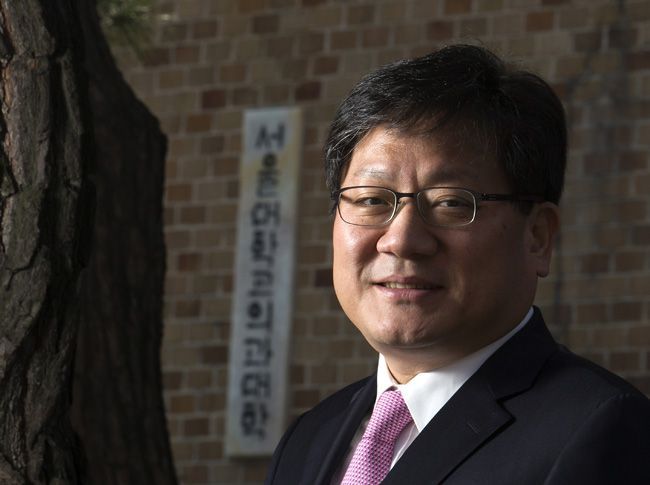
Kang Dae-hee, dean of Seoul National University College of Medicine, said he will train the next generation of doctors as medical orchestrators rather than medical technicians. /Korea Times
JW Lee Center for Global Medicine
Kanishka, a four-year-old girl from Nepal, was brought to JW Lee Center for Global Medicine at Seoul National University Hospital (SNUH) in January.
Her heart was failing, and her condition was critical. Her surgery in India to fix the problem failed, and she was expected to die within a few months.
However, at Dhulikhel Hospital in Kathmandu, she fortunately met Kim Woong-han, a SNUH cardiothoracic surgeon, who brought her to the center and performed another surgery on her. She has since recovered and returned to her home country on March 11.
The center was established in 2012 to help sick and underprivileged people in developing countries. The SNUCM-affiliated organization was named after Lee Jong-wook, a former director-general of the World Health Organization (WHO).
One of the center’s missions is providing children with medical services. It also conducts healthcare research and education abroad.
“Korea has coped with all kinds of healthcare issues as its economy has expanded rapidly over the past few decades, which puts the county in a great position to help others going through the same process in healthcare industry,” Kang said. “Korea today is equipped not only with technologies but also with know-how about rare diseases in rich countries.”
Among the organization’s other projects are educating doctors from developing countries in Asia, such as Cambodia, Mongolia and Laos, helping the countries build medical schools and hospitals and advising policymakers in setting up medical systems.
“It is about giving back what we received from the Minnesota Project,” he said. Through the U.S. government-sponsored project from 1955 to 1961, the University of Minnesota helped Seoul National University establish basic medical infrastructure in the aftermath of the Korean War in the 1950s. The knowledge SNU received has since spread out to the rest of the country.
“I hope to hear similar success stories from the countries we are helping,” Kang said.
Rewriting health principles for Asians
According to the recent report by the WHO's International Agency for Research on Cancer, bacon, ham and sausages, alongside cigarettes, asbestos and alcohol, are the main culprits of cancer.
The report also said red meat is regarded as “carcinogenic to humans,” leading to, in particular, pancreatic and prostate cancer.
However, according to other studies conducted by the Asia Cohort Consortium (ACC) and Shanghai Women’s Health Study, this finding isn’t necessarily true for Asians.
“There is no solid evidence that eating red meat increases the risks of pancreatic or prostate cancer for Asians,” Kang said. “A lot of health information isn’t accurate for Asians because it comes out of non-Asian samples.”
To produce correct health information for Asian countries, which had long relied heavily on data from the West, Kang established the ACC in 2004, in cooperation with doctors from 12 countries.
One of the most notable findings of the consortium is that Koreans, Japanese and Chinese, whose body mass indexes range from 22.6 to 27.5, show the lowest probability of death. The WHO considers a BMI of 25 or above as overweight, but the study demonstrated that what is considered a healthy weight could differ by ethnicity.
Thus, through the ACC, which today has about 50 active member countries, Kang expects to create and provide more accurate health information for everyone.
“Nearly two-thirds of the world’s population lives in Asia, which should be the focus, not an afterthought, of health studies,” Kang said. “For now, our cohort is too young for cancer studies, but it will be used for more studies in the future.”
Kang is one of the nation’s most renowned experts in the field of preventive medicine. After graduating from SNUCM in 1990 with a medical degree in preventive medicine, he earned his Ph. D. in environmental health sciences from Johns Hopkins University in the United States in 1994.
He worked at the U.S. Epidemic Intelligence Service as a so-called “disease detective,” or field epidemiologist, from 1994 to 1996, and then became a professor at the department of preventive medicine at his alma mater in 1996. Thereafter, he served as the director of external affairs and development of Seoul National University Hospital before taking his current post.