"Memphis is back"

Kartell
At the Milan Furniture Fair 2015
Troubled European economy hinders new product development
By Yun Suh-young

Moroso

Bosa
It is impossible to see all of the exhibitions held at the Milano Furniture Fair, held annually at the Milan Fairgrounds, due to the enormous size of the space, designers who annually attend the fair say.
"Salone del Mobile.Milano," an international furniture fair held in Milan every April, showcases products manufactured by 2,500 of the most dynamic and creative firms operating on the international market in an exhibition space covering a net display area of over 230,000 square meters. The week-long fair held during the Milan Design Week attracts visitors from 160 countries around the world.
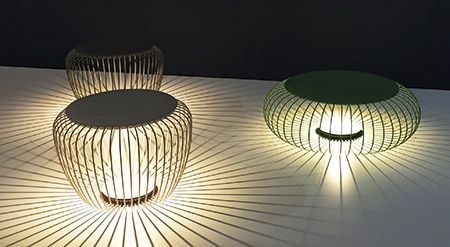
That is why design experts such as the team from Gensler, a global interior and architecture company, meticulously plan their trip by carefully selecting the exhibitions they'd like to view in advance. Otherwise, it's easy to get swamped by the plethora of choices and end up meandering in confusion around the thousands of exhibited brands.
To smartly overview the exhibition through an expert's eye, W requested K Chung, director of Gensler Korea, to be the magazine’s correspondent for this article during her trip to Milan and share her and her team of designers insights on what they saw.
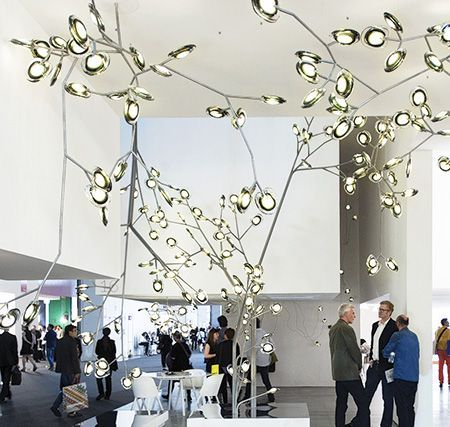
Bocci
No new product development

Sawaya & Moroni

Tog
What all the designers agreed on during this trip, according to Chung, was that there was no prominent movement this year at the fair.
"We didn't see a particular movement this year. There weren't many new product designs or groundbreaking, innovative designs this year," she said.
Chung attributed the phenomenon to the stumbling European economy.
"It made us think that the economy really wasn't doing well. Design innovation goes hand in hand with the cyclical cycle of the economy. Here, we're seeing the impact of the European economy," said Chung.
"Italian furniture manufacturers said the only brands surviving are those exporting to the United States or Asia. This is coming from them. They say there's no demand within Europe," said Chung.
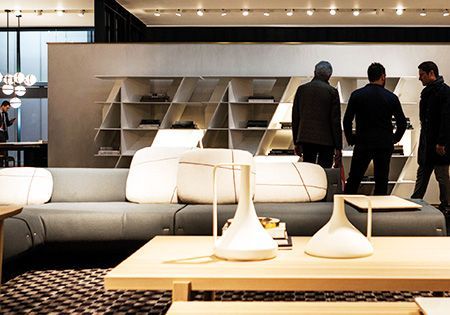
Poliform
Memphis is back
Amid the difficulty in spotting a particular movement, Gensler designers agreed that there was one characteristic that stood out, according to Chung.
"We all agreed that Memphis is back," she said, referring to the movement in Europe which led to post modernism in America.
"Two years ago, the living wall was everywhere and we saw mix of material of wood, plastic and metal but this year it wasn't this or that. Everything was mixed but the little thing we saw was Sottsass."
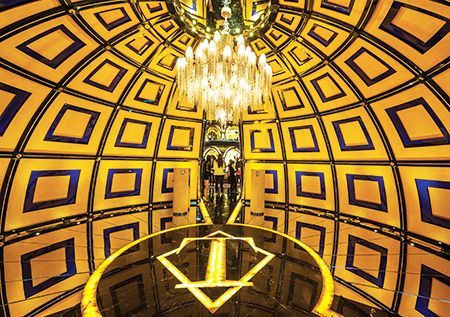
Turri
Ettore Sottsass was a designer who led the Memphis movement which was characterized by kitschy, wacky style designs.
"It could be just this year and it could suddenly go away, but the display of Memphis-style designs at the fair was a noticeable characteristic amid the indistinctiveness," she said.
"Putting the birthday cake on top of the table - the whole idea of it, the composition- when put together, this is Memphis," she said pointing to a photo of a showroom by Cappellini.
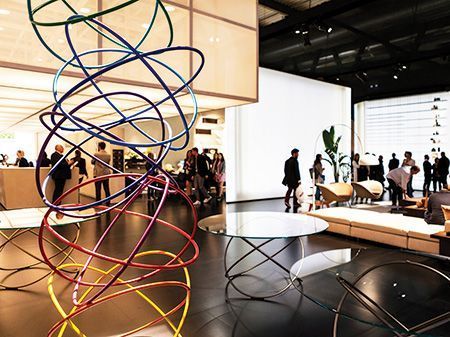
Molteni & C

Cappellini
Memphis was the name of a collaborative group of designers who Sottsass gathered in the early 1980s in Milan. The group produced and exhibited furniture and designed objects between 1981 and 1988, inspired by pop art and kitsch and futuristic themes. Their products debuted at the Salone del Mobile of Milan in 1981.
"Everybody got tired of less is more which defines modernism. So they wanted to bring back historical reference to modern design which was how post modernism was created," said Chung.
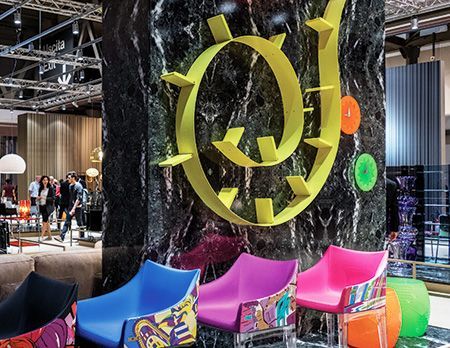
Kartell
"As the Memphis movement crossed over to America, it became post modernism and the context became important. Post modernism started adapting cultural references and interpreted them in a kitschy, wacky way. Then came deconstructivism, the deforming of structures. Now there's no particular movement in contemporary design."
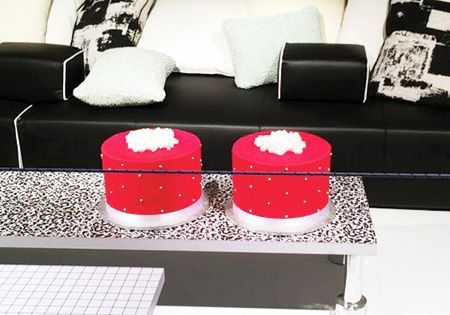
Cappellini
Carpets
Another noticeable characteristic this year was that there were carpets everywhere, according to Chung.
"Everybody came out with carpets- Moooi, Hayworth, Patricia Urquiola and Paola Lenti to name a few. Many of the brands came up with area rugs, flooring and carpet solutions," she said.
.jpg?w=728)
Golran
When asked why, she didn't know exactly why this was so.
"When somebody does something, everybody comes out as if they spoke. Designers see this commonality and think, 'well, everybody thought of the same thing!'"
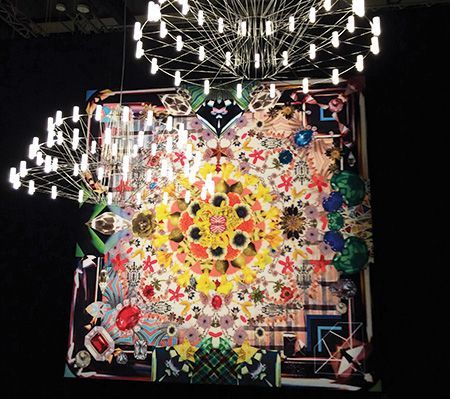
Moooi
Big Will

Philippe Starck

Philippe Starck
Then there was Big Will which, according to Chung, is a design innovation.
"The Big Will by Philippe Starck was something designers saw, but ordinary people could have overlooked. They installed wheels on the bottom of the table legs," said Chung.
"The flexibility of the design and the fact that the furniture moves - this is something nobody thinks of. This is design innovation. It is something unexpected to see at a furniture fair like this which isn't a smart office showcase."
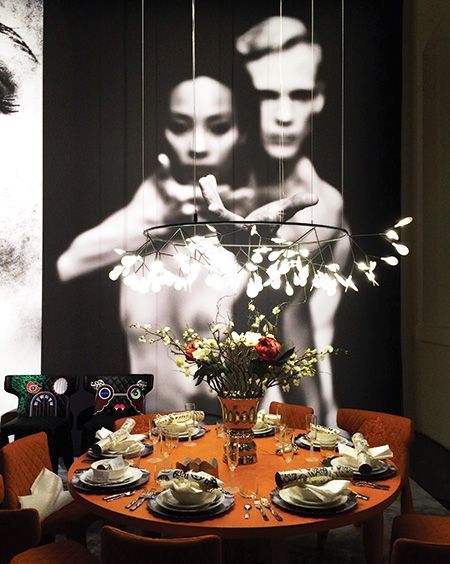
Moooi