Latest trends in workplace design: Activity-based workplace

By Yun Suh-young

Cushman & Wakefield, San Francisco © Gensler
A few years back, workplace design was not a big factor when companies furnished or renovated their offices. Now, much more attention is being paid to the interior not just for the aesthetics, but to cater to employees’ needs. And these needs are changing.
In today’s digitized world, sitting at a desk all day does not necessarily produce the best outcome. With today’s devices, we can work anywhere. The spaces where people are most comfortable may be the most productive places after all.
Productivity comes from efficiency, and efficiency comes from an environment where less time and energy is spent dealing with unnecessary disturbances.
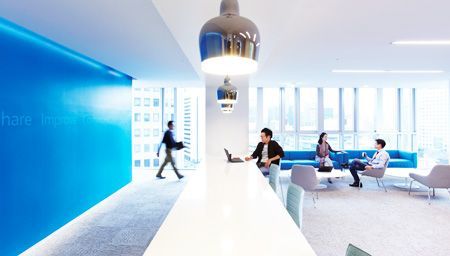
© Microsoft Korea
An employee-friendly workplace design not only enhances workers’ productivity but also their well-being.
And it is not just about efficiency. When workers are happier and healthier, they are likely to be more productive, more innovative and more collaborative.
Creating a happy, healthy workplace that maximizes productivity is where design comes in.
“When we come to work in the morning, we spend the whole day in the office,” says K. Chung, director of Gensler Korea, a branch of the global interior and architecture company that leads the way in workplace design.
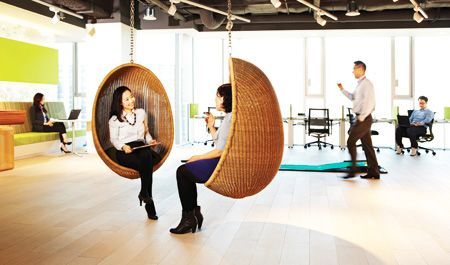
The hub © Microsoft Korea
“Many times, we spend more hours in the office than at home, so a well-designed office should be a healthy and pleasant space rather than a luxurious and well-decorated space. Workplace design is important because the office is the basis of work,”
Gensler, which pioneered the concept of workplace design, releases publications forecasting design trends every year.
Of the six design meta-trends that it forecasts between now and 2025, the first is mobility and collaboration in workplaces.
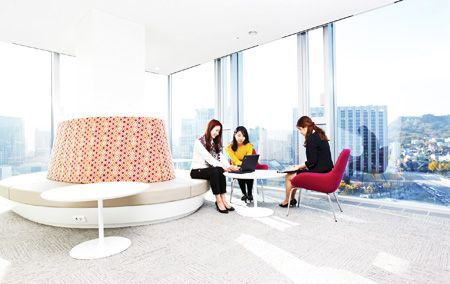
© Microsoft Korea
More communal space
Office spaces have long been equipped with individual cubicles for privacy, but the interior is changing to allow more communal space.
“If offices used to be more of a ‘me’ space, they have now started becoming a ‘we’ space,” says Chung. “Individual seating arrangements are no longer so important, and more communal spaces are being included.
“There are also more diverse facilities with different interiors. The design is more activity-based and experiential. People can work anywhere, anytime. They can work at a coffee shop, at the office, or at home. So the office must be a place to support work activity.”
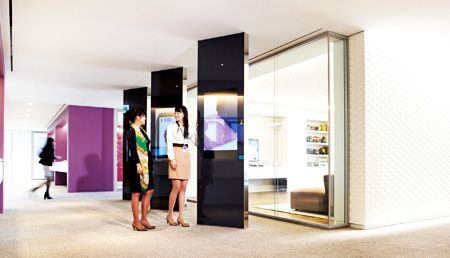
© Microsoft Korea
Microsoft Korea, which celebrated its first anniversary at its upgraded offices in Gwanghwamun, Seoul, on Nov. 13, has received a lot of publicity for its design and “smart office” environment.
The office, which used to have cubicles next to each other, no longer has assigned seats ― anyone can sit wherever they want. The company revamped the working environment into what it calls “freestyle workplace” where employees can work in their preferred styles at preferred locations.
There are a variety of rooms for different purposes. Employees can use the rooms for individual work or for meetings. They can use a private room if they need to focus, a four-person table for a meeting or sit at any desk for regular work.
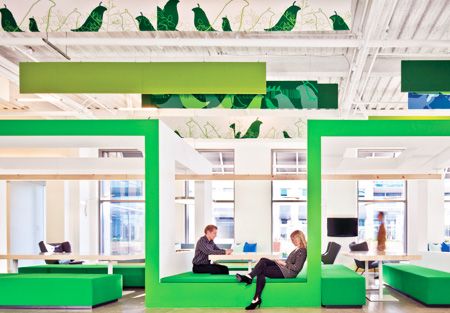
Nokia, Sunnyvale © Gensler
The hours spent on collaborative work has increased 1.5 times because there is more space for collaboration. Official meetings decreased while unofficial meetings increased, according to the company.
“The renovated interior was based on activity scanning of our employees,” says Microsoft Korea public relations manager Lee Seung-yeon. “The new office has increased productivity by up to 30 percent and raised employee satisfaction to 90 percent.
“I feel like I’ve earned two to three hours a day because meetings have been reduced by 30 percent. Now I meet people at the hub, which is the snack area. Because the hub is in the middle of the office, you end up meeting somebody there. That was what the company intended ― to make people collaborate. Through these unexpected encounters, we save time sending e-mails and calling meetings.”
.jpg?w=728)
Airbnb, San Francisco © Gensler
Because the company’s focus still necessitates a lot of meetings, two floors are designed entirely for this purpose.
Gensler designed the office, conducted an activity analysis and a utility survey to provide the optimum design.
“We survey how many people stay at a certain location and for how long. We create spaces and decide how many seats are needed, and where, based on that research,” says Chung.
“There’s something called the four modes of work, which shows why and when people go to the office. They go to focus, collaborate, socialize and train. So we try to design a space based on people’s activities. We aim for the design to help them, and vice versa.”
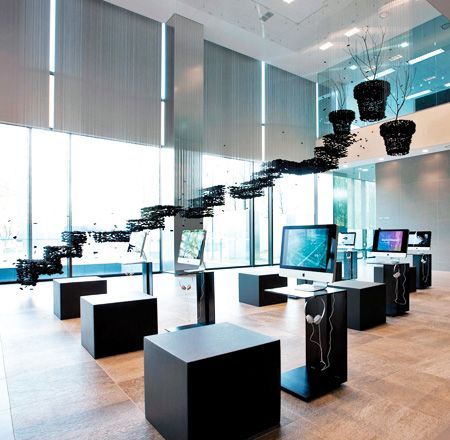
Lobby © Hyundai Card
Simplicity for mobility
Financial service company Hyundai Card, well known for its focus on product design, also operates out of design-centric headquarters in Yeouido, Seoul.
The design itself is not exactly eye-opening, but what is unique about the interior is that it has a consistent tone and feeling that stresses simplicity for efficiency.
According to a company official, all Hyundai Card offices here and overseas have the same interior structure and design.
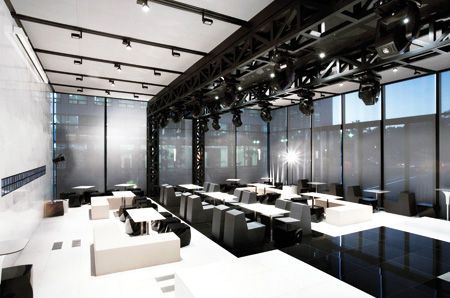
The box (lounge) © Hyundai Card
“Because people are often and easily transferred to various branch offices worldwide, the company tries to provide the same environment so workers feel at home at any branch,” said Hyundai Card public relations team associate Cho Nam-hee. “This is for efficiency and convenience. Because our company requires quick communication, everything is simplified. All the rooms, including executives’ offices, are transparent, which facilitates open and direct communication between employees anywhere, anytime.”
Even the furniture is consistent ― similar-style hard, square plastic chairs throughout the building are placed from the cafeteria to the meetings rooms. This is also part of the planned design for efficiency.
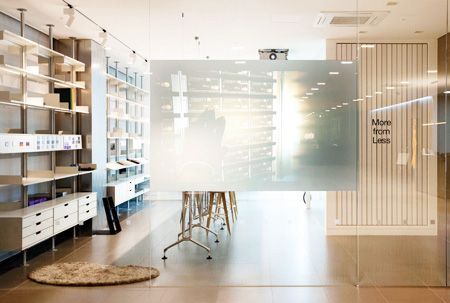
Design lab © Hyundai Card
“We don’t have long meetings. So the focus of the chairs is not for comfort, but for mobility,” Cho says. “Being able to sit anywhere, anytime, but also move away anywhere, anytime is the key concept.”
The desks at the “design lab,” which is the most secretive department and off limits to everyone except the designers who work there, are detachable and movable. If they need to, the designers can detach their individual desks and reattach them as a larger unit for a meeting.
Raising awareness

The hub © Microsoft Korea

Locker © Microsoft Korea
Although a few such as Hyundai Card or NHN, parent company of portal site Naver, have incorporated employee-friendly designs into their workplaces, workplace design is still new to Korean companies.
“It’s just the beginning for Korean companies to consider designing their offices,” says Chung. “I think the concept has only started to gain traction here since global companies such as Microsoft opened offices in Korea. There’s still no awareness about workplace design among Korean conglomerates except for a few exceptions.
“Because the concept is fairly new here, companies don’t realize how much design affects the corporate culture. Gensler’s Korea office opened only four years ago, which is when Korean clients started seeking us for projects.”
Chung hopes Korean companies will focus more on “people” rather than results.
“I hope companies will take a humanistic approach,” she says. “When people become important, sensitivity about the workplace will increase. Global companies such as Samsung, Hyundai and LG should have global awareness about the workplace.
“It’s not just about productivity, but also about attracting talent. If workplaces aren’t attractive, people won’t apply to work there. Workplaces are an important factor for hiring and retaining talent.”