Riding high

By Yun Suh-young
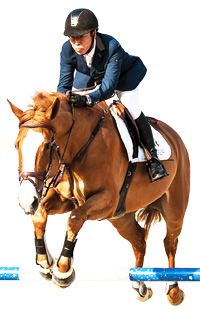
Not having ridden a horse for over a decade – except for brief hop-on, hop-off experiences at occasional events – riding for this journalist proved quite a painful experience.
I had been a regular rider, going out once a week after school when I lived in Switzerland – a place where there were accessible and affordable stables usually within walking distance.
Nearly 15 years on, I revisited that nostalgic experience here in Korea, except at locations further away from my home, but equipped with much better facilities.
Horseback riding in Korea, unlike in Europe where the activity is more popular, is still considered a luxury because of its cost.
The reasons for this are the maintenance costs of the facilities, which are mostly well-built with top-notch equipment, and the fact that many horses are imported from overseas. The cost of attracting top-quality instructors also hikes lesson fees.
Nevertheless, horse riding is slowly and steadily becoming more popular.
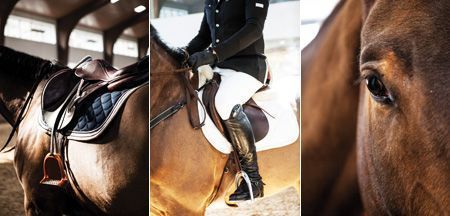
The merits of horseback riding as a sport are that it helps correct posture and shape the bodyline, as well as burn calories. It’s also good for enhancing concentration, especially for children who are easily distracted.
Riding lessons are usually between 45 minutes to an hour.
The sport requires movement throughout the entire body (although it may not look so), from the calves, thighs, buttocks, all the way to the arms and neck – making it a total body workout.
The easiest stage is learning to walk with the animal, in which the rider and horse simply walk around the stable in a steady rhythm. The rider need not do much except sit on the horse with your back straight up.
The next stage, trotting, requires a little more effort and burns more calories. Riders must move up and down in cadence with the rhythm of the horse's movement. It starts becoming real exercise as you move your upper body up and down, constantly repeating the sitting and standing posture in rhythm with the horse.
When doing this, be sure not to squeeze the knee too tight to the saddle as it will only make it harder to stand up. The best posture is to put pressure on the calves and thighs, firmly grasping the saddle with the legs as a whole. The position of the foot must be parallel, forming the number 11.
The next stage, cantering, is the part where you can really feel like you’re riding. As the horse is running at a faster pace, the rider must hold the reins more tightly and keep the feet steadily positioned next to the saddle.
Beginners cannot begin to canter on their horses unless they are accustomed to trotting, and visitors experiencing horse riding for the first time will only learn how to trot.
Galloping or jumping hurdles are limited to experienced riders.
After riding, you might find yourself in pain the next day with muscle strains in your legs and arms, or your thighs or calves being chaffed from the up and down movement, and even some bruises on the buttocks.
“If you get bruised on the buttocks, it’s either because you’re too skinny, with not enough fat to protect your bottom, have weak skin, or because the saddle is new and too stiff. The older the saddle, the less painful it is,” says Baek Min, instructor at the Royal Saddle Equestrian Society.
No worries with the after-ride pain; it’s natural because you’ve used muscles that you haven’t used before. It’s like that for any sport!
Where to go for a ride
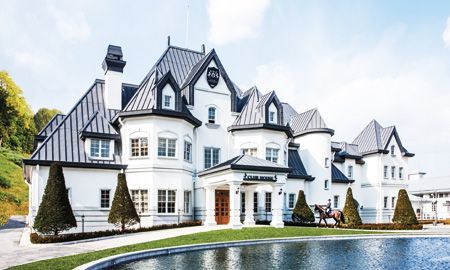
Sono Felice Equestrian Club
Opened in March this year, the club located in Hongcheon, Gangwon Province, is by far the best equestrian club in the country in terms of facilities, equipment and the quality of instructors.
What grabs visitors’ attention immediately upon arrival is the mesmerizing scenery that the club provides.
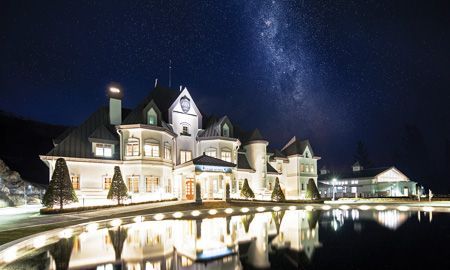
The white club house building resembling a luxury mansion in Europe makes visitors feel as if they’ve become a count or a countess, off on vacation to enjoy the leisurely sport. The club house is surrounded by mountains, providing a serene getaway away from the outside world, as well as a fantastic view.
A noticeable difference of Sono Felice’s facility is the equipment supplied by Rower & Rub, a German horse equipment company known for quality products.
There are two indoor riding grounds and two outdoor. The indoor riding area is equipped with a heating system.
The club has top-notch instructors who are all national champions. Other than the five Korean champion coaches, there is a German coach who provides lessons in four languages – German, French, English and Korean.
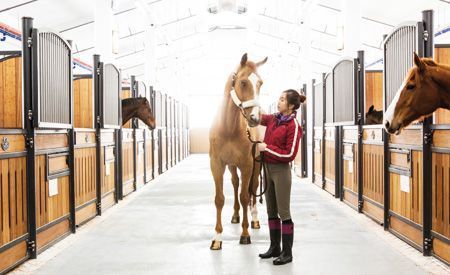
The main stable at Sono Felice Equestrian Club
For those who want to eat after a ride, the club house has a dining area where brunch and other menus are offered – something that isn’t available at other riding clubs.
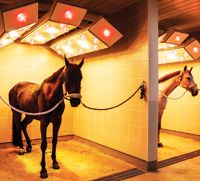
Horses receiving infrared therapy
Address : 262, Hanchigol-gil, Seo-myeon, Hongcheon-gun, Gangwon Province
Phone number : 033-439-8790 Operating hours : 9 a.m. - 5:30 p.m.
Lesson fees : Start from 121,000 won per session + additional fee depending on the qualification of the coach (excluding equipment rental fee)
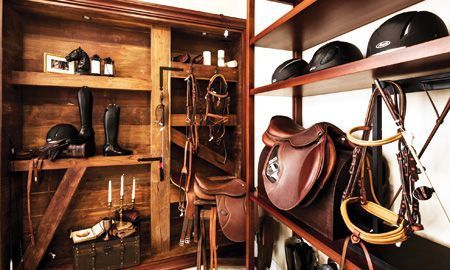
Posh shop, the equipment shop selling riding-related items
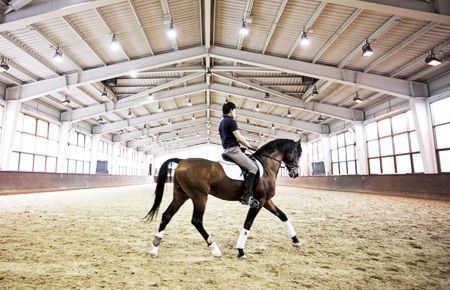
A rider trotting at the indoor arena
Royal Saddle Equestrian Society
This equestrian club located in Ilsan, Gyeonggi Province, is an hour ride from Seoul and also one of Korea’s top riding facilities.
Although built in 2003, which is relatively old compared to other facilities, the club has been well maintained and provides a cozy atmosphere.
There are five riding areas – one indoor, four outdoors – and six instructors, two of whom are from Denmark and have championship records. The club also has some foreign members who come to ride regularly, according to the staff.
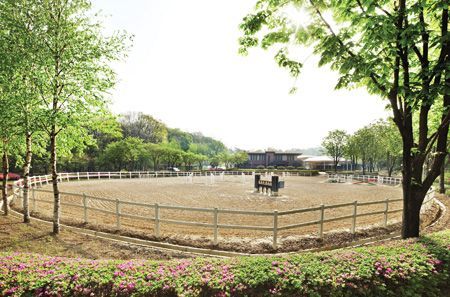
The main outdoor riding arena at Royal Saddle Equestrian Society
The facility isn’t comparable to Sono Felice in terms of style or quality, but it’s still a top-tier riding club with clean facilities and 50 horses both imported and bred here.
There is no heating system equipped at this club and it may be a bit cold to ride in the winter. For dining, riders can find restaurants nearby outside the club.
Address : 402 Gyeondalsan-ro, Munbong-dong, Ilsandong-gu, Goyang, Gyeonggi Province
Phone number : 031-977-2662
Operating hours : 8 a.m.- 7 p.m. (closed on Mondays)
Lesson fees : Begin from 90,000 won per session (including equipment rental fee)
Other clubs to take note of:
Bundang Equestrian Club
Address : 340 Neungwon-ri, Mohyeon-myeon, Cheoin-gu, Yongin, Gyeonggi Province
Phone number : 031-334-7935
Operating hours : 8 a.m. – 6 p.m. (closed on Mondays)
Lesson fees : 70,000 won per ride/ 110,000 won including lesson
Stevens Sports Academy Center
Address : 476-4 Huan-ri, Hobeop-myeon, Icheon,
Gyeonggi Province
Phone number : 031-631-5572
Operating hours : 8 a.m. – 5 p.m.
Lesson fees : from 99,000 won for beginners
W Horseland
Address : 96 Bongsu-ri, Sang-myeon, Gapyeong, Gyeonggi Province
Phone number : 070-4352-5488
Operating hours : 9 a.m. – 7 p.m.
Lesson fees : 150,000 won per session