Hangeul museum illuminates history of Korean alphabet

Special exhibition
By Oh Seo-jin (intern reporter)

Yongbieocheonga, one of the first texts written in hangeul

A letter written by King Jeongjo

The first hangeul typewriter created by Gong Byung-woo

A structure that shows the process of combining consonants and vowels
The National Hangeul Museum, which exhibits artifacts and artwork related to hangeul, the Korean alphabet, opened in Yongsan next to the National Museum of Korea on “Hangeul Day” ― Oct. 9. Hangeul Day is a national holiday designated to celebrate the creation of the Korean alphabet.
The museum consists of three floors that feature different types of exhibitions, an outdoor garden for events, a seminar room for educational sessions, and a café.
The first floor features a library funded by Naver, seminar rooms and offices. The permanent exhibition is held on the second floor while special exhibition is held on the third. The third floor also features a children’s museum and Hangeul learning center for foreigners which were both funded by Google.
The permanent exhibition currently on display is “The Journey that Hangeul Went Through” which explores Hangeul’s creation and how it expanded its presence to the ordinary public.
Artifacts such as type writers and novels written in Hangeul are displayed and videos portraying the process of combining the consonants and vowels are played to enhance visitors’ understanding of the language.
The exhibition is organized in time sequence to show the evolution of hangeul from its initial stage recorded in the “Hunminjeongeum” manuscript to the modern day Korean textbook. Hunminjeongeum Haeryebon, part of the Hunminjeongeum manuscript created by King Sejong (1397-1450), explains the principles of the vowels and consonants of Hangeul.
The museum exhibits approximately 10,000 hangeul-related works that were collected and donated since the advent of Hangeul in 1443.
The special exhibition on the third floor currently holds an exhibition about King Sejong along with artworks of 10 contemporary artists who created works inspired by King Sejong’s endeavors. The exhibition hall resembles an art gallery more than a museum.

Permanent exhibition
The Children’s Museum encourages elementary school children to actively take part in activities related to Hangeul to further their understanding.
The Hangeul Learning Center is where those unfamiliar with Hangeul can elevate their understanding of the Korean alphabet by examining its structure, combination of vowels and consonants, and pronunciation.
The Storytelling Exhibition Tour around the museum with professional docents is available three times a day, at 10 a.m., 2 p.m., and 4 p.m., in four different languages ― Korean, English, Japanese, and Chinese. A General Exhibition Tour is also available upon request at the information desk.
Various educational programs on Hangeul for families with young children, adolescents, and teachers are offered free of charge. For further information, visit www.hangeul.go.kr or call (02) 2124-6200.
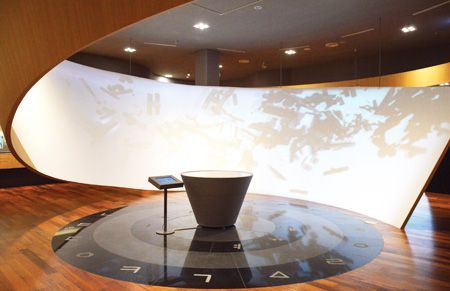
A screen that shows how hangeul is formed
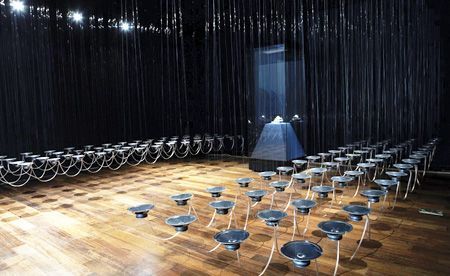
The "Visible Sound" work displayed at the special exhibition
Museum info:
Address: 139 Seobinggo-ro, Yongsan-gu, Seoul 140-026
Phone number: (02) 2124-6200
Opening hours: 9 a.m. – 6 p.m. / closing time extended to 9 p.m. on Wednesdays and Saturdays, and to 7 p.m. on Sundays and public holidays
Closed every Monday and New Year’s Day
Parking: free / accommodates 70 cars
Admission: free / reservation is necessary for student groups of 30
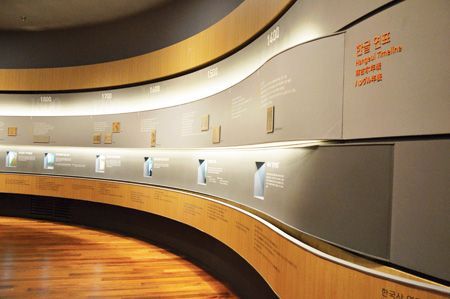
Chronology of hangeul's history
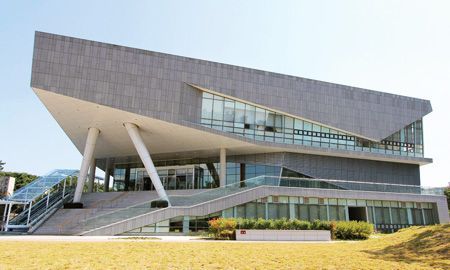
A view of National Hangeul Museum