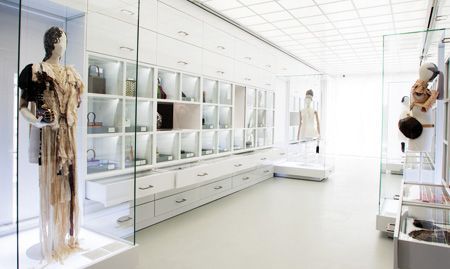
Bag to the Future

Store manager Downey Choi traces paper templates to cut leather
By Kim Yeon-soo
How would you feel if your bag looked better than a 60 million won Birkin? Not just a bag you bought, but a bag you made yourself?
Buying that ordinary purse ― the one every woman has ― might seem so yesterday once you’ve started making your own.
In this fast-changing fashion world, DIY is the next “it” trend, the fashion-forward for those constantly wanting something new.
Skipping a shopping spree at an expensive boutique and paying a visit to a DIY workshop could be a fashionista’s next smart idea.
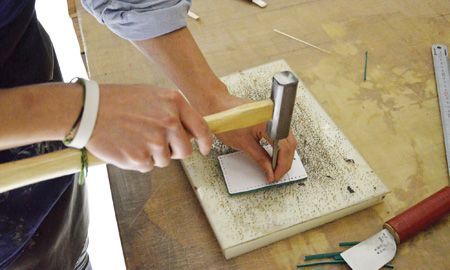
Choi punches holes into the leather with a hammer
Making your own bag
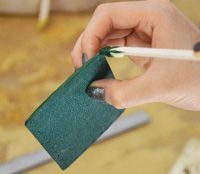
Intern reporter Kim Yeon-soo paints the edges of the leather
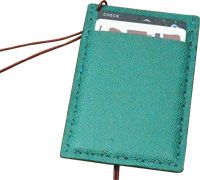
The final product of the cardholder-making experience
Nestled on the B3 floor of Bagstage, a five-story building with four underground levels in Sinsa-dong, southern Seoul, which also features a “handbag museum,” is a craft workshop called “Material Bazaar.”
The awe-inspiring workshop is where students learn how to create their own unique bags.
The place is mesmerizing as soon as you walk in.
Stepping through the doorway, you’re immediately greeted with the pungent smell of leather. The smell, however, isn’t unpleasant. It’s rather engaging, and even welcoming, as if to invite visitors to the world of leather.
Rolls of leather are stacked row after row on shelves next to the wall.
The workshop features more than 500 types of leather and 5,000 pieces, overwhelming students with options.
After choosing a style of bag they would like to design from the samples exhibited there, students then choose the type of leather they would like to use as well as the texture and color.
They then start drawing the outlines for the design, with the help of an instructor. When that is done, they cut out their leather shapes, glue or sew parts together depending on the design, and put the final touches on the bag by adding zippers or buttons.
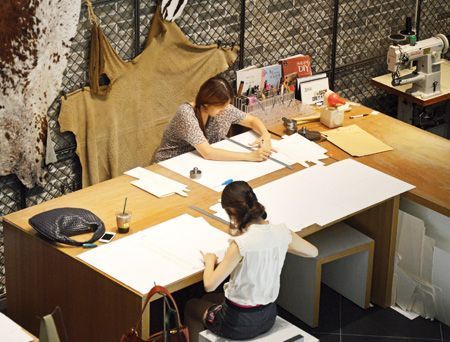
Students draw outlines for their bag designs during a DIY handbag making class
This reporter had an opportunity to make something of her own when she visited the workshop. Due to time constraints, she wasn’t able to design a handbag, as it would have taken more than 12 hours over four classes. Instead, she was offered the chance to create a leather cardholder ― an hourlong procedure.
She chose a green variety of leather with a lumpy surface. Store manager Downey Choi helped cut the paper templates that the reporter would trace to make the pieces. Then Choi cut along the outlines and produced three leather pieces.
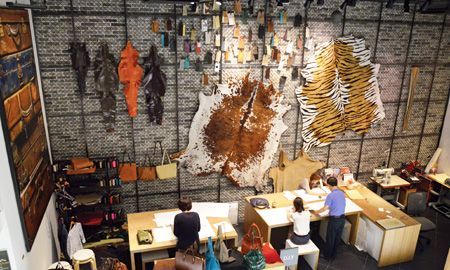
Workshop director Song Duk-gu and students at work at Material Bazaar
The cut parts were then thinned out with a machine by the workshop’s director, Song Duk-gu, an artisan of 30 years.
“Because the product ends up thick when the leathers are placed on top of each other, it’s important to thin them out,” he said, running the machine.
After gluing the pieces together, the next step was to punch holes with a hammer along the edges so the product could be stitched together.
This reporter had fun punching the holes with a hammer ― punching is a stress reliever. According to Song, it was a favorite part of the workshop for most students.
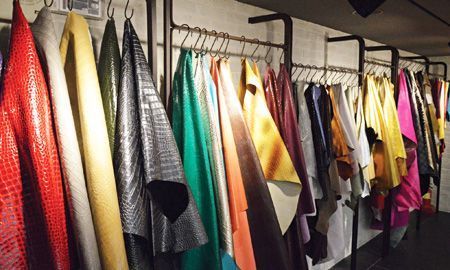
A variety of leather displayed at Material Bazaar which students can choose from
Then came the stitching. After neatly weaving the product together with matching green thread, the reporter colored the edges with green paint. Last, she attached a string to the corner so she could carry the cardholder around her neck.
When this reporter was learning the art of cardholder making, there were three other students learning how to make their own handbags.
“I had always been interested in accessories and bags,” said Lim Soo-young, a 53-year-old housewife. “I wanted to do something special and different with them.”
“I like that I can actually make something myself and I’m really excited to see the end results,” she said.
The class, which is offered throughout the year, is always fully booked. Because it is limited to four students maximum, prior reservations are a must.
About Bagstage:
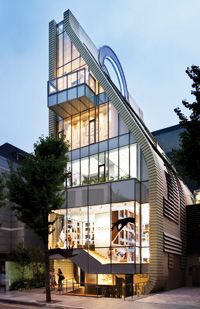
The “Bagstage” building catches visitors’ eyes with a futuristic facade.
The Simone Handbag Museum, which displays handbags from the 16th to 21st centuries, is located on the third and fourth floors of the building. The third floor was inspired by a science laboratory theme, while the fourth floor gives off a dark and prehistoric vibe.
The Simone Handbag Museum logo ― two handles of a purse ― immediately tells us what the museum is all about.
On the first and second floors, visitors can shop for handbags at 0914 ― Simone’s own brand, which will be officially launched in 2015. Other famous brands such as Rebecca Minkoff, Milly, 49 SQ Miles and Oroton are also available at the shop.
On B1 are a cafe and shop where visitors can rest and chat, and on B2 lies “Gallery 0914,” which features a new exhibition every three months.
For more information, call 02-3444-0790.