Pistachio Principles: Fool yourself full to lose weight

When pistachios are in shells, people tend to eat less of them compared with shelled-nuts. They consume even less when the empty shells are left on the desks as a visual reminder of consumption. / Courtesy of Pistachio Health Institute
By Yoon Ja-young
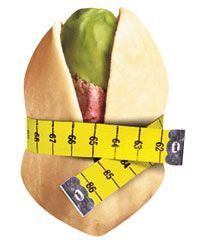
With the arrival of summer, many people are rushing to get in shape. They probably resort to extreme calorie-cutting methods such as carbohydrate restrictions or not eating. However, we know that this mostly ends in failure each year. Dr. James E. Painter, a food psychologist and professor at the University of East Illinois, suggests applying behavioral psychology to dieting. His “Pistachio Principles” suggest that we can fool ourselves to eat less through simple visual modifications and still feel equally sated.
At a meeting with the media in Seoul, Monday, the professor pointed out that Korea is not an exception to the global epidemic of obesity — now one out of three Koreans are categorized as fat. Why are people around the world gaining weight? Lack of exercise, sedentary lifestyle, stress and advertising are some of the things people blame. Industry is also responsible, inducing people to upgrade their meals to larger portions and taking in unnecessary excess calories, the professor points out.
While these factors are to blame, are people following the right diet methods themselves? Painter doesn’t think so. “Typically when people want to lose weight, they say ‘I am going to have less of this food,’ or ‘No more carbohydrates for me.’ No matter what food you eat less of, you start craving it and eventually eat it.”
He said that the crucial thing to remember about healthy dieting is that we eat more because we lose track of how much and what we are eating. Another fact is that we can fool ourselves in dieting. The following are his “Pistachio Principles,” the facts he found through experiments for a successful diet.
—Visual cues
When there is a visual cue to remind people how much they have eaten, they might stop eating earlier and feel just as satisfied. A group of participants in a study were given pistachio nuts to eat. The shells piled up on the table for one group, while the other group had their shells cleared away. The result? Those who had shells pile up consumed 22 percent less calories compared with those who had the shells cleared. “They lost track of how much they ate. Visual pictures are important in determining how much we eat,” he explained.
In another study, a group of participants were each offered a bowl of soup. Some of them, however, were given bowls in which the soup was secretly refilled through a hidden pipe linked to the bowl. Those who were given the refillable soup ate 73 percent more calories, but the two groups felt equally full.
—Form matters
He also introduced a study in which 140 university students were assigned to consume either shelled or unshelled pistachios. Those who ate pistachios without shells consumed an average of 211 calories while the group that ate nuts with shells consumed 125 calories or 41 percent less. However, participant’s satisfaction levels were just the same in the two groups. “With shells, they had to remove them. It took time. They ate significantly less because they had to do this,” Painter said. The slower consumption also helped people feel more satisfied.
—Shape and size of containers
“The bigger the container, the more you are going to eat,” Painter said. In a study, housewives who used bigger tins and packages of oil and spaghetti consumed more when cooking compared with those using smaller amounts.
He also introduced a popcorn study, in which those who had extra-large buckets ate 50 percent more than those with large buckets. It was the same when they were given 10-day-old popcorn. “Ten day old popcorn is not very good and they eat less, but if they are given a big bucket of the nasty tasting popcorn, they still eat more,” Painter said. The findings tell how you should make your portion decisions.
In another study, even bartenders were fooled. “Whether they are experienced or not, they poured more into short tumblers than tall glasses. Whatever is placed in front of you, it is considered a normal serving.”
—Visibility and convenience
Consumption of snacks, either healthy or unhealthy ones, increased when they were placed on a table than in drawers. “If you want to eat more pretzels and pistachios, have them out, have them visible. If you want to cut chocolate, keep it out of your sight,” he said.
—Effect of a name
People in a restaurant were given the same food, but the menu was either in plain name or descriptive name. People thought the latter tasted better because of its descriptive name. “People evaluate descriptive foods as more favorable. People thought the texture was better and had more calories,” he said. How to apply it in your diet? Call healthy food with good, descriptive names. This is also effective in inducing children to eat healthier food.