Psychiatrists opening eyes of patients
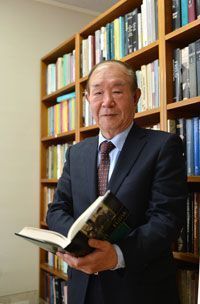
Prof. Cho Doo-young, who introduced Freud’s psychoanalysis to the country, says that we can find answers for the present from the past. / Korea Times photo by Shim Hyun-chul
By Yoon Ja-young
There are generational trends in the specialty areas that medical students choose to pursue. It has been a decade since top students chose minor subjects such as dermatology, ophthalmology or plastic surgery due to the expansion of the “beauty industry.” A few years ago, psychiatry became the trend, with 271 interns applying for 162 vacancies for resident training in 2012, becoming the most competitive.
This is a notable change in a country where psychiatric treatment is regarded as something to hide. Cho Doo-young, honorary professor at Seoul National University Medical School who introduced Freud’s psychoanalysis to the country, said that the demand for psychotherapy will increase due to increased levels of stress and rising incomes.
When asked why he decided to become a psychiatrist at a time when few had even heard of the profession, Cho said psychiatry was like literature for him. He was a lover of literature. But as the country was still recovering from the 1950-53 Korean War, pursuing literature as a job was not a viable option. Becoming a doctor, however, was a job that guaranteed survival.
“I was walking by Biwon in Seoul one winter before the college entrance exam, when I saw the signboard of a clinic, ‘Dr. Nam’s Psychiatric Clinic.’ I decided at that very moment that’s what I wanted to do.”
He compared psychoanalysis to literary analysis. “Literature is about understanding people. You see the world through the eyes of a character; understand why he has certain behavior. I think literature is essential for psychiatrists to understand patients.” Cho published a book on psychoanalytic study on the works of Sohn Chang-sup, a famous Korean novelist, as did Freud with the works of Shakespeare. His doctoral thesis was about the psychoanalysis of Confucius.
Psychoanalysis of Koreans
Just like literature which is universal, Cho basically doesn’t see much difference between patients in different countries. That is Cho’s conclusion after practicing psychoanalysis and psychotherapy in the United States for nine years.
Then what about “hwabyeong?” Hwabyeong, or the anger illness, was adopted by the American Psychiatric Association as a Korean culture-bound somatization disorder. Cho said hwabyeong is basically depression that comes from suppressed anger. “That’s seen in the Western countries too. However, they express their anger more easily (compared with Koreans).” He said the prevalence of hwabyeong in Korea has to do with the Confucian culture in which hiding emotions such as joy, anger, sorrow and pleasure is seen as a virtue.
However, these days Cho sees that it has become the opposite. Koreans burst too easily into anger. He showed concern that Korea is going from one extreme to the other.
Answer is in the past
As a psychoanalysis guru, he uses no medicine, or only a small amount if necessary. Cho showed concern that psychiatrists tend to focus on medicine. “Instead of trying to understand patients by listening to them for a long time, they prefer handling it simply with medicine. However, medicine only lessens the symptoms temporarily. The problem will recur.” Even in the case of schizophrenic patients, he says psychotherapy should be the main treatment, though he also uses small amounts of medicine. “There are only a small number of professors who teach psychoanalysis at medical school. The rest just talk about serotonin. Medicine can calm down crazily raging patient for an instant, but you should also find out why a patient is so angry. That’s why medicine should be accompanied by psychoanalysis.”
Freud is the father of psychoanalysis. Some of his theories were right and some of them were wrong, but it became the root of modern psychoanalysis and therapy, according to Cho. “Freudian psychoanalysis begins with the theory that most psychiatric problems today have their roots in the past. For instance, if someone is continuously blinking their eyes, why are they doing so? It may be because they had a startling experience in the past. You find out the key for the patients’ current symptom from the past and tell them. The patients get enlightenment.”
After finding out the reason, does the doctor provide a solution? Cho said no. “Most patients soon find the solution by themselves. You just open their eyes.”
The problem is that it takes a lot of money and time for psychoanalysis. It is especially so as the government’s health insurance isn’t covering much. As psychoanalysis is a very energy consuming process for the doctor and they aren’t fully compensated for it, they are likely to prefer giving out medicine instead. Cho said this is the sector where the government should pay more attention.
Even so, he said the future of psychoanalysis is bright. Patients visiting his clinics are more open than those in the past; they accurately represent themselves, and have some understanding of psychology. This compares with decades ago when he worked at Seoul National University Hospital. Patients were reluctant to sit and wait for their turn in the psychiatric department. They would be sitting meters away, in the ophthalmology department, for instance, and rush in when the nurse called their name.
Less desire, healthier mentality
Stress will increase as the society becomes more competitive, but this society is simply telling them to do their best without telling them how to handle stress. When asked to give advice on how to be mentally healthy, Cho said that one shouldn’t want too much of something. “When we were kids, parents would advise us to fill only 70 percent of the rice bowl instead of eating a full bowl. They would tell us that we shouldn’t do 100 percent of what we desire.”
For mothers, he advised that they shouldn’t push their kids too much. “Children will grow for themselves. Sometimes they may excel, and sometimes they may not, but the latter can also be happy.” Instead of setting too high a goal for kids, he recommended hugging them often.
He also said that people shouldn’t regret too much because to err is human.
Who is Cho Doo-young?
Born in 1937, Cho graduated from
Kyunggi High School and studied medicine
at Seoul National University. He had an
internship at Brooklyn Jewish Hospital in
New York City, and resident training at Cornell
University Hospital. He worked at High
Point Hospital and Coney Island Hospital
until 1974 when he joined Seoul National
University Medical School as a professor.
He served as president of the country’s
psychiatric association and psychoanalysis
association, and won numerous awards for
academic achievement, including the
Sigourney Award in 2002.