Aristocratic clan's heritage at a glance

The National Folk Museum of Korea will display some 160 items related to the Pungsan Ryu clan in collaboration with the Advanced Center for Korean Studies throughout the year. / Courtesy of National Folk Museum of Korea
Exhibition features
‘the Story of the
Pungsan Ryu Family’
By Chung Ah-young
Ryu Seong-ryong (1542-1607), a prominent scholar of the Joseon Kingdom (1392-1910), has frequently inspired novels, dramas and films for his contribution to Confucian studies and state affairs. “Jingbirok,” a historical drama inspired by Ryu is currently being aired on a local television network and shedding new light on the loyal scholar.
Renowned for Jingbirok, or the “Book of Corrections,” which details the Imjin War, or the Japanese invasion into Joseon in 1592, he came from the Pungsan Ryu clan, a powerful local family which generated outstanding scholars and politicians.
To help understand the clan’s history and family stories, the National Folk Museum of Korea is holding an exhibition titled “The Story of the Pungsan Ryu Family” throughout the year, in collaboration with the Advanced Center for Korean Studies (ACKS).
The exhibition displays some 160 items including a bamboo desk used by Ryu Seong-ryong when he wrote Jingbirok.
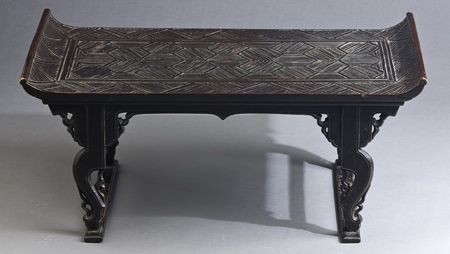
Ryu Seong-ryong’s desk / Courtesy of National Folk Museum of Korea
The Pungsan Ryu clan was based in Andong, North Gyeongsang Province where Hahoe Village, registered as a UNESCO World Heritage site, is located.
Since Ryu Jong-hye settled there in the 16th century, the Andong Hahoe Village has served as a one-clan community where the Ryu brothers, Ryu Un-ryong and Ryu Seong-ryong were born.
The Ryu brothers learned from Yi Hwang (1501-1570), one of the most notable Confucian scholars in the Joseon Kingdom.
The Pungsan Ryu clan, one of the five powerful families in the region, was recognized as an influential aristocratic clan during the 16th century.
The exhibition includes the king’s appointment certification of Yeonguijeong (prime minister) endowed on Ryu Seong-ryong when the Imjin War broke out.
“The clan put emphasis on loyalty and filial piety and contributed to forming a Confucian literati school in this region,” the museum said in a statement.
Ryu Seong-ryong left his works to his children before he died, saying “there is nothing to care about but loyalty to the state and filial piety to parents.” His descendants followed his words and created a tablet inscribed with “Chunghyodang” hanging in their house.
The exhibition screens the videos showing family values of “chung” or loyalty to the state and “hyo” or filial piety through diverse Confucian rituals.
“Through the story of Pungsan Ryu’s clan, we hope visitors can think of their families and ancestors who are the roots of what we are now and at the same time their family values will inspire visitors’ present lives,” the museum said.
The museum said that it will continue to exhibit other prominent clans’ family stories and their values from this region.