Book review: convergence of self-driving cars, ride sharing service will bring urban transformation

A self-driving vehicle is showcased in a smart mobility launch ceremony held in Sangam-dong, Seoul, in this May 20, 2020, photo. Korea Times file
By Park Han-sol
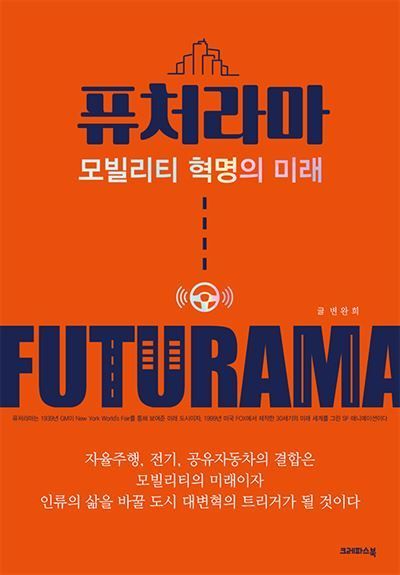
"Futurama: Future of Mobility Revolution" by Byun Wan-hee / Courtesy of Crepas Book
The development of cities and transportation has always remained inseparable in the discourse on urbanization. From carriages to railroads, each mode of transport has significantly expanded the concept and physical space of cities, with the popularization of cars in the 20th century serving as the greatest catalyst.
In the present day, the automotive industry has turned its attention to self-driving cars as its near future. Not only the traditional players such as GM, Ford, Toyota and BMW, but the IT and mobility companies including Google, Uber and Baidu are in a fierce competition to gain the lead in the market.
Against this backdrop, Byun Wan-hee, an expert of city transport and future mobility service, examines in his new book "Futurama: Future of Mobility Revolution” how the convergence of three trends in the auto industry ― autonomous driving, electric cars and ride sharing ― will forever transform the urban landscape and human lifestyle.
A perceptible change can come in the form of reduced vehicle collisions and traffic congestion. According to the National Highway Traffic Safety Administration (NHTSA) in the U.S., more than 90 percent of today's accidents occur due to human drivers' negligence. If V2X technology (vehicular communication system that allows cars to detect moving parts of traffic) can marry autonomous driving, the Korea Research Institute for Human Settlements (KRIHS) estimates an 81 percent decrease in such accidents.
Moreover, thanks to the driverless cars' real-time responses to external signals and hazards, vehicle platooning, or a group of cars traveling extremely closely and safely together at high speed can be made possible, leading to less traffic congestion, Byun states.
The physical structure of urban space can also undergo a fundamental transformation. The author sees that autonomous vehicles, combined with ride sharing service, will greatly increase demand for sharing cars instead of owning them. Such cars, when popularized, will be available anywhere to travel in and there will be no need to worry about parking. And since there is no human driver, the fare will likely become cheaper with no concerns for passenger or destination refusals.
If a ride sharing, autonomous car becomes mainstream, there will be noticeably less vehicles on the road, causing the present-day space and road dedicated for parking and driving to be less essential. The extra space can then newly revolve around pedestrians' needs as parks, green zones and widened sidewalks.
Lastly, such vehicles can have a substantial impact on the general urban lifestyle. The “bonus” time that is no longer spent on driving, parking and refueling can be used more productively, Byun writes. The car will also be better at protecting the accessibility of the elderly population and people with disabilities.
In the cases of lockdowns and quarantines, an issue that became especially visible after the COVID-19 pandemic, self-driving cars can be proven useful as they can carry medical specimens as well as other supplies and necessities to the affected without concern of infection.
But in his book, Byun does not solely paint a rosy picture of the future of mobility service. As he mentions the ethical, economic and social limits of such technology, the reader naturally comes to consider the need for the establishment of social consensus and the extent of consumer acceptance.
As it happened with the introduction of the steam locomotive, and again with the car in the past, there is bound to be resistance against driverless cars, the author writes. The more immediate backlash can come from the transportation sector ― taxi, public transportation, delivery service, and it will also require a significant amount of time for urban policymakers and planners to fully adopt a new vision of the evolving cityscape.
As partially seen in the Sejong Smart City and Pangyo Zero City, testbeds of self-driving cars and smart mobility services, the future of driverless cars can only come after the accumulation of political and technological experiences of experts as well as the building of general social consent.