Book review: Physician warns of medical misinformation
By Kang Hyun-kyung
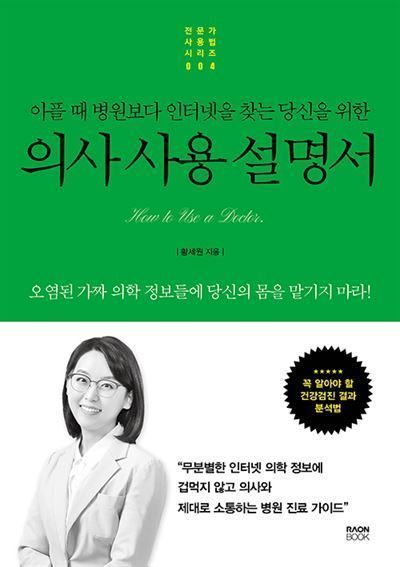
“How to Use a Doctor” by Hwang Se-won
Hwang Se-won's “How to Use a Doctor” published by Raon Books warns of the dangers of self-informed patients' quack remedies for their medical symptoms, saying their self-diagnosis based on medical misinformation could make their condition worse.
Using an eatery analogy, the physician urges patients to consult with their doctors if they have questions or are experiencing certain symptoms.
“You can see lots of places to eat when you surf the web to find good eateries. Many of the restaurants that pop up there are ones that hired social media influencers to promote their businesses. Their sponsored reviews make it tough for consumers to find real good restaurants,” she writes. “A similar thing happens when we search information about certain diseases or symptoms. The internet is flooded with information but little of it is reliable or verified. This is what's happening in medical fields as people having no medical knowledge or training upload their posts based on inaccurate personal experiences.”
“How to Use a Doctor” is an informative piece not only for patients suffering certain diseases but also for people concerned about their health as it gives an overview of diseases and symptoms common in Korea, including diabetes, hypertension and heart disease.
Noting that people now live in an era where patients “shop” for doctors, Hwang provides tips for making the most of their physicians.
She encourages patients to stick with one hospital, not becoming medical migrants exploring several different hospitals.
“If you go to a certain hospital for years, your medical records will be accumulated there,” she says. “The data compiled for years can be used as a good reference for your medical condition, because doctors can compare their past and current results. It is easier for doctors to decide whether their patients need extra medical tests or treatments in case they have certain extra symptoms. Like countries having their own history, patients also have their own medical history.”
The author says patients need to be specific in their communication with their doctors.
When explaining their symptoms that brought them to the hospital, she says don't go around and go ahead directly with symptoms that troubled them most without mentioning what kinds of past diseases or symptoms they have suffered.
“For me, it's difficult to treat patients who answer 'I have no energy' when asked what brought them to the hospital,” she says. “If my patient describes their condition like that, I have dozens of thoughts and possibilities in my mind because the expression could translate into various medical conditions, from a minor one to a serious one that requires immediate medical intervention.”
She shares a story of a 20-something female patient who visited her recently. The patient told Hwang that she had no energy and she felt discomfort in her chest.
“Her inaccurate, vague description of her health condition led to a complicated situation… It was tough to figure out what went wrong with her also because she had no underlying medical conditions,” the author says.
Hwang checked her blood pressure, body heat and blood sugar level and all were normal.
The physician kept asking questions to narrow down the possibilities. When the doctor asked if the patient had proper meals that day and the day before, she said she ate almost nothing for two days because she had difficulty with digestion. Hwang said she was able to figure out what went wrong and concluded her patient might have been dehydrated. The physician decided to give her patient physiological saline which she said worked well.
“The story of my treatment was simple. My patient was dehydrated and I gave her water. She felt fine,” the doctor says.
But her communication with her patient was not that simple and she had to conduct several tests with multiple questions to reach that conclusion.
“For her, having no energy meant she was dehydrated. But for some other patients, the same expression could have completely different meanings with very different medical conditions,” she says.
The author says she decided to publish the book to share her experiences as a physician to better inform medical patients of diseases and finding doctors.