A journey to No Man's Land

Penguins are seen in ice-covered Antarctica from the Russian scientific research vessel Akademik Fedorov (not seen in this photo) in this January 2008 file photo. Before South Korea has its own icebreaker, scientists of the Korea Polar Research Institute (KOPRI) relied on foreign ships to do their research. / Courtesy of KOPRI
Polar biologist speaks on voyage to Antarctica on ice-capable vessel, global warming
By Kang Hyun-kyung
Biologist Kim Ji-hee's annual research trip to Antarctica is always an exhilarating rollercoaster ride.
Kim, a principal scientist at the Korea Polar Research Institute in Songdo International Business District created along the waterfront region of Incheon Metropolitan City, first went to King George Island in 2002 to research biodiversity and plants on the ice-covered region. Since then, she embarks on a field trip to Antarctica every year during its summertime from November to March.
Her field research with a team of five or six other scientists began with excitement about their mission.
But she became nervous once the airplane arrived in Christchurch, New Zealand, after a 15-hour flight from Incheon International Airport. From its port town of Lyhelton, South Korea's homegrown icebreaker Araon kicks off an eight-day sea voyage and cruises into island-less waters to reach Earth's southernmost continent. The port in Christchurch is one of the two locations from which the icebreaker begins its journey to Antarctica. The other is in Hobart, Australia.
The eight-day sea travel is full of nervous excitement mainly because of the tumultuous sea, so even an experienced scientist like Kim is drained physically as well as mentally once the sea voyage is over and the sacred land of penguins is in sight.
Kim knows her seasickness would continue for five days until the ship reaches serene ice-filled waters. The first five days are literally agonizing.
Due to its function-oriented structural characteristics, the icebreaker is vulnerable to outside shocks. Once the erratic movement of the ship begins, she tries hard to hang on by gripping her bed tightly so as not to roll off onto the floor.
Vomiting, nausea and yawning during the days of sea travel are part of the price polar scientists pay in order to perform scientific research on Antarctica.
For scientists, however, the desolate continent is the land of opportunity as there are lots of things that remain unknown and await discovery.
Kim takes motion sickness pills twice a day for the first five days after the icebreaker cruises into the open seas. “Fortunately, the medication works well for me,” Kim said in a recent interview with The Korea Times. “I am fine during the sea travel as long as I take the seasickness pills.”
During the eight days of ocean travel, the biologist said she works on reports or takes care of other chores.
Seasickness disappears on the sixth day when the icebreaker ship Araon eventually enters ice-filled waters and the turbulence eventually subsides.
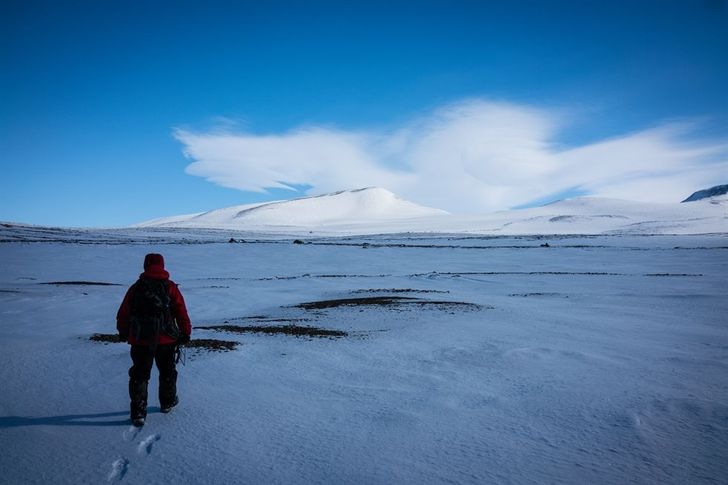
Kim Ji-hee, a biologist and principal scientist at KOPRI, goes to Antarctica every year to conduct a survey of the plants and ecosystem of the polar region. / Courtesy of KOPRI
Every year, Kim spends two to three months from January on mainland Antarctica to conduct a survey of the plants and ecosystem of the polar region.
Last year, however, was an exception. She went there in November and stayed only three weeks because of her tight schedule.
“Antarctica has been changing constantly,” she said. “The vast majority of the territory was covered with ice sheets, so it's hard to predict what's beneath. Some parts that were previously covered with thick glaciers turned out to be ocean as the ice is melting. With global warming, coastlines of the continent have been revealed gradually. Ponds are spotted here and there.”
Over the past nearly two decades of scientific research in Antarctica, she found that global warming is real and its pace is much faster than expected.
Climate change has led to a change in vegetation in the polar region. The presence of flowering plants near the King Sejong Research Station on King George Island is one of the striking differences that marks Antarctica before and after global warming.
In 2002, scientists identified clusters of two indigenous species known by their scientific names of Deschampsia Antarctica and Colobanthus quietensis near the research station. The habitats for the two species have since continued to expand in the area, a piece of evidence showing temperatures in Antarctica continue to rise.
“The presence of the two flowering plants is a canary in a coalmine,” Kim said. “In the past, the area of King Sejong Research Station had only lichen and there were no flowering plants. As the temperature has risen, it now rains in Antarctica during summertime. Soil moisture provides a favorable environment for flowering plants to grow. Their habitats continue to expand. Climate change in Antarctic has affected biodiversity and the spread of the indigenous plants.”
Kim recently released a book, “The Story of Antarctic Plants” published by GEOBOOK, based on her 18 years of research of plants and biodiversity of the Earth's southernmost region.
With photos and graphics, the book gives a peek into Kim's nearly two decades of experiences as a biologist of the polar region and her findings with detailed explanations of lichens and flowering plants along with a brief history of Antarctica. The region's dramatic transformation from the land of tropical temperatures to the ice-covered continent is also explained.
A South Korean expedition team first stepped onto the continent in 1985, when ex-lawmaker Yoon Seok-soon led a team of 17 people consisting of scientists and climbers who arrived on Chile's research station on King George Island of Antarctica via an aircraft. They stayed on the icy land inhabited by penguins and seals for 24 days, climbing the region and meeting scientists from China, Chile and Russia, the countries that already had research stations there.
The 17 pioneers' historic visit
paved the way for South Korea's joining of the Antarctic Treaty the next year in 1986, becoming its 33rd signatory.
South Korea's membership has paved the way for the establishment of its first King Sejong Research Station on Barton Peninsula, King George Island, in 1988. It was the beginning of Korea's scientific research in the southern polar region.
It took another 26 years for South Korea to establish a second base ― the Jang Bogo Research Station, this time on the Antarctic mainland.
Kim said South Korea's development of the icebreaker Araon is a watershed event in Korea's polar research. “Before we had the icebreaking vessel, it was unthinkable for South Korea to establish a research station on the Antarctic mainland,” she said.
Many scientists echoed that Araon is a game changer in South Korea's polar research. Some even say that South Korea's scientific research in Antarctica and the Arctic can be divided into two stages ― before and after Araon.
Kim agreed, noting that the description is no exaggeration. “In the early stages of our search for the ideal location for our second base on the mainland, we were faced with plenty of challenges and all those challenges came from the fact that we didn't have an icebreaking vessel,” she said. “We went to Antarctica on an icebreaker owned by a foreign government. We had to modify our research plans a lot depending on the schedule of the scientists from the country that owned the vessel. Our independent research hinged on their schedules. So, it was difficult to meet the research timeline we set.”
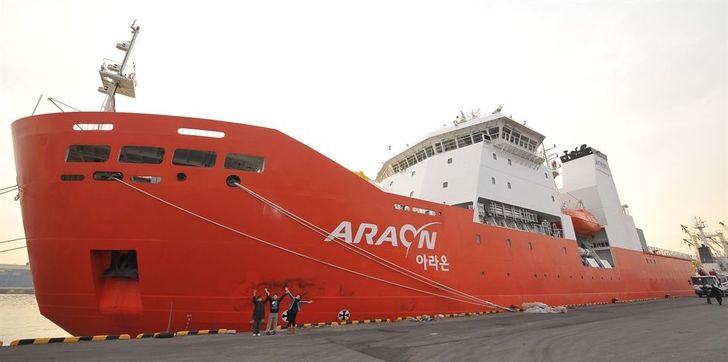
South Korea's icebreaker ship Araon embarks on its maiden voyage to Antarctica in December 2009. / Korea Times file
Kim was part of the taskforce to establish the second base project in Antarctica which was launched in 2008. She and other scientists embarked in the ice-capable vessel on a field trip to the Antarctic mainland for a survey of candidate locations for the research base in December 2009. It was Araon's maiden voyage.
The soft-spoken biologist became passionate when she spoke about the significance of the homegrown icebreaking vessel for polar scientists like her.
“We often mention our fellow scientist for his shoes metaphor to show the pivotal role the ice-capable vessel has played in our polar research,” Kim said. “He said, 'Before the Araon, we explored Antarctica barefoot, but with the ice-capable vessel, we now have shoes to wear.' I think his remarks are insightful enough to summarize what the Araon means for South Korea's polar research.”
Polar scientists are able to carry all the necessary equipment to Antarctica for their scientific activities during their summertime research and they no longer worry about the supply of goods and commodities needed for their research in the polar region.
Antarctica is literally “No Man's Land.” Besides South Korea which has two Antarctic research stations, several other countries, including the United States, China and Japan, run research stations there. The Antarctic Treaty signatories' past and current research activities would likely help them better prepare for a possible territory dispute in the region in the future.