'King Maker,' liberal commentator turn back on their allies

Kim Chong-in, a chief campaigner of the main opposition United Future Party, released a memoir, “There is No Such Thing as Eternal Power,” earlier this month. / Yonhap
Two authors release books ahead of National Assembly election
By Kang Hyun-kyung
Kim Chong-in, a chief campaigner of the main opposition United Future Party, and liberal political commentator Kang Jun-man seem to have nothing in common in their personal, educational or professional backgrounds.
Kim, 80, has been active in politics for three decades, starting in 1990 when he served as the chief presidential secretary for economic affairs during the conservative Roh Tae-woo government. After that, he served as a lawmaker five times and then transformed into a political consultant, becoming a self-claimed “kingmaker.” He claimed he successfully led the conservative politician Park Geun-hye to win the 2012 presidential election and then defected to the liberal party to help it win the 2016 National Assembly elections.
Compared to Kim, Kang, 64, has been an academic for decades. He is a professor of journalism at Jeonbuk National University and author of dozens of books, mostly about Korean politics.
Despite their different career paths, comparing them is not impossible.
Their areas of specialization ― one is a veteran in politics and the other a critic of politicians ― overlap. This brings them together ahead of the April 15 National Assembly elections: Kim and Kang both released books about Korean politics.
They both commented on Korean presidents and their followers and concluded who's responsible for undermining democracy in this country.
What's interesting is that in their new books, they “zigzagged” in their political orientations and turned their backs on their “allies” accusing them of misleading the nation.
In his memoir, titled “There is No Such Thing as Eternal Power” published by SIGONGSA, Kim commented on President Moon Jae-in and his predecessors based on his private meetings and interactions with them.
The veteran politician wrote he “owes two apologies” to voters because of his critical roles behind the elections of Presidents Park Geun-hye and Moon Jae-in.
“Voters chose them as their leaders. But (I was) partially responsible for their winning presidency because I created the political conditions that enabled the people to vote for them (in the past presidential elections),” his memoir reads.
Kim disclosed previously unknown stories about the two presidents.
In 2012 during the presidential election campaign, Kim joined the Park Geun-hye camp and his idea about economic justice shaped the direction of Park's economic campaign pledges. Park-Kim relations, however, turned sour as the election neared.
Kim said Moon, who was then running in the presidential election on the then-main opposition party's ticket, visited his home accompanied by his aides.
“He encouraged me to cut ties with Park and join his campaign team. It was at a time when Park and I were distant,” his memoir reads. Kim said he turned down Moon's offer. “I took his remarks to be insulting because (I thought leaving Park) to be unthinkable and unethical. I didn't see him as a better candidate than Park Geun-hye, either.”
Kim went on to say that he felt if Moon was to be elected, he would be a puppet and his aides would exert influence behind the scenes and if so, this would create even more serious problems.
“He was not prepared to be a leader,” Kim wrote.
Kim's memoir is his personal account of Korean politics and presidents and concludes that Korean presidents are doomed to fail because the system allows them to abuse power.
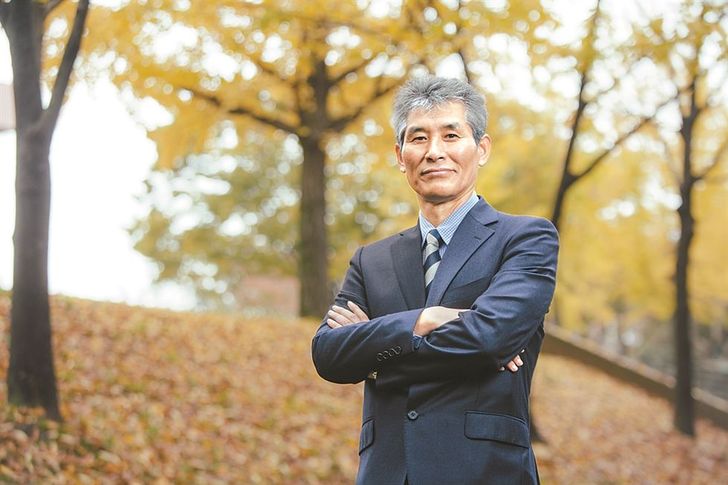
Kang Jun-man, a professor of journalism at Jeonbuk National University, unveils a new book, “Shopping is More Important Than Voting.” / Courtesy of Great People and Ideology
Compared to Kim, Kang is a prolific, outspoken author of many books through which he harshly criticizes Korean society and politics.
In his new book, “Shopping is More Important Than Voting” published by Great People and Ideology, Kang puts forth a consumer-driven movement to reform Korean politics.
“Shopping is More Important Than Voting” suggests the power imbalance of the same people who are called consumers in the market and voters in politics as the source of democracy in retreat.
In the market, Kang says consumers exert real power because their cause-driven, ethical consumption or boycotting of certain products can make or break companies. Consumer-corporate relations are tilted toward the former, enabling them to have a greater say.
In politics, however, the same people are powerless, having no means to make their voices heard once elections are over.
Politicians try to curry favor with constituencies only during the campaign period, and once elected they turn a deaf ear to their requests, according to Kang. If voters were as mighty as consumers, the author says, Korean politics would change.
Kang criticizes President Moon for failing to live up to the commitments he made during the presidential campaign.
“He pledged to end the politics of hatred and division. But what he has done over the past years since he was elected is the opposite,” he wrote.
Kang accused President Moon of siding with his confidant Cho Kuk, the disgraced former justice minister.
“Cho Kuk, who was under immense pressure (as he and his family were accused of various illicit activities) eventually stepped down. But Moon Jae-in didn't offer an apology to the public for his poor choice. Rather, he made remarks sympathetic about Cho and the way he reacted to the Cho Kuk scandal facilitated the pros and cons debate between Cho supporters and the rest,” his book reads.
Kang switched gears to target Moon supporters.
He called former health minister and liberal supporter Rhyu Si-min a man stuck in the Cold War mentality. “He reminds me of the 1984 spy scandal at Seoul National University and he is still locked in that mentality that there are the good and the bad and they are doomed to clash without a possibility of being together,” he wrote.
The author lashes out at Moon Jae-in's supporters, calling them “government mouthpieces” and alleging they try to tame the media in favor of the political leader in power.
Kang has been viewed by many as a left-leaning political critic who earned fame for his characterization of some liberal politicians as “Gangnam leftists,” a characterization of wealthy liberals who have no deeper understanding of poverty but pretend to sympathize with the have-nots.
In the liberal camp, Kang is a critic from within.
Kim is a little different. It's hard to pigeonhole his identity in the political arena, mainly because he has switched political orientations. In 1990 during the Roh Tae-woo government, Kim served as chief presidential secretary for economic affairs and he promoted himself as the man who played a key role in including the term “economic justice” in the Constitution. He is an “unprecedented” politician who served five times as a lawmaker selected through the proportional representation system.
In Korea, there are two different ways to become a lawmaker. Candidates are selected by a certain party to run in the National Assembly election on the party's ticket. They become lawmakers if they are elected. The other way to make it is running in the proportional representation system. Unlike their counterparts in the battleground, the candidates on the proportional representation system don't need to campaign or woo voters directly because their chances to get elected hinge on how many seats their party secured in the election. Proportional representation candidates don't need to spend money on campaigning during the election. For this trait, being on the proportional representation system is considered a perk. Making it five times just as Kim did is unprecedented.