LTI Korea honors devoted literary translators

From left, translators Kim Hwan, Li San-lun, author Kim Un-su, translators Sora Kim-Russell, Yoon Sun-me, and author and publisher Pio E. Serrano attend a press conference held in central Seoul, Monday. / Courtesy of LTI Korea
By Anna J. Park
The Literature Translation Institute of Korea (LTI Korea), a state-run translation arm aiming to promote Korean literature worldwide, held its annual awards ceremony Monday in central Seoul. Three different kinds of awards were jointly given ― the LTI Korea Translation Award, Distinguished Service Award and Translation Award for Aspiring Translators.
The LTI Korea Translation Award, the representative award by the translation institution launched back in 1993, had been awarded every two years until 2013, when the award has changed into an annual event.
This year's award winners are Yoon Sun-me for her Spanish translation of novelist Han Kang's “Human Acts,” Sora Kim-Russell's English translation of novelist Kim Un-su's “The Plotters,” and Li San-lun and Kim Hwan for their joint Russian translation of Cheon Myeong-gwan's “Whale.”
The awardees were chosen after thorough evaluations of 153 translated books on Korean literature published last year alone in 24 different languages.
“When I first read novelist Han Kang's The Vegetarian many years ago, I was 100 percent certain that this should be translated into Spanish, and I did; the book received so many great responses from readers,” translator Yoon Sun-me said during a press conference held in Monday afternoon, prior to the official ceremony.
“Human Acts was Han Kang's other novel I translated; as Han is a novelist as well as poet herself, her books are not easy to translate. Her sentences are filled with figurative expressions and intentional blank spaces which readers themselves are supposed to fill as they read the book. That is also one of the peculiarities of Korean literary works, different from Western literature. Due to such blank spaces in sentences of Korean literature, translators need to put extra efforts to explain the hidden meaning of authors' succinct sentences for readers' better understanding. That makes translators' work more difficult, but also with a greater sense of achievement.”
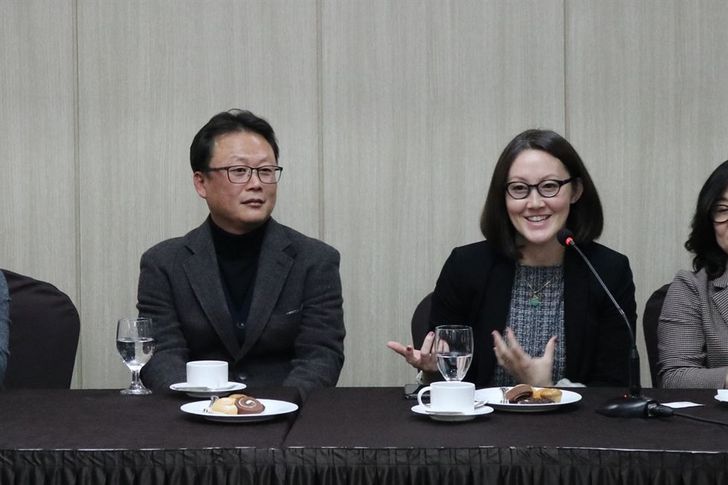
Literary translator Sora Kim-Russell speak during a press conference held in central Seoul, Monday. Next to her is author Kim Un-su. Courtesy of LTI Korea
Sora Kim-Russell, a veteran award-winning translator, also shared the difficulties of literary translators.
“Every author has their own styles of writing; in case of novelist Kim Un-su's book, it included more curse words than other authors. As every society has different meanings of expletives, it was difficult to vividly deliver the exact feeling of Kim's original expressions. But that was also the part of fun,” Kim-Russel said at the press conference.
“Regarding a question as to what kinds of Korean literary works would make it in foreign markets, I think it all depends. Readers have all different tastes in their reading lists. For example, some readers read every Korean literary work, or some would read according to their own preferences. I'm not sure those who liked to read Han Kang's The Vegetarian would also like Kim Un-su's The Plotter, because the two books are entirely different except that they both contain violent elements.”
Kim Un-su, author of “The Plotters,” a thriller novel garnering awards and favorable press reviews from countries including France and the U.S., also attended the press conference, offering his views on the importance of supporting translators.
“No matter how great one's novel is, it is impossible to be successful in foreign markets without the work of top-tiered translators. I often hear compliments on my sentences from readers abroad, but then they didn't read my Korean texts, but the English translations. I am here to celebrate and express my gratitude to translator Sora Kim-Russell, who delivered my work wonderfully in English. I also think more support from the government to translators is necessary for further promotion of Korean literature,” Kim said.
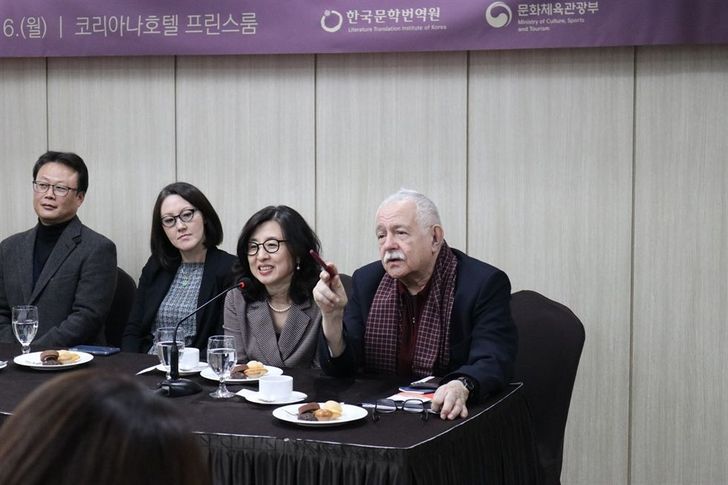
From left, author Kim Un-su, translators Sora Kim-Russell, Yoon Sun-me, and author and publisher Pio E. Serrano attend a press conference held in central Seoul, Monday. Courtesy of LTI Korea
The LTI Korea Distinguished Service Award, the seventh annual award since its beginning back in 2013, honors two winners this year: publisher Pio E. Serrano from Spain and English poetry translator Choi Don-mee.
Serrano, author and CEO of his publishing house Verbum in Spain, has so far published over 50 books of Korean translations, as well as introductory books on Korean literature. Choi received Canada's International Griffin Poetry Prize in 2019 with poet Kim Hye-soon; she herself is also a poet and the winner of Whiting Award for poetry in 2011.
“Korean literature was introduced to Spanish readers not too long ago; Verbum's initial goal was to let readers in Spain get to know more about Korea ― a country with strong cultural power from thousands of years ago. In Spain, Korean literature was not well-known compared to other countries like China and Japan in Far East Asia,” Serrano said during the press conference.
“One of the achievements of Verbum is that Spain's central libraries are beginning to have a separate category of Korean literature, which was not present until recently. Also, many bookstores in Spain include Korean literature books.”
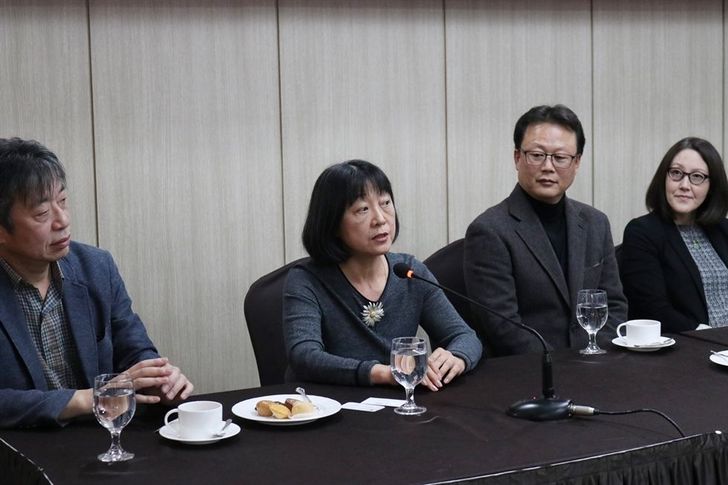
From left, translators Kim Hwan, Li San-lun, author Kim Un-su, and translator Sora Kim-Russell speak during a press conference held in central Seoul, Monday. Courtesy of LTI Korea
This year's LTI Korea Translation Award for Aspiring Translators, launched since 2002, has been given to eight winners: Bae Young-jae, Chloe Gautier, Martin Mrzyglod, Park Jeong-hyo, Olga Klimenko, Jinan Zhang, Maki Ito and To Thi Thanh Thuong, each from eight language categories of English, French, German, Spanish, Russian, Chinese, Japanese and Vietnamese. The winners were chosen out of more than 340 candidates. LTI Korea said that Arab language will be added next year.