Book fair emphasizes healthy eating, mind, lifestyle

Stephen Ritz, the author of “The Power of a Plant” and founder of Green Bronx Machine, takes a selfie with students from different parts of the UAE on Nov. 6./ Courtesy of Sharjah Book Authority
By Jung Hae-myoung
SHARJAH, United Arab Emirates ― At the Sharjah Expo Center in Sharjah, the United Arab Emirates, students, scholars and people from all around the globe bustled, strolling between the booths of books from all around the world.
The Sharjah International Book Fair (SIBF) is one of the most significant book fairs in the world along with that of Frankfurt and London. This year, the fair ran from Oct. 30 until Nov. 9, at the Sharjah Expo Center under the theme of “Open Books, Open Minds.”
Among various cultural activities for both children and adults at the fair, one of the themes that largely circled on was healthy eating and well-being that was shown through cooking showcases and talk sessions of related authors.
Stephen Ritz, author of “The Power of a Plant: A Teacher's Odyssey to Grow Healthy Minds and Schools,” was one of them, delivering his passionate speech about healthy eating, to young students that filled the grand ballroom. Multiple schools joined together to hear what Ritz had to say about how he became the educator and founder of Green Bronx Machine.
Before he became a sustainable education teacher for 35 years, he was working to become an athlete. However, when his dream failed, he started eating junk food such as hotdogs and burgers, which led him to weigh over 300 pounds. On the stage, Ritz showed his young audience how big he was using a t-shirt he used to wear when he was overweight.
After becoming an educator he saw how his students and children living in his neighborhood had the same habit, which motivated him to become an advocate of healthy eating and lead an education for green life. Now, under his guide the students grow 37 kinds of fruits and vegetables indoors.
The plant growing started in the classroom which became the first “edible classroom” in the world. This small farm enlarged to other parts of the school, them to community in Bronx, to other schools, until it eventually built a replica in the US Botanic Garden in Washington D.C.
His curriculum is being used in hundreds of schools across the United States, and internationally from Colombia to Dubai, from Canada to Cairo and beyond.
Ritz and his students have grown more than 85,000 pounds of vegetables in the South Bronx, and in the process he has increased school attendance from 40 percent to 93 percent daily.
“We need to get communities back to eating healthy and fresh foods, making eating real food a 'revolutionary act,'” he said to the young audience passionately. “Science is not something you learn or teach. Science is what we do. We need to create farms of the future using science”
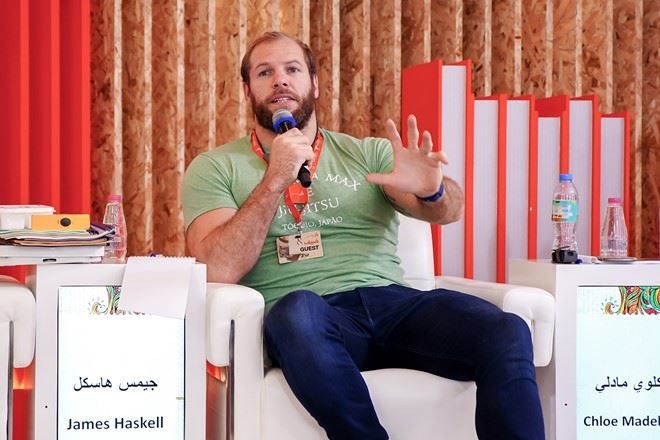
James Haskell, a former rugby player and now a mixed martial artist, talks at the cultural activity session at SIBF held at Sharjah Expo Center, Nov. 4./ Courtesy of Sharjah Book Authority
On the other day, Nov. 4, James Haskell, a professional mixed martial artist and former rugby player, joined a talk session at the SIBF with his wife Chloe Madeley, a health and fitness guru. Expert dietician Dr. Mohammed Al-Ghandour and Omar Al-duri, an award winning football coach, also joined the session.
Exchanging multiple questions and answers, the talk led to the subject of mental health, which is a significant part of leading a healthy life.
Haskell shared his story on his struggles on mental health despite the stereotype of masculinity in society that “all men should be strong.” After breaking his toes and not able to play rugby anymore, and he had a hard time deciding what to do next. After treating his mental health with a professional he was able to take his career into another area of sport, mixed marital arts.
He also emphasized reaching out to professionals is critical for those in need, as it is often overlooked.
“Educating the mind and brain to facilitate the needs of the body is critical for good health,” Haskell said. “In sports we spend huge amounts on equipment, training and technology to stay physically fit but pay no attention to what the mind needs.”
Yet he continued saying that “the mind is the most powerful tool we have.” He described his visits to a sports psychologist at age 18 to build up confidence and work on his performance goals.
“Men often bottle up and refuse to share what they feel; but opening up to the psychologist was the best thing I ever did.”
Dr. Al-Ghandour also commented: “When people think of health they think of what you eat, but pay no attention to the state of your mind.” He brought out the link between physical and mental health saying absence of disease in the physical body does not always constitute perfect health.