Exhibition looks into modern publishing history

A visitor looks at books on display at “Publishing a Book ― 100 Years of Modern Publishing in Korea,” an exhibition at the Samseong Museum of Publishing in central Seoul. Yonhap
By Kwon Mee-yoo
"Publishing a Book ― 100 Years of Modern Publishing in Korea," an exhibition at the Samseong Museum of Publishing, sheds light on the history of modern publishing in Korea, which is full of ups and downs.
"The history of publishing is the history of publishers,” Kim Jong-gyu, founder of the museum, nestled in Gugi-dong, Jongno-gu, said. “Korean publishers have been printing books despite tough times, such as the annexation of Korea by Japan and censorship by the government. We organized an exhibition to take a look at Korea's modern publishing industry by publishing house."
Kim is a man of publishing, who took over the family business Samseong Publishing Company and ran it successfully. The museum is also based on Kim's personal collection of 100,000 printed works, including a National Treasure and nine Treasures.
The exhibit showcases 110 rare publications from 37 publishers in the museum's collection, ranging from books of Hoedongseogwan, founded in 1897, to those of Hangilsa Publishing, established in 1976.
Kim, who also serves as president of the Korean Museum Association, said there was never a favorable environment for Korean publishing companies.
"This exhibition is dedicated to those publishers who continuously produced books despite harsh conditions," Kim said.
The exhibit divides Korea's modern publishing history into three periods that date back to the late 19th century.
The first phase begins in 1883, when the Joseon Dynasty established Bangmunguk, or the Office of Culture and Information, which introduced Western-style printing machines and movable type.
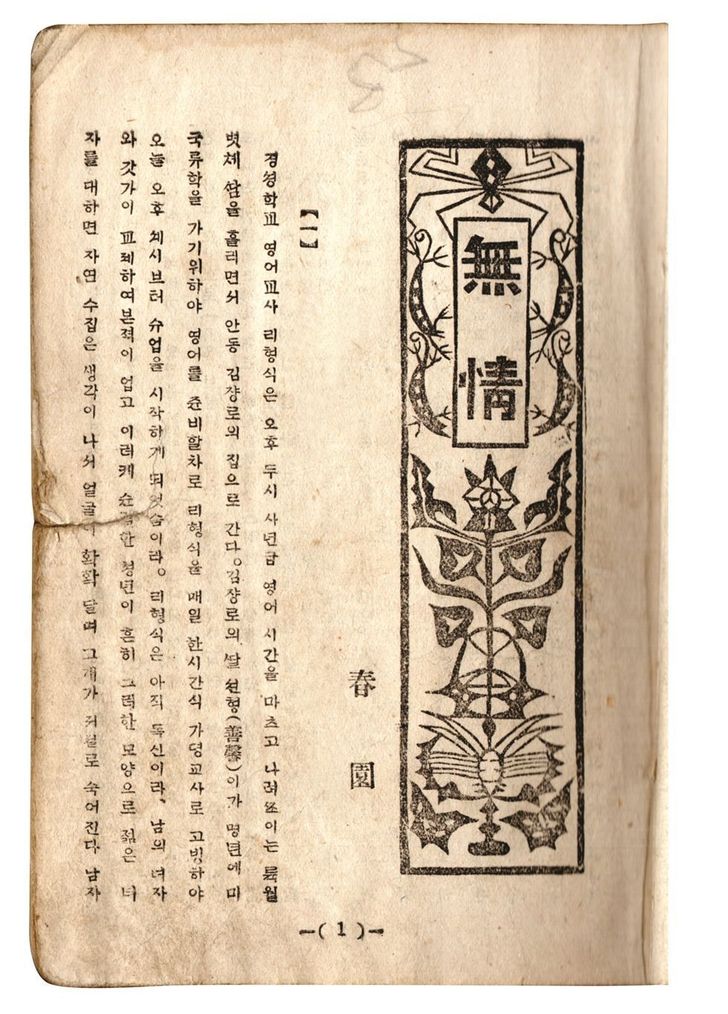
The fifth edition of Yi Kwang-su's “Mujeong” (Heartlessness)” from Hoedongseogwan / Courtesy of Samseong Museum of Publishing
A highlight of the exhibition is the fifth edition of "Mujeong” (Heartlessness) by Yi Kwang-su (1892―1950). "Mujeong" is considered the first modern work of fiction in Korea, serialized in the Maeil Sinbo newspaper and released by Korea's first modern private publisher Sinmungwan in 1918.
"Back then printing houses doubled as publishers,” Pyo Jeong-hun, a literary critic, said. “Mujeong was published by several printing and publishing companies, up to the ninth edition by Bakmun Publishing Company in 1953. Most of these editions have disappeared and this is the only remaining copy of the fifth edition by Hoedongseogwan. We have to research further to find out if this edition differs from others."
Also on view are "yukjeon soseol," or six-coin novels, the first low-priced pocketbook novels to popularize literature, by Sinmungwan.
"Popular novels such as the Record of Lady Sa's Southward Journey were published in the form of yukjeon soseol," Pyo said.
The second phase is the period after liberation from Japan in 1945 until the 1950s, when many publishing companies were established amid a bursting desire for knowledge after the war. Many well-known Korean publishers, including Hyeonamsa Publishing and Hyundae Munhak Publishing, were founded in the 1950s.
"After Korea's liberation on Aug. 15, 1945, publishers registered with the government,” Pyo said. “However, paper was very rare and the priority was given to textbooks and newspapers first, then publishing companies."
The critic said Jeong Bi-seok's novel "Madame Freedom" is considered Korea's first best-seller. "Chunwon Seogan Munbeom" (“Examples for Letter Writing” from Chunwon Yi Gwang-su) was another popular book from the 1950s.
"Letters were a major means of communication and it was important to write proper business or love letters,” Pyo said. “So these kinds of books, telling readers how to write good letters, were quick sellers."
The exhibit defines the 1960s as the balmy days of publishers, as the spread of knowledge was crucial amid rapid growth.
The exhibit runs through Dec. 10. Admission is free.