Baseball legend recalls shattered Major League dream

Sun Dong-yeol, a retired baseball pitcher and the former national baseball team manager, speaks during a news conference for his new book, “Sun Dong-yeol, the Baseball Incarnate,” at the Plaza Hotel in Seoul, Tuesday. Yonhap
Former Tigers' pitcher Sun Dong-yeol releases memoir 'Baseball Incarnate'
By Kang Hyun-kyung
Korean baseball legend Sun Dong-yeol, 56, is one of the greatest pitchers of all time and undeniably an unrivaled athlete, particularly in the late 1980s when his arch-nemesis Choi Dong-won's career had declined.
As his nickname “Mudeung Stealth Bomber” suggests, hitters of rival teams were devastated whenever he took to the pitcher's mound and dominated with his iconic fastballs. Mudeung is the name of a mountain in his hometown Gwangju and his nickname shows he was a source of pride for the locals.
It recently became known that his stardom came at the expense of his shattered Major League Baseball (MLB) dreams.
Sun broke the silence about the price he paid as a star athlete in the 1980s at a news conference for his memoir, “Sun Dong-yeol, the Baseball Incarnate” at the Plaza Hotel Seoul on Tuesday.
“People think my baseball career had gone well throughout, without any career lows or major difficulties. But that wasn't the case,” he said.
Like other sports stars, he said he had encountered numerous frustrating moments, noting the worst part was his shattered MLB dreams because of political interference.
“The spy agency played a part to deter me from joining the big league,” he said.
“In the early 1980s, several Major League baseball teams had contacted me as well as my father, encouraging me to consider signing a contract with them. Around the time when their offers were made public through media reports, my father got a phone call from the spy agency. What they had said to my father was quite threatening. They told my father to persuade me to forgo the Major League option.”
Sun said he himself didn't hear anything in person from the spy agency or politicians regarding his possible Major League option. But he said his parents and his older sister did.
Then President Chun Doo-hwan, who rose to power through a military coup, needed the sports star to stay for various reasons. Chun was grappling with his vulnerable leadership base, particularly after his brutal crackdown on the popular protests in Gwangju which killed hundreds of people, put his leadership to the test.
The Korea Baseball Organization League was launched in 1982 with six baseball clubs, an effort the Chun government made to allay public opinion which had gone from bad to worse.
To make it a popular sport, the Chun government needed sports stars like Sun in the local league. Some players in the U.S. minor league were also called upon to join the KBO League.
“It's hard to understand now but it was the way of the country back in the 1980s,” Sun said. “I was no longer a son of my father with the dramatic boost of my status as a sport star. Korea was then ruled by the military general-turned-president. The status of the spy agency was quite different from what it is today and people were scared if they said something to you. I was scared after I heard from my father about the phone call from the agency.”
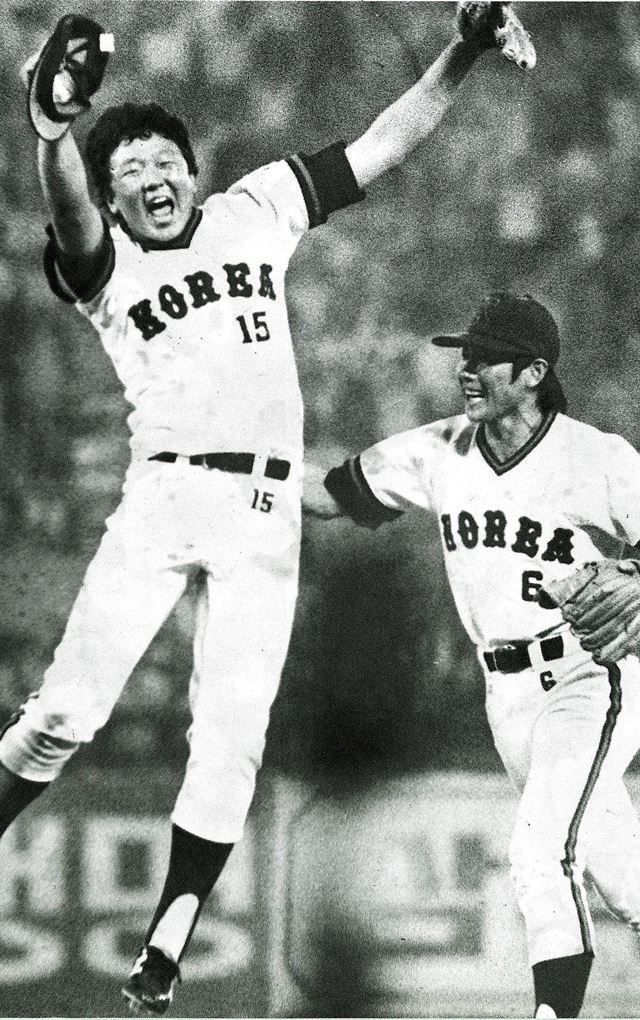
Sun Dong-yeol, left, then a pitcher for South Korea's national team, celebrates South Korea's 5-2 victory against Japan to clinch the 27th Amateur World Series championship in Seoul in this 1982 file photo. / Korea Times file
Sun emerged as one of the highest-in-demand baseball stars among Major League scouts after he had ventured abroad to clinch two international championships for Korea in 1981 and 1982.
His fame at home owed largely to his overseas success.
Sun rose as an international pitching sensation in 1981 at the U-18 Baseball World Championship finals against the United States.
South Korea clinched the championship after defeating the host in the finals at Don Edward Park in Newark, Ohio.
He had a complete game win with his stellar pitching. In the final game against the United States, he allowed a single home run but led South Korea to edge the U.S. out 2-1 and win gold. He struck out 11 U.S. players.
All during the championship, he pitched a total of 24 innings, striking out 36 hitters with an unbelievable 0.34 ERA. Sun, along with a U.S. player whose name he doesn't remember, shared the MVP award and the two appeared in Sports Illustrated magazine.
Then an 18-year-old South Korean pitcher, Sun had multiple calls from several Major League baseball teams to join their clubs. “The New York Yankees were the most aggressive,” he recalled. South Korea's mandatory military duty stood in his way.
His strong reputation remained intact the next year as South Korea clinched gold at the 27th Amateur World Series in Seoul. Sun dominated the championship with his stellar pitching. He pitched a total of 29 innings with 0.31 ERA and 30 strike outs. The MVP award went to him again.
Anxious to have the South Korean pitcher in their club, the Milwaukee Brewers even sent a team consisting of a scout and a translator to his hometown in the southwestern city of Gwangju and met his father. They asked if there was anything they could do to help him escape the military duty and join their club.
Telling them he was also eager to join the MLB, he, along with his father, tried to make it work and agreed that he would complete his military service first and then go to America. But it didn't go the way he planned.
Already a big star in Korea, Sun fell victim to a game of expectation.
The entire nation was against his American dream and wanted him to be their star at home.
Besides the political factor, Sun was also under pressure for his hometown's high expectation toward the Gwangju-based club Haitai Tigers, which later became the Kia Tigers.
“My life became entangled in Korea's turbulent modern history,” he said in his memoir.
“Hundreds of innocent people lost their lives during the 1980 pro-democracy protests in Gwangju. The traumatic experiences made people in the Jeolla region ― not to mention Gwangju residents ― live all their remaining lives in agony and anguish. The Haitai Tigers were more than a baseball club for them. The club was hope and reason for the locals to lead their lives. If the Tigers won, the residents felt a sense of comfort and catharsis. They had fought against state-sponsored violence and military dictatorship and lived in despair after fellow citizens fell to guns and swords.”
Sun eventually chose to respond to the calls to join the Tigers. During his 11 seasons in the Tigers, he led his team to win the regular seasons and the Korean Series seven times with his remarkable records.
He pitched in 367 games in total, won 146 games with 40 defeats and 132 saves. He became regular season MVPs three times. He was a leader in ERA for seven consecutive seasons between 1985 and 1991, three times achieving an ERA below 1.00. His career average ERA during the 11 KBO seasons was 1.20. He later joined the Chunichi Dragons in the Japanese professional baseball league until his retirement in 1999.
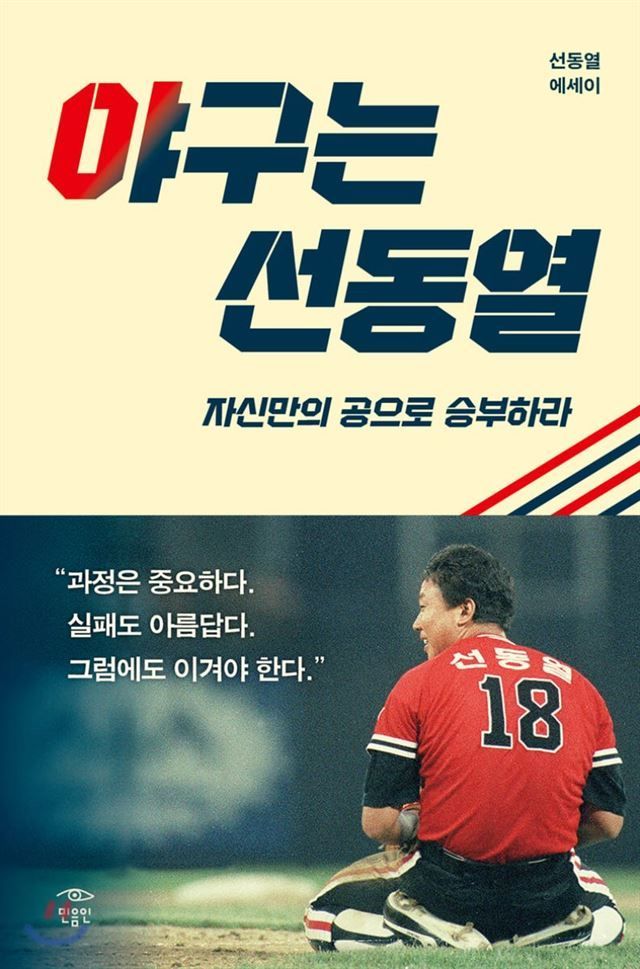
“Sun Dong-yeol, the Baseball Incarnate” published by Minumin Books
For Sun, the Major League became a road untaken.
Regarding any regret about his decision to give up his Major League dreams, he paused for a moment and said, “I think I was able to lead a successful career as a baseball player and then manager because of the great players who came before me. I think the opposite may also be true. We have many great players these days, maybe because I chose to stay in the KBO League no matter what the reason was.”
Sun is preparing for the next chapter in his career as a manager. He was invited to the New York Yankees spring training to be held in February in Florida. He will attend meetings and conferences which will be organized by the Yankees staff and front office. The Yankees are also known to promise him an opportunity to explore the Yankees system for one year after the spring training. Sun said he would like to learn the Major League system and their way of baseball during the period.