Jeolla dialect 'gwin' defines southern hospitality

Five women pose with big smiles in this June 2018 photo taken in Manho-dong, Mokpo City. Starting in 2014 on the southern island of Jeju, photographer Im Jay-cheon embarked on the discovery photobook sequel and has since released three photobooks, including “Jeollado.” / Courtesy of Noonbit Publishing Co.
Photographer, 50 donors join hands to discover Korea
By Kang Hyun-kyung
While mingling with locals to shoot photos in the southwestern region of Jeolla last year for his photobook sequel, Im Jay-cheon, 52, occasionally encountered a problem with the local dialect.
They used the word “gwin” a lot, particularly when they described their first impression of, or feelings about, the photographer.
Some told him “You look gwin,” or “You're gwin.”
Curious about its meaning, he looked it up. According to the dictionary, gwin is a word in the Jeolla dialect widely used among the locals to mean “cute.”
Interacting with many locals there for four months, Im said he realized its meaning is much broader than just “cute.”
“Depending on circumstances, it also means you are good-looking, likable, or good-natured,” Im said during a recent interview with The Korea Times in Seoul. “Sometimes it means they are honored to have met a wonderful person like you. They use the word in various circumstances. To figure out what it exactly means, you should consider the context, rather than focusing on the word itself.”
The southern dialect is a primary theme featured in Im's photobook “Jeollado” which was published in June. It contains 130 selected photos, showing the lives of farmers, fishermen and people relying on wetlands for a living. It also shows things that are disappearing in urban areas, such as rice mills and barbershops packed with miscellaneous items.
Since 2000, Im has worked as a full-time photographer and captured images of the scenery and people in rural areas of the country. His photobook “Discovery of Korea” was published in 2013.
While shooting photos all across the country, Im said he realized there are local-specific scenes and cultures that are vanishing as the rural areas are modernized.
He felt the need to focus on each region because there is a lot to discover in each province.
Starting in 2014 on the southern island of Jeju, he embarked on the discovery photobook sequel and has since released three photobooks, including “Jeollado.”
His region-specific photo projects allowed him to mingle with the locals and experience unique local culture.
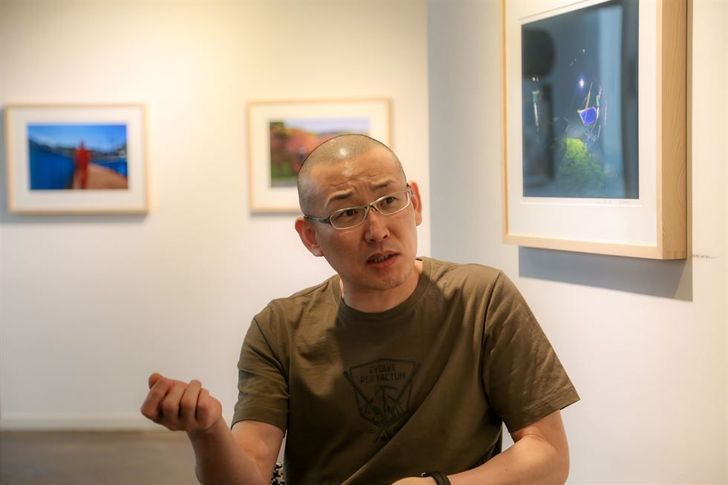
Photographer Im Jay-cheon speaks during an interview with The Korea Times in southern Seoul last week. / Photo from Im Jae-cheon
Im said gwin and pronoun “geosigi” are two symbolic local words that can summarize what Jeolla people are like.
“In the south, people use geosigi a lot. They use it when they are struggling to find the right word or phrase that all parties involved in the conversation, including the narrator, know about. So when people say geosigi, everybody knows what they are talking about, so their conversation goes smoothly,” he said.
Born and raised in the land-locked southeastern county of Uisung, Im has an instantly recognizable, strong North Gyeongsang Province accent.
His hometown is situated on the eastern side of the nation right below Gangwon Province, whereas Jeolla Province sits on the lower western side of the Korean Peninsula.
Gyeongsang and Jeolla have been archrivals for decades in many ways. Their rivalry becomes evident, particularly when the nation goes to the polls to select the president or parliamentary representatives. The eastern side of the nation is sweepingly in favor of the conservative party, which is described as “the party for the haves,” while the western side of the nation is predominantly inhabited by liberal party supporters. Due to this, in every election, the nation sees a clear east-west vote split.
During the military dictatorships in the 1970s and 80s, the Jeolla region was rebellious and it became the epicenter of the pro-democracy uprisings. Meanwhile, the Gyeongsang region was depicted as home to ruling elites as conservative leaders from the region took power for a long time until the late 1990s when President Kim Dae-jung, a Jeolla native, was elected.
Politicians are largely responsible for the east-west divide during the campaign season as some try to fan animosity toward each other by raising a development gap or creating negative public opinions about the counterpart region, in order to consolidate voters in favor of them.
Im said his months-long immersion in the Jeolla region for his photobook sequel has taught him that there is no such thing as animosity or rivalry between his hometown and the Jeolla Province.
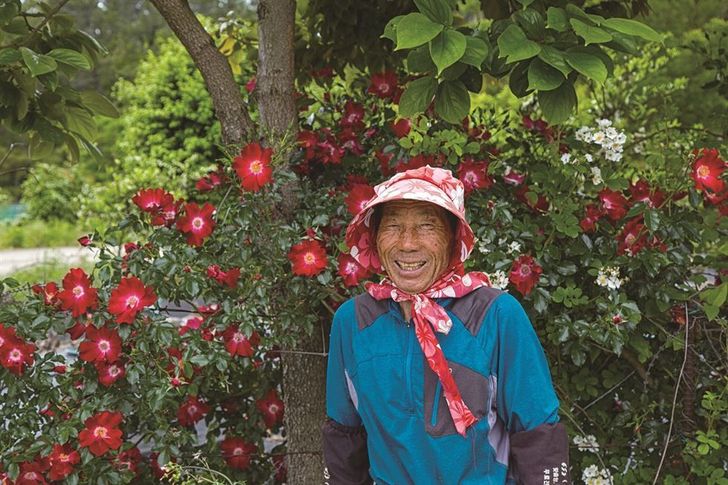
Im Jay-cheon's photobook “Jeollado” was published in June. This photo was taken in May 2018 in Goheung, South Jeolla Province. / Courtesy of Noonbit Publishing Co.
Rather, he said, the opposite is true.
He said Jeolla people are warm and have wonderful hearts and they are open-minded toward people from Gyeongsang Province.
“I heard an interesting story about the regional rivalry from an elderly man in Gimje, North Jeolla Province. He recognized my Gyeongsang accent and said, 'you're from Gyeongsang, aren't you?' I said correct and he said then you're 'mundi from Gyeongsang.' I said yes and he asked me if I know what that term means,” said Im.
“I said 'mundi' refers to a leprosy patient. He said I was wrong and explained that mundi originated from the two Chinese characters 'mun and dong' which together mean 'a child who is reading books' and Jeolla people have called people from Gyeongsang as such because they knew people in the Gyeongsang region are educated. So he said the term initially meant that Jeolla people admire people from Gyeongsang for their educational zeal.”
The once positive term was distorted by some self-serving people who tried to take advantage of the regional rivalry, Im said.
The photographer said he never met any locals in Jeolla who harbored hard feelings toward people from Gyeongsang.
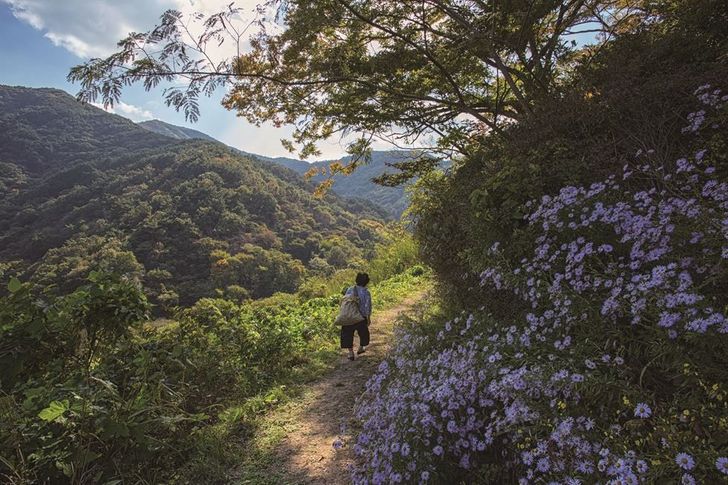
A farmer walks an unpaved road in Gudam Village, Imsil County, in this October 2018 photo. / Courtesy of Noonbit Publishing Co.
He said one of the joys of being a photographer is that he has the opportunity to meet various people and hear about things he had never expected, mentioning “a poetic, nature-loving farmer” he met in Jeolla last year.
“I met an old lady in the rustic Gudam Village in Imsil County surrounded with mountains. On her way back home after finishing work on her pepper farm, she discovered chamomile that covered the hill on her right side,” he said.
She was drawn to the beautiful scene and exclaimed, “Who made you beautiful flowers? You made me stop here for you. I can't take my eyes off of you.”
“I was amazed by her creativeness. She was like a poet and improvised the prose as she was touched by the wonder created by Mother Nature,” said Im. “Whenever I look at the photo of her carrying a bag full of pepper and walking past the chamomile, I think of the innocent, warm Jeolla people.”
He said the locals are so generous that he was treated to free meals many times.
His understanding about the region has deepened, so he said he came to understand what's inside the hearts of the locals.
Whenever he asked middle-aged or older ladies if they would be okay with him taking a photo, he said, they say no with their hand gestures but have big smiles on their faces. “I know when they say no with such facial expressions, this doesn't necessarily mean they don't want their photo taken. They are too shy to say yes to my request,” he said.
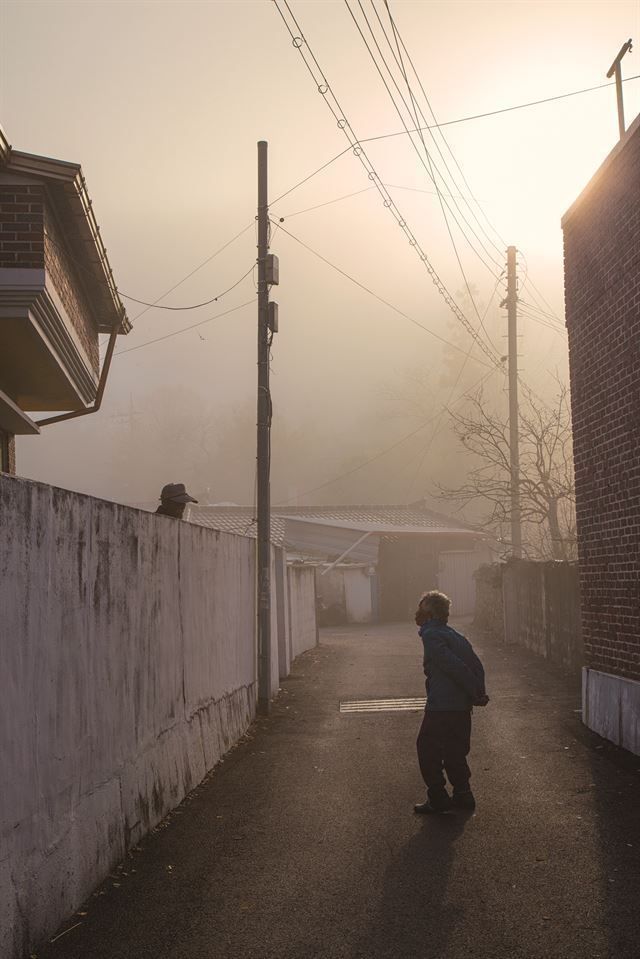
A local resident, left, climbs up the wall of his house to communicate with his neighbor on the other side in this November 2018 photo taken in Hwasun County, South Jeolla Province. / Courtesy of Noonbit Publishing Co.
Im characterizes himself as a laborer, not an artist or professional photographer.
“Photo works require a great deal of labor until they are published,” he said. “I walk a lot whenever I work on a photo project. Once I arrive at a certain spot where I like the background, then a waiting game begins. Last year when I worked on the photo project in Jeolla Province, I once waited for four hours until passers-by came to the location that I wanted to photograph. I take documentary photos so people are my focus. The waiting game has been part of my project.”
In addition, Im said working long hours is inevitable for him to get the shot that he wants.
He said he began his day very early in the morning ― before sunrise ― and went to bed late at night after sunset because the dawn and dusk are two of the highlights of his photos. Some of his photos feature farmers and fishermen working during the dawn and dusk.
A tight budget is another factor that kept him busy. His entire budget for the one year photobook project was 50 million won ($45,000).
Since 2014 when he embarked on the discovery sequel, he has raised money through his Facebook account to finance his photobook project.
He uploaded a post rallying support for his photo project to find 50 donors who were willing to pay 1 million won ($950) each per year to move his year-long project forward.
He provided some details, including his purpose and what benefit each donor could receive. In return for their annual donation of 1 million won, each donor will get a photo of his or her own choice among some 150 photo shots Im has taken. The selected 50 photos will be on display for the public at an exhibition hall with their names on it. The 50 photos, along with some 100 others, will be published in a photobook project.
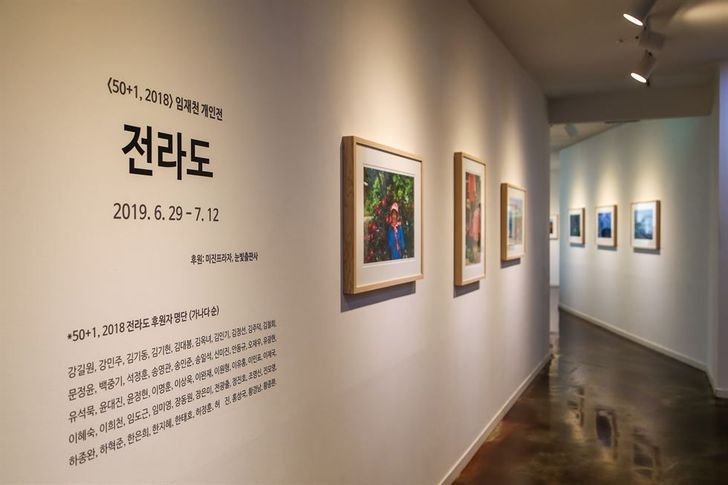
The names of 50 people, who each donated 1 million won ($950) to help photographer Im Jay-cheon to publish his year-long photobook project “Jeollado,” were recognized on the wall of the exhibition center in southern Seoul last week. Im held the exhibition to showcase photos he took last year in the southwestern region. / Photo from Im Jay-cheon
Im's social media-based fundraising was successful. In 2014, 75 people signed up for his cause within two days after he began his online fundraising. “Honestly, I was surprised. I didn't expect so many people would underwrite for my project in just two days, which was amazing,” he said.
Some donors said they feel Im's project is rewarding.
“He impressed me,” Lee Weon-hyung, 54, said. “I was a typical urbanite who believed growth and development are necessary. So when he said he was trying to capture things that are vanishing as a consequence of development and such photos are needed for the future generation, to me it was like a culture shock. I was convinced that we need a project like this.”
Lee, a second-time donor for Im's discovery project since 2015 when he worked on Gangwon Province, said she chose the barbershop photo and Im's photos are worthy of recognition.
“I picked the photo because it shows the things that are gone in urban areas. At first sight, the barbershop looks a little bit messy as it shows many things. But when you look at it thoroughly, you will see there are several things that no longer exist in urban areas,” she said. “Having a documentary photo in return for a 1 million won of donation is not a bad idea. But what moved me was the thought that I could help a professional photographer like him focus on his project without worries about financial difficulties, which was a big thing to me.”
Another donor who asked to be named by his alias Paul Hwang said Im's photos made him feel nostalgic. “My pick was the one featuring an elderly lady waiting for a bus.,” he said. “I'm from Jeolla Province and can see such a scene when I go down to my hometown. The lady in the photo reminds me of my mother.”
Oh Jae-woo, 50, a restaurant owner in Ulsan, South Gyeongsang Province, said he liked the idea of preserving things, which are pushed out in the name of development, in the form of photos. “I travel a lot with my kids whenever we have time, so I think I am familiar with many parts of the country. But when I look at his photos, I feel that my understanding of the country is very limited. I learn a lot from his photos,” he said.
Im said along with his toils, his photobook is the result of the 50 donors' commitments and their full support for his project. He said he also owed some volunteers who gave him rides during his photo projects. Im has no driver's license and thus he asked for volunteers who could take him to the region he was to shoot photos.