Carefree houseboy debunks Korean War blues

A “houseboy” in cowboy clothes poses in Chuncheon, Gangwon Province in this 1953 photo. Houseboys cleaned the tent and washed clothes for U.S. soldiers at the U.S. military camp and in return they were provided with food, pocket money and a warm place to sleep. / Photos from Noonbit Publishing
Korean War veteran's photobook 'Hello Korea' depicts what post-war Korea was like
By Kang Hyun-kyung
A temporary job was created for war orphans during the Korean War (1950-53) ― they worked inside U.S. military bases, cleaning and washing for U.S. soldiers stationed in them.
They were called “houseboys.” Unlike other war orphans who were starving and begging for food on the streets, houseboys had no worries about food and where to live because they were given pocket money, food and a warm place to sleep in return for their work.
Rupert Nelson's photobook “Hello Korea: Korea at the End of the Korean War Seen by a U.S. Soldier” published in June by Noonbit Publishing Co. in Seoul, has a photograph of an unnamed houseboy who worked at a U.S. military camp in 1953 in the eastern city of Chuncheon. The tanned, slim boy in cowboy clothes grins while posing for the photo.
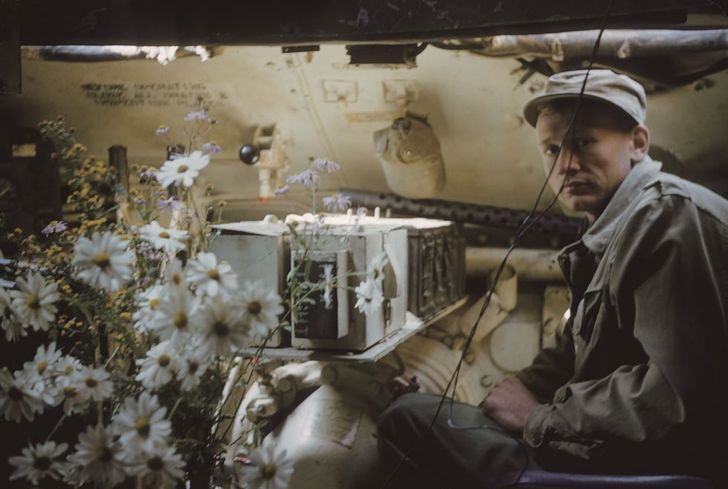
Rupert Nelson poses inside the tank he climbed into in this July 1953 photo. He said he was surprised to find beautiful wildflowers in there.
“Hello Korea” showcases 109 selected photos the Korean War veteran took while he was stationed in Korea from January 1953 to February 1954.
His well-preserved photos depict vividly what Korea was like during and after the war and how the survivors made a living amid the ashes of the fratricidal conflict.
In addition to the houseboy, Nelson also captured porters waiting for work, poor but bustling traditional market areas and the breathtaking scenery of mountains in Hwacheon, near the front lines in the eastern part of the country, and the city of Chuncheon.
“Hello Korea” hints at two contrasting images of the war-torn country in the 1950s ― the country was stricken with poverty, yet like the houseboy, some people seemed to be carefree.
During the war, Nelson, now 88, climbed the mountains of the region every day to perform his topographical survey missions.
He always carried his Zeiss Ikon camera, which he purchased in Japan during leave, and took photos of the scenery and Koreans in the war-torn nation.
To give readers a deeper understanding of the behind-the-scenes stories, excerpts from Nelson's 2005 autobiography “Like the Rings of a Tree” are included in some chapters.
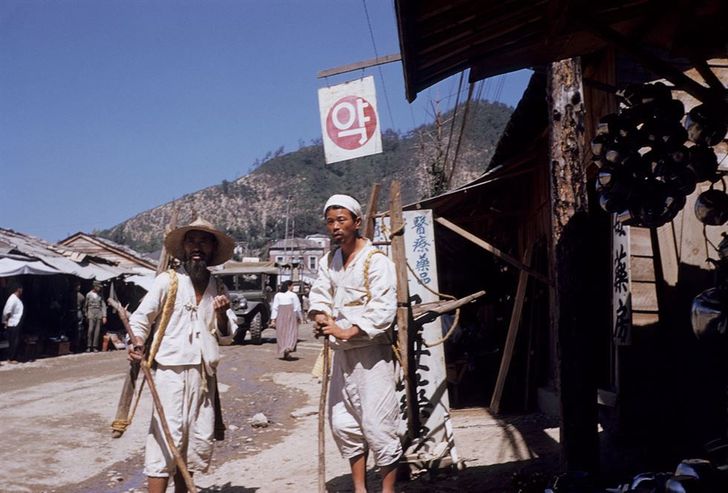
Porters carrying 'jigae' or A-frame carriers wait for work in this September 1953 file photo.
Nelson's 13-month stay in war-torn Korea was a rollercoaster ride.
From the perspective of a young South Dakotan farmer, Korea was a country full of wonder ― pristine nature and beautiful scenery remained intact despite the three-year war and farmers still relied on centuries-old agricultural traditions in which oxen were used for ploughing rice paddies.
There were some nice surprises as well. One day, Nelson discovered beautiful wildflowers inside a tank he climbed into to perform his mission.
The post-war Korea seen by Nelson, who now lives in Claremont, California, was also tragic.
The children orphaned by the war were faced difficult lives. Having no other means to survive, some of the girls in urban areas became mired in prostitution to make a living.
“There were thousands of prostitutes,” Nelson recalled in a part of his autobiography that was added to the photobook. “(W)hen we went on errands to Chuncheon or Seoul they were everywhere. Young boys were often their pimps. In military bases in the rear areas it was common for soldiers to have a moose. The Japanese word for girl was 'musamae' which became abbreviated to moose…. Those relationships had a financial basis. Women received about $40 a month plus some food and other benefits.”
“Hello Korea” hints that an increase in biracial children, “GI babies,” in the wake of the Korean War was definitely related to post-war poverty.
“More or less, (the U.S. soldier's) long-term relationship would be worked out with a moose and the two became a couple. Sometimes the young lady would have a baby from a previous relationship so we would see family groups consisting of man, woman, and child. Perhaps more commonly the baby would be left with relatives or abandoned… The mixed-race children of those relationships were unwanted and prejudiced against.”
Nelson's narrative of post-war Korea, particularly the GI babies, is a valuable historical record as it helps historians and demographic experts trace the roots of racial diversity in Korea.
Jung Gun-na, a professor of economics at Hanshin University in Gyeonggi Province, who helped Nelson publish his photos through the Korean publisher, said “Hello Korea” also provides other valuable information.
“First of all, his color photos are rare. There are many black and white photos and lots of TV footage featuring the Korean War. But color photos are uncommon,” said Jung. “Nelson focused on things that interested him, such as the scenery, agricultural techniques and poor children. Unlike documentary photos that highlighted the cruelty of the war, Nelson captured ordinary people and rural areas of the country and thus his photos show what Korea was like immediately after the war.”
Jung said “Hello Korea” is post-war Korea seen by a young South Dakotan farmer.
“Mr. Nelson kept his photos as slides, so their overall condition is still very good, even though several decades have passed since he took them,” Jung said. “For each photo, Mr. Nelson provided detailed information about when and where it was taken and what the photo was about.”
Professor Jung met Nelson in 2018 at a conference in Claremont, California. At that time Jung was on a sabbatical and spent two years as a research fellow at the center for Process Studies at Claremont School of Theology.
After finding out Nelson was a Korean War veteran and had many photos of the war, Jung visited his home in Pilgrim Place, California to learn more about the photos.
Jung said initially he was curious about Nelson's photos and planned to share his stories and photos with friends and acquaintances.
His curiosity about the Korean War veteran developed into a mission as he became determined to share them with other Koreans.
“His life is inspiring, too,” said Jung. “The Korean War impacted him to pursue a degree in agricultural engineering. He saw poverty in person and was determined to fight it in developing countries.”
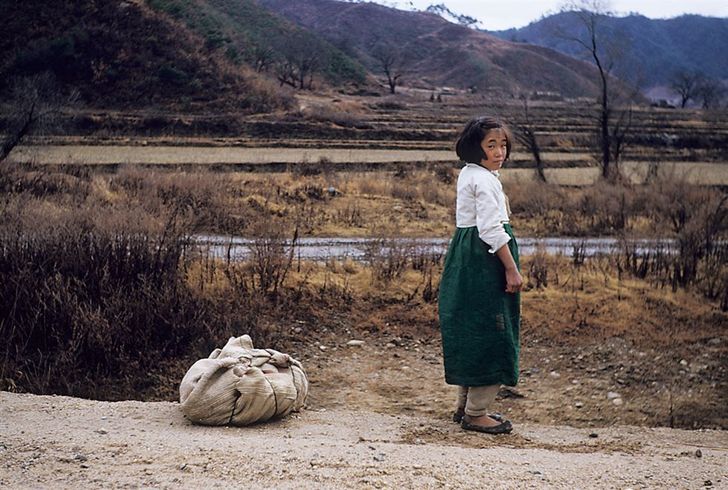
A girl takes a rest, placing her burden on the unpaved road in an unspecified rural, mountainous area in this October 1953 photo.
The Korean War became a turning point for Nelson. After returning to the United States in 1954, he studied agricultural engineering and became a Christian missionary, serving the poor people in northern Thailand.
He stayed there for almost three decades before returning to Montana in 1996. He moved to the retirement facility Pilgrim Place in Claremont, California in 2000 after suffering a minor stroke.