'Everybody Lies' gives insight into human psyche
By Jin Yu-Young
Seth Stephens-Davidowitz's new book “Everybody Lies” reveals shocking insights into the human psyche. After analyzing big data (via Google search engines, social media platforms, online surveys, etc.) the author reveals that the majority of us not only lie to others, but also to ourselves.
In the book, Stephens-Davidowitz refers to online search engines as the “Digital Truth Serum,” as behind the privacy of online, anonymous, and anti-human interfaces of the computer screen, we can probe into our darkest inquiries in secret.
By examining scores of Google searches, the author discovered many off-record truths including increased child abuse throughout the 2007 financial crisis, the questioned sexuality of many partners in heterosexual relationships, and the hidden political orientation of many members of the public. It is through tracking the patterns of our daily online activity that he found what other social scientists and experts have missed.
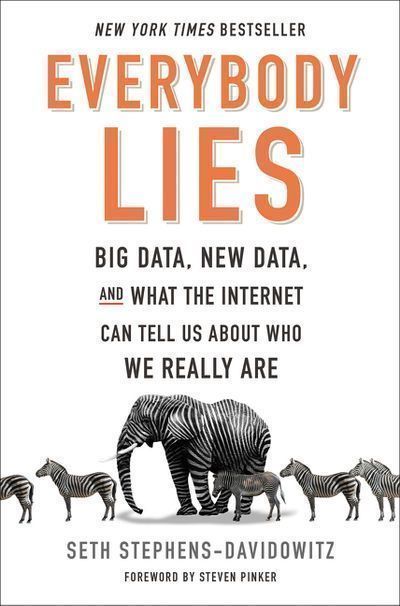
“Everybody Lies”
Using big data, we have the key to the subconscious thoughts of Internet users and therefore the ability to influence minds. For example, the author refers to Barack Obama's speech on Islamophobia. After delivering not one, but two speeches on the matter, the first word next to “Muslim” on Google was no longer “terrorist” but rather words such as “athletes” and “soldiers.” Therefore, Stephens-Davidowitz concludes that to a certain extent, Obama was able to shift the attitude towards Muslim Americans.
The author marks his hopes that Big Data will be used for making progress on societal issues such as growing body image concerns in young girls and women.
The author also reveals to us his most shocking discovery: while people are unapologetically vulnerable on Google search engines, they are equally if not more dishonest on online surveys and on social media platforms. Due to the social desirability theory in which people wish to appear favorably in front of others, respondents have a tendency to lie on surveys.
This trend is particularly noticeable in political elections where the difference between reported registered voters and actual voters differs by over 10%. Another example involves the U.S. Presidential Election in 2016: online polls miscalculated Trump's support by two percentage points. The author attributes this error to the dishonesty of survey-takers when marking their support for a political candidate.
Social media is another prime opportunity to lie, as many people only portray the highlights of their lives. For example, users may display affection towards their significant others in their daily posts but use Google to research unhappy relationships and negligent partners.
The incentive to look good or appear happy in front of our friends leads us to create the facade of a “perfect” life on social media. It is only when we dig into search engines that we can determine whether or not the happiness is genuine.
The author finishes by addressing the question of ethics that come into play with acquiring and utilizing big data.
With recent incidents such as the Facebook-Cambridge Analytica scandal, it has been proven that big data has the potential to become a powerful weapon. Therefore, it becomes a moral issue of who has the right to access what. For example, would it be morally acceptable to allow large corporations to view online consumption patterns in order tore-strategize marketing tactics? Would it be ethical for governments to monitor online searches to prevent potential crime? The author leaves on a cautious note: he neither advocates for nor condemns the usage of big data but rather uses the book to emphasize its potential for both positive and negative change.
Jin Yu-young is a Korea Times intern.