Koreans' innocent smiles captured in old photos
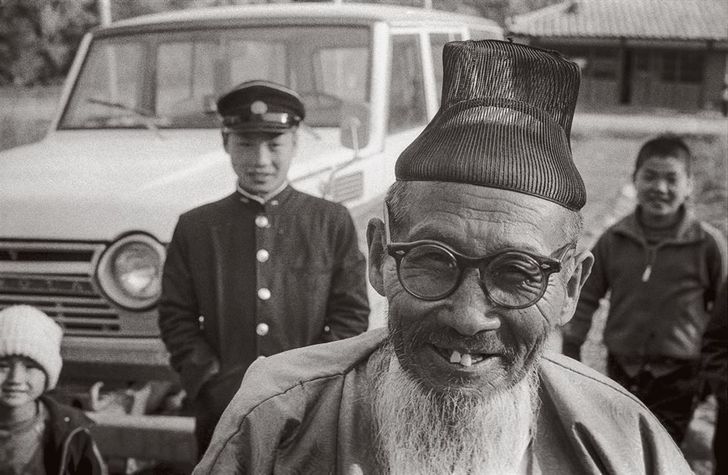
An old man wearing a beard and a traditional hairstyle of “sangtu” with all of his hair pulled to the top of his head and held by a hair band “manggeon” poses with a big smile in this photo taken by French photographer Laurent Barberon in March 1978.
French photographer releases two photo collection books
By Kang Hyun-kyung
In Korea, the 1970s and 1980s had been chaotic and turbulent as the death of the military general-turned-President Park Chung-hee in 1979 led to a military coup and ensuing pro-democracy uprisings.
Ordinary Koreans, however, were unfazed by such political turmoil and managed to live in peace.
Caught in French photographer Laurent Barberon's vintage photos taken in those days, they were seen as carefree and never lost their innocent smiles.
Barberon, author of the photo books “Coree Graphies” and “Coree Coloree,” has captured the moments of urbanites and rural residents over four decades between 1973 and 2016.
His photos testify to the untold modern history of Korea in the eyes of ordinary citizens.
Barberon, 67, said he tried to shoot original photos. “I always tried to avoid mockery,” he said in an email interview with The Korea Times.
Some of his photos are funny and give viewers the joy of small things. In his black-and-white photo taken in the summer of 1986, for example, a man and a woman sitting next to each other on a subway train are falling asleep with the man placing his head on the shoulder of the female passenger. It turned out the two passengers didn't know each other.
A photo like this and the story behind the scenes are fun and enjoyable, according to Barberon, who says taking photos is “often an unexpected happy time” and as a photographer he said it makes him happy, too.
The French photographer considers Korea his second home, saying he feels at home in the country. “I feel more Korean than French,” Barberon said.

French photographer Laurent Barberon / Courtesy of Laurent Barberon
His first visit to Korea came in 1973 when he competed in the World Taekwondo Championships.
Back then, he was a 22-year-old taekwondo practitioner representing France.
He was a rare Westerner who learned some words in Korean. The Frenchman was anxious to discover the country that was then little-known to the world outside.
Despite his tight schedule, he was able to find a day to look around Seoul.
Yet his ties with Korea began years before his first visit to Korea.
In 1968, he met a young Korean man passing through his hometown Sceaux near Paris. The Korean was studying in the United States and took time off during his vacation to explore France. Barberon said he was “very kind.”
Returning home, Barberon searched for information about Korea which he had never heard of before.
His curiosity about Korea has since grown and led him to make friends with several Koreans in France. They were students, soybean growers, restaurant owners and diplomats working at the Korean Embassy in Paris.
Barberon learned taekwondo under Korean master Lee Kwan-young and began to pick up some Korean, while mingling with his Korean friends there.
In 1975, Barberon came back to explore Korea further.
His four decades of journey as a photographer began then.
“Coree Graphies” and Coree Coloree” each showcase 200 chosen photos he has taken. The former consists of black-and-white photos, whereas the latter are photos in color.
In a black-and-white photo taken in March 1978, an old man wearing a beard and traditional hairstyle “sangtu” featuring the hair pulled into a topknot and held by a headband called a “manggeon” smiles, with two boys wearing school uniforms behind him.
Considering sangtu was a hairstyle for the men of the 1392-1910 Joseon Kingdom, Barberon's photo shows traditional lifestyles continued into the 1970s in rural areas.
His vintage photos also show a development gap already existed in the 1970s. In Seoul's southwestern part of Yeouido, high-rise buildings and modern apartment buildings are seen.
Meanwhile, a farmer is spotted using an animal for paddy field farming in the nation's midsection of Chungcheong region.

In Barberon's 1978 photo taken in North Gyeongsang Province, a woman smiles widely near bricks of dried fermented soybeans.
In another photo, a tall, thin woman tries on pants at the now-defunct high-end Midopa Department Store in central Seoul. In a separate photo taken in North Gyeongsang Province, a middle-aged woman having a round face is posed with a big smile near a cottage, with bricks of dried fermented soybeans that serve as the basis for various Korean sauces.
Some of his photos _ particularly one taken in 1986 at a brothel called “Miari Texas” in Seoul _ illustrate Korea's past that Koreans don't like sharing with outsiders. The ban on the sex trade came much later in 2004.
Lee Kyu-sang, publisher of Noonbit Publishing Corp., said Barberon loves Korea more than anyone else.
“Unlike Korean photographers who prefer to shoot moments related to a grandiose phenomenon or mega trends, Barberon focuses on ordinary people and captures the moments of small details of their lives,” Lee said. “So, it's fair to say his work shows the untold history of modern Korea revealed in the grassroots.”
Lee recognized the value of Barberon's photos in 2016 when he visited the French photographer's home near Paris during his stay in France for an international book fair and encouraged him to publish his work.
“Coree Graphies” and “Coree Coloree” were published last week.
The publication of his photo collections came much too late.
The French photographer initially planned to release a photo collection in 1980.
Time was not on his side, though. His photos were not well received by his Korean friends or by French people.
At that time, few French people were aware of or heard about Korea.
“Only a handful of people, such as missionaries, Korean War veterans and Oriental Studies majors were aware of Korea,” Barberon said. “It was no wonder few French people were interested in the Land of Morning Calm back then.”
His Korean friends didn't support his publication, either, as they believed Korea was “isrepresented”in his photos.
“We Koreans, particularly the older generation, want our country to be seen as an attractive and splendid one that has achieved miraculous economic growth,” Lee said. “Some were saying we have great national parks featuring pristine nature and natural wonders and they wonder why the French photographer didn't take such fancy sides of the country but instead focused on that part of our country we're not proud of. I understand this is why his Korean friends were not happy with his idea of publishing his photos at that time”
In the face of unfavorable reactions from his Korean and French friends, Barberon gave up on publication.
The times have now changed.
To France, Korea is no longer an obscure country.
Fueled partly by the success of Korean singer Psy and some K-pop groups and partly by the stronger presence of global Korean companies such as Samsung and Hyundai, many French people are eager to know more about the country.
Lee also helped the French photographer release his photo projects.
He said Barberon's work has its own merits as a record of what happened in this country in the 1970s and 1980s.
“When we Koreans talk about modern Korea, many of us like to focus on gigantic high-rise buildings as symbols of miraculous economic growth the nation achieved after the Korean War,” he said.
“Therefore some of us want those things to be presented. But I have a different idea. Laurent's photos are meaningful in that his work provides a lens through which people can see how Korea has transitioned over the past decades. His photos feature ordinary people and so audiences can see the transformation of Korea from a poor to a rich country through those ordinary people.”