Breathing new life into time stained books

Jaeyoung of JY Book Conservation restores old, damaged books. / Korea Times photo by Choi Won-suk
Conservator restores memories about books
By Kwon Mee-yoo
"A rainy day like today is not good for a book conservator," Jaeyoung of JY Book Conservation, said in an interview with The Korea Times on a wet day in May. "Humidity affects the amount of moisture in paper and since I mostly deal with very delicate paper, the weather strongly influences my work. I sometimes alter my schedule to do less work on rainy days."
JY Book Conservation repairs books and brings back memories of book ownership in the era when printed books are becoming obsolete. E-books have surged in popularity in recent years, but paper books cannot be completely replaced by the convenience of e-books as they cherish memories. A book conservator's role is to keep the memories found in books intact for a long time.
There are a few antique bookstores offering book repair services in Korea, but JY Book Conservation is mostly well-known through social media such as Twitter and Instagram, where Jaeyoung shares her procedures.
The book conservator majored in graphic design in undergraduate studies and studied book art and papermaking in graduate school in the United States.
"I was not skilled in handicraft book-making, so my professor suggested working in the university library's conservation laboratory to learn manual skills. I originally planned to work for three to four months to learn techniques, but ended up working over three years after graduation because I really liked working at the lab," she said.
"The books coming to the lab ranged from ordinary contemporary hardcover and paperback to rare, old books. Once I worked on a 14th century map, which crumbled into pieces and I had to spend six months putting the puzzle together using tweezers."
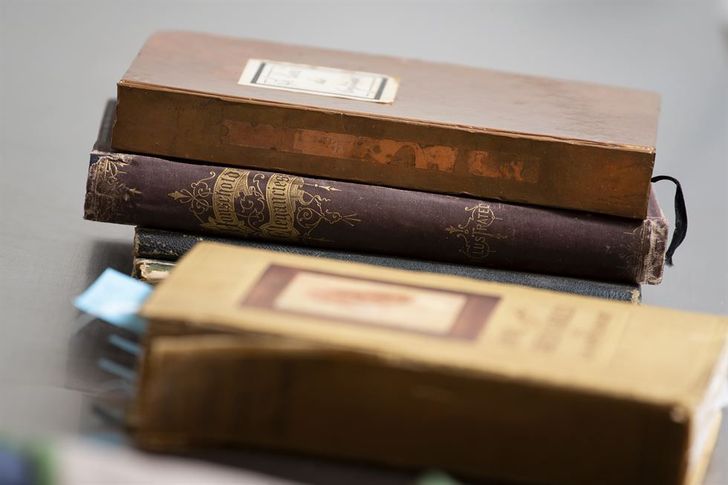
Books waiting for restoration / Korea Times photo by Choi Won-suk
Some might expect her finding her job such restoring and preserving books rewarding, but Jaeyoung is more interested in the shape of damaged books.
"People usually buy books they like and thus cherish the book, so we have little opportunity to find wrecked books. But a wide variety of damaged books pour into the library lab and I was fascinated by visual elements of the books," Jaeyoung said.
She takes interest in the visual aesthetic of books, but her attention hovers over physical and structural traits of books such as thickness, bookbinding techniques and even spinal curvature, rather than cover design or contents.
However, with so many books to take care of, Jaeyoung felt like it was becoming too routine and started to look for opportunities to concentrate more on each book.
"Also I am an artist who creates book art and wanted to combine book art with conservation. The answer was to open my personal studio."
Considering the increasing awareness of art books in Korea, Jaeyoung decided to return to her home country for her personal project.
How to repair books

The spine of a book removed for repair / Korea Times photo by Choi Won-suk
At first, she was worried about whether there is enough demand in private book restoration services in Korea or not, but a diversity of requests came in ― from the first edition of "Anne of Green Gables" published in Korean to a vintage cookbook bought during travels, to a thesis book.
Since opening in February, JY Book Conservation received and confirmed 17 orders as of mid-May. The first order for Jaeyoung was to restore a 70-year-old handwritten diary.
Yoon Yeo-jun commissioned her to fix up an old diary written in 1948 by her grandmother Jung Suk-jin during university.
"The content of the journal is trivial, but precious. She wrote about her day and book reports and sometimes transcribed literature. Writings about women's liberation in her neat handwriting made me realize how valuable this is," Yoon said. "However, I could not open and read this diary frequently because it was too old. The cover was long gone and paper sheets fell into pieces. I tried to repair it and asked around antique bookshops, but was told it is difficult to restore a handwritten diary."
Yoon knew JY Book Conservation even before Jaeyoung opened her studio, watching Jaeyoung's book conservation process through social media, and thought she was the right one to give new life to the old diary.
When a repair request comes in, the first step is to set up a meeting with the client.
"I cannot give a quote or decide how to mend the book until I see actually see it," Jaeyoung said. "I have to carefully check the book literally from cover to cover to find out what treatment the book needs and what is the intention of the client ― some want the book to be sturdy, while others prefer beautification."
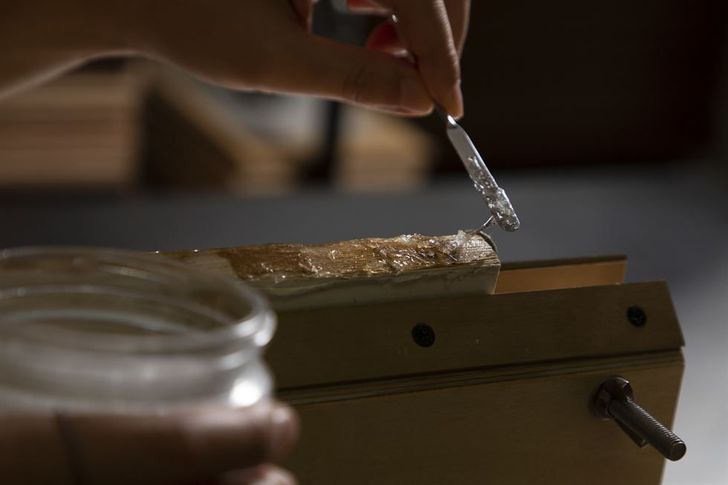
Book conservator Jaeyoung cleans the back of a book after removing the spine. / Korea Times photo by Choi Won-suk
The restoration and conservation process varies widely based on the book's structure and status, but the book conservator's ground rule is to maintain the atmosphere of the original book.
"Minor repair could start from mending ripped sheet of paper or replacing the spine and some books require more complicated repairs such as redoing bookbinding or making a new cover. Each book's condition is unique and each requires different treatment," Jaeyoung said.
Working on personal orders made the book conservator concentrate on the stories behind each book.
"My clients ask for restoration of a book because it is precious to them. Some of the books they commissioned are still available at bookstores and they can purchase a new book at a much lower price than repairing it. But instead they come for the book restoration service. I think their memories with the book are priceless."
Another client Shin Hyeon-gyu requested conservation of two volumes of a big Standard Korean Language Dictionary.
"It was my toy when I was young. It might sound awkward to call a dictionary a toy, but I liked turning over the pages of the book, looking at illustrations. Then I used it to look up words as I studied Korean language in university," Shin said. "The dictionary has been with me for a long time and I wanted to repair this book which went through all sorts of hardships with me."
The two-volume dictionary completed the conservation process and went back to its owner, who was filled with emotion upon his reunion with the book. The Korean language major will use the restored book to study as he did before.
"I mended the book for practical purposes and the book will get worn and might be damaged once again. However, I will make new memories with this restored dictionary," Shin said.
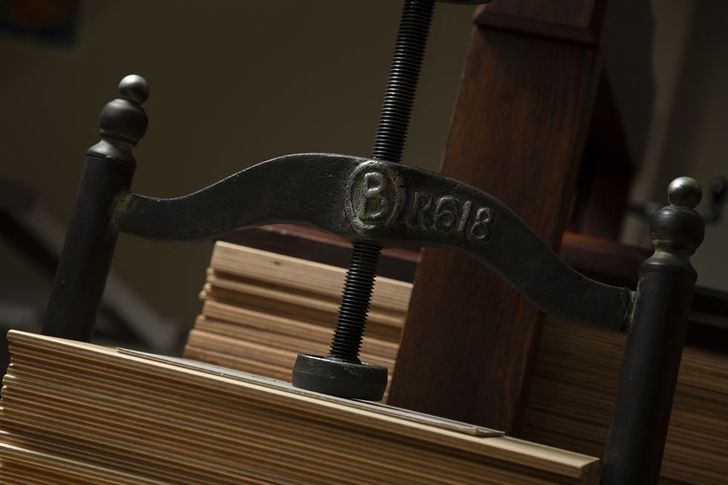
A bookpress / Korea Times photo by Choi Won-suk