'White Book' unravels emotional pallet
By Yu Young Jin
In “The White Book,” award-winning author Han Kang utilizes unconventional storytelling methods ― she relays the narration in small passages, rendering it almost poetic.
Han, who won the Man Booker International Prize in 2016 for her book “The Vegetarian,” successfully balances a simplistic format with repeated allegory, and this gives her readers an unprecedented reading experience. Her eloquent voice and clear imagery gives the novel a monochromatic emotional pallet: the readers are neither left in agony nor with joy.
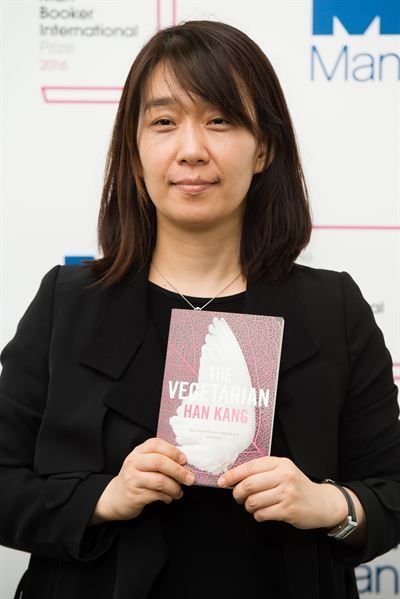
Author Han Kang with her book “The Vegetarian” / Korea Times file
They are only left with an emotion that is difficult to put in words but perhaps explicable by the emptiness we feel in a winter that is cold, nostalgic of the past, and white.
“Now and then, the passage of time seems acutely apparent. Physical pain always sharpens awareness,” the author writes. “The migraines that began when I was 12 or 13 swoop down without warning, bringing with them agonizing stomach cramps that stop daily life in its tracks.”
In part two, Han associates white objects and the different emotions they evoke. Each item representing another facet of her mourning, Han illustrates a multitude of these objects. She describes how a baby's name was inspired by the cold winter frost and how the snowfall has the power to draw the eyes of everyone even in its silence. In another powerful use of imagery, Han describes the feeling of minuteness we feel when looking out into the white froth of the ocean and realize that our lives are but brief moments in time.
Han depicts the different emotions associated with the color white, in mourning and memory of her older sister, who died just two hours after birth.
The novel is split into three parts: “Me,” “Her” and “Every White Thing.”
Readers are taken back to the day her older sister is born and, unfortunately, dies. In the heartrending scene, the poor mother holds the baby close and begs, “Don't die. Please don't die.”
The baby, however, defies her mother's outcry and passes away a mere two hours later.
The mother recalls her baby as cute with clear-cut features, particularly her eyes and nose, and how she looked at her mother for a moment before she died which she says is a painful memory.
The mother couldn't release the baby even after she died. She held her dead baby tightly to her chest and felt cold as the baby's body temperature went down as time passed. No tears rolled down on her face.
In the third and final part of the book, the author recognizes that if was not for her sister's death, her and her brother may never have been born. She addresses her older sister and projects a hypothetical relationship between the two had her sister survived. In the final passage of the book, Han bids her sister farewell by saying, “Within that white, all of those white things, I will breathe in the final breath that you released.”
“The White Book” put Han Kang and her translator Deborah Smith on the final list for the Man Booker International Prize again. Writers and translators of five other works were also shortlisted for the award. The winner will be announced May 22.
Yu Young-jin is an intern at The Korea Times.