Canadian author releases poetry book to celebrate self-love
By Celeste Kriel
“This isn't poetry because it's not Shakespeare or Dickens or Goethe or White,” author Magda Ayuk writes in her newly released poetry and prose piece, “Blue Bird.”
Ayuk's writing in “Blue Bird” is at once an unapologetic weapon against anti-blackness, an ode to women of color and a soothing balm of self-love for all who need it.
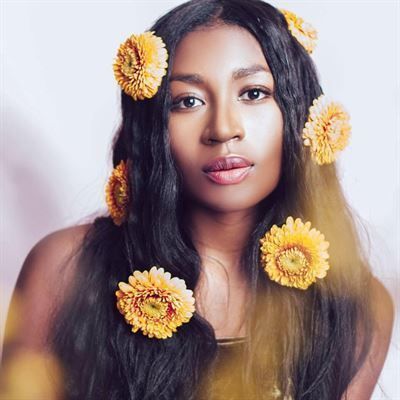
Magda Ayuk / Korea Times
Ayuk says the first draft of her book was not as bold ― or in her own words as “black” ― as the final published version. But her poetry took a slightly more radical turn after a woman posted a grating review of the first version, saying what Ayuk writes isn't poetry and poetry greats would be turning in their graves reading her work.
“People see those people like Goethe as the standard... and if it's not like them then it's not poetry. I have a tradition, my culture has a tradition of poetry but it's not valid to other people if it doesn't fit those standards.”
The Canadian author ― of Cameroonian descent ― is currently based in Korea and credits the country as a catalyst for the beginnings of her healing journey and the home of the fledgling phases of her life as an adult poet.
“Korea for me ... I really have a soft spot for Korea because it changed my life,” she said. “This is where I started writing poetry again.”
Her days of writing started long before she moved here. As a first-generation Canadian in Montreal, Ayuk spoke English but the medium of instruction at school was French and that is when her love for languages and the written word began.
The first poem she wrote at age eight was about a blue bird, and it was chosen to be published in a book along with the works of other young and talented wordsmiths, but choosing “Blue Bird” as the title of her book was serendipitous.
“I knew I wanted bird in the name, because it represents freedom. I added "blue" because blue brings to mind serenity and makes you think of the sea too, which is an image I love playing with. My first poem was about a blue bird, but I remembered that later, so it was like a confirmation that I had picked the right title.”
With her linguistic flair, she pursued a translation degree, but as is the norm for a multi-passionate millennial, she took a different route after graduating. Ayuk went straight back into a journalism career she had started at 18, and by age 25 she was married and had a thriving translation business.
Getting married at such a young age took its toll and the struggles extended to her business as well.
Despite her efforts she was left with debt as her business was failing and her marriage was collapsing, so she packed her bags to come to Korea “for a year” for space and time for healing in 2014.
Upon coming to Korea, she hibernated, with no family or friends around, and healing from the failed relationship and mourning the loss of a business.
“I was depressed. I said to myself let me just start writing. People would invite me out, I'd just say sorry I can't make it but I wouldn't tell them why. I started writing ― it really helped me to write ― it was an integral part of my healing.”
Sad, angry and lonely in a place that wasn't home, Ayuk, an alchemist of sorts, turned those feelings into art through writing again as a means of expression. She shared her poetry with a few friends, and they encouraged her to start sharing it with others too, and so she started posting it to Instagram.
“I was dealing with a lot of anger at the time. I was just writing ― I didn't think this was going to be a career. I would write and then I'd send it to my friend and she would say 'you should share it' and then I started sharing on my Instagram and then that's when my content started changing, and my feed became a bit more intentional. People started receiving it really well and there were a lot of positive responses and that's when I decided, let me write a book!”
After finding her feet in Korea, and then heading to Macau for a year, she was able to recover financially and started writing for the Huffington Post with an article titled, “How I Saved 20k In A Year Without A Budget.” She continued writing.
Back on track financially and emotionally, Ayuk found that her writing started to change. Instead of using poetic devices just to express her own feelings of anger or sorrow she felt compelled to use her words as a means of healing and inspiration for others who might be feeling similarly. Her poetry became love letters to herself and others.
“I was looking back on how I wrote before and I noticed there was a lot of anger before, and afterwards for some reason I really tried to help people. It started to grow into advice for me and advice for others. I find the writing process quite holy. I know it sounds cheesy but before I write I ask, 'What is it that people need to hear?' and I write that.”
People, especially women of color, have been resonating with her contemporary style of poetry and her curated Instagram feed where she features beautiful positive images of women of color, and bits of her poetry as captions.
“A dark-skinned Indian woman messaged me the other day to say that coming to my page and seeing these positive images of darker-skinned women made her feel good. I think we need to see more of these images in the media. It's so important.”
After Macau, and a short stint moving between Canada and the U.S, she returned to Korea last year and began working on “Blue Bird.”
“My mission is to focus on helping people of color love themselves boldly and remind ourselves that what other people think doesn't matter. I have experienced people calling me monkey and ugly and stuff like that but it made me have more confidence because it made me build myself up from within.
This world teaches you to hate yourself in so many ways, so that's what I want to inspire…self love. Obviously, our love for self wont rid the world of systematic oppression. But empowered by a love for self and our communities, and equipped with anger, we can go ahead and take concrete steps to fight for change.
“As people of color we sometimes have this pressure of packaging ourselves to be more palatable for people or the masses and at this point in my life I'm not going to change who I am. People stereotype me if you think I'm stereotypical that's fine ― I like watermelon I like hip-hop, that's fine.
“I used to like fried chicken before I became vegan,” she jokes.
Blue Bird explores the intersections of race, gender and self-love and imagines a new reality for each. It is an antidote to what society says you should be.
Find more of Ayuk's poetry on her Instagram account @MagdaAyuk. Blue Bird is available on Amazon.com.