Joseon prodigy indulging in intellectual stimulation
'Chusa Kim Jeong-hui' unravels why multi-talented scholar was not well-known
By Kang Hyun-kyung
Kim Jeong-hui (1786-1856) was one of the more prominent figures of the 1392-1910 Joseon Kingdom, but very few know who he really was.
He is widely known as a Late Joseon calligrapher who invented the iconic Chusa font and has since earned the nickname Chusa.
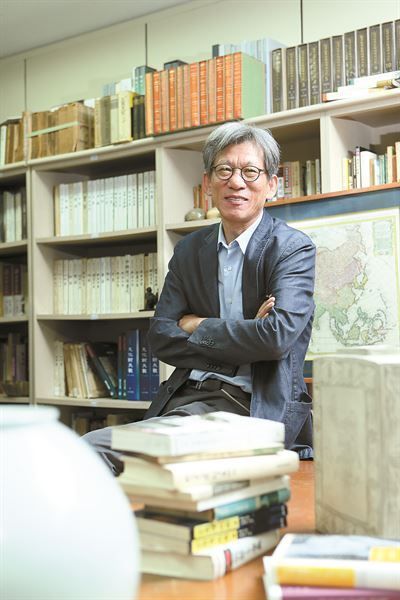
Yoo Hong-joon, art historian and author of “Chusa Kim Jeong-hui: The Mountains Are High, The Seas Are Deep” / Courtesy of Changbi Publishers
In his new book, “Chusa Kim Jeong-hui: The Mountains Are High, The Seas Are Deep,” art historian Yoo Hong-joon says calligraphy was just one of the skills with which Kim was gifted. He was a multi-talented man who indulged in intellectual stimulation throughout his life by exchanging ideas with noted Chinese scholars, according to the author.
Kim was a rare Joseon-era man who led a life of glory and international fame for his splendid academic accomplishments. His knowledgeable interpretation of practical learning, “Silhak,” also known as “Northern Learning,” inspired Chinese scholars, according to Yoo.
Regarding the book's subtitle, “The Mountains Are High, The Seas Are Deep,” Yoo says the phrase had never left his mind while he wrote the book.
He gave no further details, but it seems to indicate the author was intrigued by the width and depth of the Joseon era scholar's academic learning.
The author says Kim was an artist, a historian and an internationally renowned scholar of his time.
According to Yoo, Kim was also a towering figure in epigraphy, the study of ancient symbols, and discovered and interpreted the monument to mark Silla King Jinheung's inspection of Mount Bukhan in Seoul. During his prolific life, King Jinheung (526-576) established monuments after achieving territorial expansion.
The multi-talented scholar, ironically, was outshone by his remarkable calligraphy skill and thus his other talents were relatively unknown to the public, Yoo says.
Yoo's new book is the result of three decades of unraveling why the great man of the Joseon era was understated among historians and only part of his accomplishments are known to the public.
Yoo, a former cultural heritage administrator (2004-2008) and author of 12 books about Korean art history and cultural heritage, says what Kim achieved during his time is akin to feats achieved by today's globally renowned artists, such as video artist Paik Nam-june.
“It's no exaggeration that Kim was better or maybe even greater than Paik when it comes to his achievements,” the author says. “Kim rose to global fame and stayed there for a long time.”
Kim introduced evidential scholarship in the study of history, influencing his fellow scholars to turn their attention to Northern Learning from neo-Confucianism that had dominated society for a long time. Neo-Confucianism was blamed for causing Joseon scholars and politicians to engage in time-consuming, unproductive, theoretical debates at a time when the nation was in peril in the face of the fast-changing geopolitical circumstances of the 1800s.
Kim's life took a drastic turn after he accompanied his father on a trip to China in 1809. Kim was 24 and his father 44. His two-month stay in China was intellectually stimulating. He met and exchanged his ideas with top-notch Chinese scholars and the Chinese soon discovered Kim was a prodigy.

“Chusa Kim Jeong-hui: The Mountains Are High, The Seas Are Deep”
Yoo counters criticism that Kim was a pro-Chinese scholar who simply tried to emulate Chinese academic inclination.
Quoting the Japanese scholar Fujitsuka Chikashi (1879-1948), Yoo says Kim was a genius who inspired fellow Joseon scholars to overcome neo-Confucianism. “He was one of the very few prodigies in the 500 years of Joseon history,” the Japanese scholar said.
Kim's bonds with two noted Chinese scholars _ Wen Fanggang (1733-1849) and Ruan Yuan (1764-1849), among many others _ were critical in shaping his understanding of the world. After returning home, Kim corresponded with them and other influential Chinese scholars to exchange their views and deepen their friendships.
“Unlike some of today's academics who studied abroad and kept mimicking what they learned there based on their sheer understanding of their areas of specialization, Kim was inspired by the ethos and techniques of evidential scholarship he learned in China and applied it to Korean reality. He also shared what he learned with his Chinese friends and through their academic exchanges, he contributed not only to Joseon but also to the Chinese academic society,” Yoo says.
Yoo says Kim was a perfectionist and this caused him to face unintended consequences. He was accused of being arrogant and overly confident. “Such criticism is not baseless, given how he reacted when he was young. He was a perfectionist and this partly caused him to face such allegations,” the art historian says.
Kim matured as he went through trying times later in his life. He lived in exile on Jeju Island for he was implicated in the political infighting surrounding the succession of power. According to Yoo, Kim became tolerant while going through the turbulent times and his decade of life in exile.
The scholar, however, revealed his limitations in his world view. Like fellow scholars, he was unaware of what was going on outside the country and believed Qing China was the center of civilization.
In 1845, when the British ship Samarang appeared off Jeju Island, Kim downplayed the West's possible future influence on Korea. He had never imagined Qing would collapse in the face of Western imperialists because, for him, Qing China was such a perfect, ideal state and had military power sufficient enough to defend themselves from foreign attacks. But he was wrong, says Yoo.