Retired diplomat discloses untold stories behind diplomacy
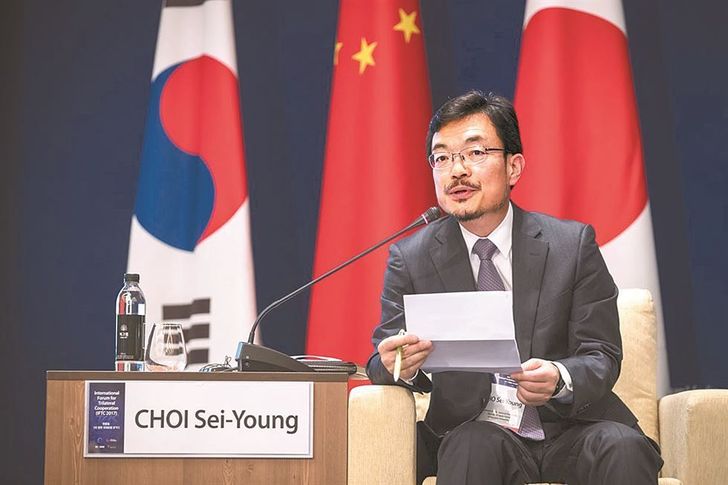
Cho Sei-young, a retired diplomat who now serves as director of Dongseo University's Japan Center in Busan, speaks during the 2017 International Forum for Trilateral Cooperation held at the Four Seasons Hotel in Seoul on April 18, 2017. / Courtesy of Cho Sei-young
'Government turned deaf ear to sex slavery victims' outcry'
By Kwak Yeon-soo
Inside the Ministry of Foreign Affairs, there are two major “factions” ― the Washington and Japan schools ― depending on the career paths and foreign postings diplomats have taken since they joined the ministry.
Those who are fit for the Washington School meet two conditions ― they have had work experience in the North American Affairs Bureau handling the U.S. affairs and served at the Korea Embassy in Washington D.C.
The Japan School refers to a group of mid-career or senior diplomats who worked in Northeast Asia Division 1 dealing with Japanese affairs and have spent years in the Korean Embassy in Tokyo.
The two factions are the mainstream of the foreign ministry, but the Washington School has long been the real power.
Since 1990, Korea has had 16 foreign ministers and 11 of them were career diplomats. Seven out of the 11 foreign ministers were from the Washington School, whereas only one of them was from the Japan School.
“The domination of the Washington School in the top job of the ministry was something regrettable,” retired diplomat Cho Sei-young recalled in his newly-released book, “Diplomacy, Untold Stories Behind the Scene.”
Cho defined himself as part of the Japan School before his retirement in 2013 after serving years as deputy director-general of the Northeast Asia Division 1 at the foreign ministry. “I was posted in Japan three times and my last position was at the bureau,” he told The Korea Times.
Between 1997-1999, he served as a presidential interpreter for two former Presidents, Kim Young-sam and Kim Dae-jung.
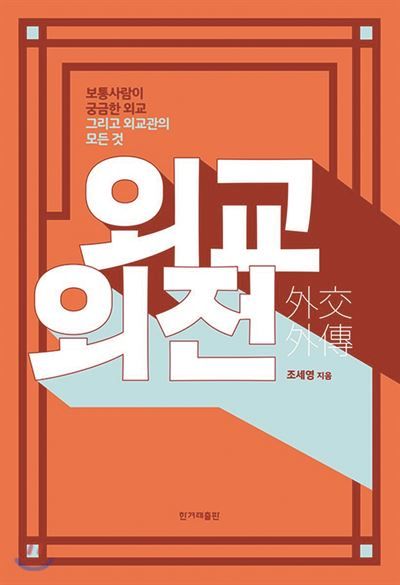
The cover of “Diplomacy: Untold Stories Behind the Scene”
Cho, now director general of Dongseo University's Japan Center in the southern port city of Busan, said he published the book for young readers who are seeking career paths in diplomacy and for the public who are keen to know what's going on behind the scenes in the foreign ministry.
“I know there are several books written by diplomats,” he said. “Many of them heavily focused on diplomatic issues and are technical. I felt the need to work on a book that the general public could read easily.”
In the book, Cho tells the story of his life as a diplomat and a negotiator for 30 years.
He draws on various episodes related to his family life, behind-the-scenes of major negotiations, and taking the role as an interpreter for former presidents.
In the first chapter, Cho begins with his efforts trying to evacuate his embassy staff, family, and residents in 1994 during the Yemeni Civil War.
Since Korea had not sent a military aircraft, Cho's mission was to make sure of the safety of the residents by beseeching embassy aides from the United States, France, and Italy to provide a few seats on planes. He recalled it was “a daunting mission.”
Cho also characterizes diplomats as hard-workers and says they try to step into new perspectives, playing bridge roles between different cultures.
He said strong analytical skills are one of the most important qualities for diplomats as they are required to brief their host government about what's going on with domestic politics back home.
In his career, Cho said he put forth a lot of effort to cushion South Korea's diplomatic ties with Japan, mentioning his experiences in negotiating with the neighboring country.
Most notably, Cho's expertise proved invaluable when he took part in the committee to review the 2015 agreement with Japan to end the dispute regarding the “comfort women” issue.
It was last year when he joined the task force as a scholar, not as a diplomat.
Former President Park Geun-hye hastily signed an agreement with Japanese Prime Minister Shinzo Abe in late 2015, calling it a “final and irreversible” settlement of the wartime issue about the “comfort women”.
As many as 200,000 women, about 80 percent of whom were Koreans, were forced to work as sex slaves at Japanese military bases during World War II.
Under the 2015 agreement, Japan apologized and promised to pay $8.8 million for the survivors. Korea vowed to not criticize Japan about the issue.
But the agreement has met mounting criticism in Korea, where many people would not believe Japan has fully made an apology and properly compensated the women for its acts against them.
After President Moon Jae-in took power in 2017, he commissioned a task force to review the 2015 agreement.
As a member of the task force, Cho admits that the government had failed to represent the victims' demands.
Putting himself into others' shoes, Cho said he realized how important public opinion is in the implementation of foreign policy. While serving as a career diplomat, he said he strove hard to make Korea's national interest realized in negotiations. But as a civilian, he said he realized the way the public feels toward the same issue is very different. He hinted the agreement about the comfort women came at the expense of the personal pains of the survivors.
Cho had a long diplomatic career, serving in Japan, China, Yemen, and the United States.
Many of the anecdotes are summed up in his articles published serially in the Hankyoreh newspaper, under the name “Diplomacy Club.”