George Mason University celebrates Choonwon's first publication
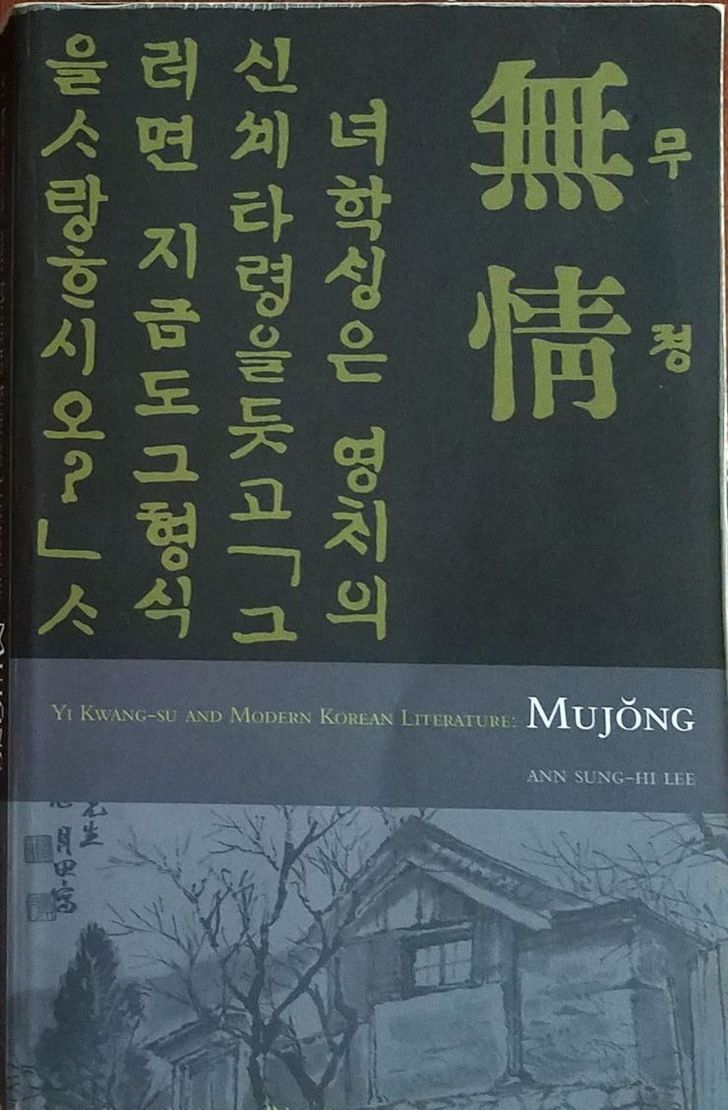
"Mujong" by Choonwon Yi Kwang-su
By Kang Chang-wuk, Choi Yearn-hong
George Mason University is hosting a centennial symposium to commemorate Korean writer Choonwon’s first publication, “Mujong,” featuring three distinguished scholars from Korea and Japan on Oct. 28, 2017, in the Washington area.
In the beginning of 1917, the daily newspaper Maeilshinbo started to publish the first Korean serial novel, titled “Mujong,” by literary giant Choonwon Yi Kwang-su.
“Mujong” was unprecedented in terms of its literary style, language, serialization and other aspects. At the time, it had been seven years after Japan annexed Korea, and thus, Korean culture was in a precarious state. Nonetheless, the serial novel became an instant success, not only among the learned but also the less educated Koreans. It was written entirely in the Korean script, Hangul, and was read by well educated, which was unheard of. This literary phenomenon destroyed class boundaries. In this sense, the serial novel more than told a story — it changed Korean society. This serial novel is a significant historical phenomenon and helped Maeilshinbo sell more papers.
The novel was written in unity of speech and writing, that was very first in Korean writing. Historically, the only available script was the Chinese script. King Sejong the Great (1397-1450) of the Joseon Dynasty invented the new Korean alphabet, which was then a completely new phonetic script that was universally used and not limited to the learned, like the Chinese script.
The new script was easy to learn, as it was close to ordinary spoken Korean, and for this reason , the aristocrats berated it. It was used only by a small population, mostly by women. The Korean social classes were very apparent in early 20th century and were similar to the Indian caste system. The servant class was banned from learning the letters. King Kojong, in 1985, pronounced an edict that public documents will be written in the new Korean script.
However, most written works were still a mixture of the Chinese and new Korean alphabets, similar to the Japanese style. “Mujong” was written entirely in Hangul and used spoken words like “handa” rather than the old written expression “hanora.” “Mujong” was epochal, like Chauser’s “Canterbury Tales” and Dante’s “Divine Comedy.”
Hatano Setsuko, a professor emeritus at Nigata University, is going to present her paper on “Mujong” in Hangul at this symposium. The first edition of “Mujong” was published in 1918, and since then, several dozen edition have been published and translated in English and Japanese. This novel has been studied by many scholars for a long time in Korea and abroad. Thus, in 2017, there has been several commemorative seminars on “Mujong” in South Korea, North Korea,China and Japan, and so far, 14 papers have been presented in various symposiums this year, according to the Yi Kwang-su Research Center.
Song Hyun-ho, a professor at Ajou University and president of the Choonwon Society is going to present his paper on their discovery of Mujong at the centennial year. His overview of “Mujong” in the past 100 years will be valuable to Choonwon studies.
“Mujong” is akin to Yi Kwang-su’s autobiography, in terms of the situations of the novel’s heroes and heroine. The protagonist Lee Hyung-shik is an orphan, not only because he lost this parents but also because he lost this country to Japan. Of course, a writer’s creative work reflects his or her life, “Mujong” is more than Choonwon’s own life experiences and aspirations.
Song points out that Choonwon’s view of Dosan Ahn Chang-ho’s life reflected in this novel. Ahn was one of the first Korean immigrants to the United States who tried to educate and enlighten the Korean people with his independence movement against Japanese rule. Song emphasized that “Mujong” was based on the ideals of American democracy, and this fact should be rediscovered in the centennial celebration of the first modern novel in Korean history. Song’s point of view was a new shock to the Korean people in the United States.
In 2015, in the library of Tokyo University of Foreign Studies, Hatano found Choonwon’s handwritten unpublished poems in a couple of monographs. She and Sogang University faculty members edited a book out of these two monographs this year. Choonwon should also be rediscovered as a pioneering poet in the Korean literary history.
He had written more than 200 poems, mostly in the modern style, but some were “sijo” and some children’s songs.
Yang Wang-yong, a poet and a professor emeritus at Busan University, divided Yi’s life as a poet into four periods. In his paper, he discusses Yi’s and Choi Nam-sun’s poems as the first new-style poems in the 1910s.
All of Choonwon’s poems were nationalistic and patriotic. Yang will point out at the symposium the many times Choonwon encountered enormous difficulties under Japanese colonial rule.
His poems were truly reflections of his painful life in the 1930s and 1940s, as well as some of his hope and despair before and after the Liberation of Korea in 1945. There will be readings of Choonwon’s poems at the symposium.
The symposium is highly anticipated.
Dr. Kang is an essayist and psychiatrist in Baltimore, and Dr. Choi is a poet and writer in Virginia.