VIDEO Clear your throats, action!
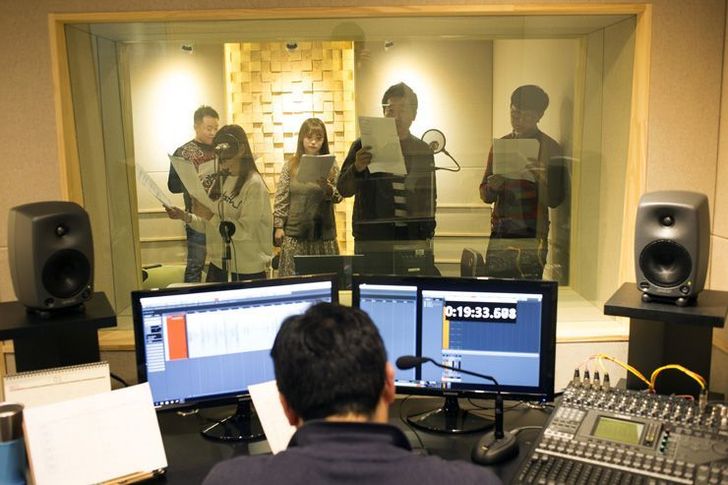
Recording booth at Audien in Sangam-dong, western Seoul, with voice actors working on audiobook series "Cat and Dog" / Korea Times photo by Shim Hyun-chul
Audiobooks make a noise in Korean publishing
By Ko Dong-hwan
In the afternoon of Jan. 31, a recording booth at Audien, in the business-savvy town of Sangam-dong in western Seoul, was bustling with actors preparing for an audiobook recording session.
Three male and two female actors skimmed through scripts just given to them, which were for episodes nine to 16 of “Cat and Dog,” a romantic-comedy audiobook series based on an online webtoon hit that ran on Korean portal site Nate in 2013-14. Audien, Korea’s biggest audiobook maker and online service provider, posts the series on its website, providing two new episodes a week, available only to subscribers.
Program director Jeong Sung-yong, seated in front of an audio control panel and computer monitors, cued actors in the recording booth, who brought the script to life with their animated voices. The surreal sounds — with extraordinary guttural pitches and controlled enunciation — came through loud and clear from two large speakers in front of Jeong. The director, who has been producing audiobooks since 2006, stopped the session occasionally for some lines that required a retake.
“For a literary genre, you really want to catch the emotional characteristics of each character and portray their psychological moods as diversely as possible,” said Han Shin, one of the male actors. Han debuted on Tooniverse, a Korean cable TV network specializing in animation and other shows for children, and became a freelance actor. He is one of over 700 members of the Voice Performance Association in Korea.
“When working on self-help, history and other liberal arts genres, you are dealing with facts in an objective manner, so you want to be well prepared beforehand,” Han said. “For orally narrated fairy-tales, you focus on how to effectively deliver stories so children can listen easily and with interest. You do not want to confuse them with slurred pronunciation.”
Han has been active in game and animation genres, dubbing Korean for video games “Diablo,” “Overwatch,” “Hearth Stone,” “Halo” and “Tomb Raider.” But he admitted he is still a novice in audiobooks, an industry he has just joined.
“When I was dining with my friend at a restaurant, his five-year-old son asked me over the phone to do the voice of Robonyan from the cartoon Yokai Watch, which I had worked on,” Han said. “When I did, everyone in the eatery looked at me. It was a bit embarrassing.”
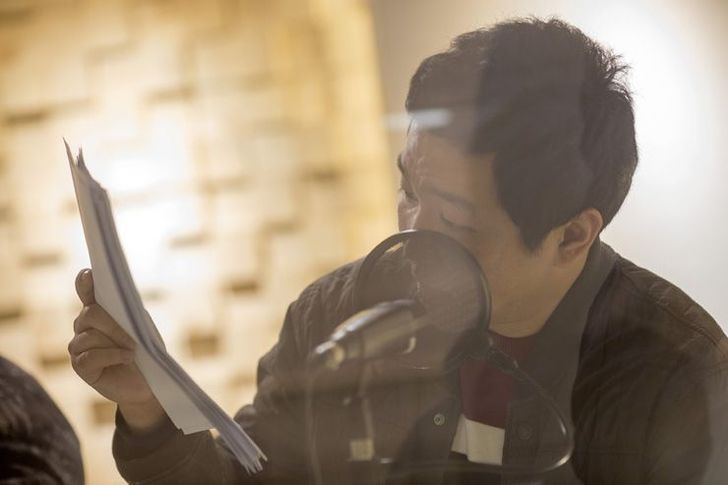
Voice actor Han Shin
Korea’s small audiobook market is on the rise. Although the books are not yet available at the nation’s major chains like Kyobo, Youngpoong and Bandi&Luni’s, Audien, which produces and sells audiobooks of various genres, has seen an annual double-digit sales increase since it was established in 2006.
Audien’s sales were boosted by its secondary sales window Yes24, a major social commerce site for books, stage tickets and music. It began selling over 90 percent of Audien’s audiobooks from 2012 and inked a deal last year to start selling Audien’s content for smartphones, the go-to platform for most products these days.
“Although audiobooks were introduced in Korea nearly a decade ago, the popularity has not grown into a boom because access to the service has been largely restricted to PCs and has not yet been able to meet mobile users’ demands,” said Han Man-jae, the company’s planning team manager.
“Regardless of industry and distributive platform, more and more consumers purchase and use products via smartphones. With the new mobile service to be launched on Yes24, Audien will see over a double sales increase in B2C (business-to-consumer) markets.”
The Korean audiobook market as of last year was worth about 10 billion won ($8.78 million), with around 2,000 titles expected to be released this year. Compared with the American market, where some 35,000 titles were released and made $1.77 billion in sales in 2015 alone, the Korean market is still taking baby steps.

Voice actor Kim Ha-ru
Some authors with a keen interest in audiobooks work with publishers first to release summarized versions of their work compared with the original in e-book and audiobook formats. If there are positive reviews, the authors can then decide to have them printed, such is the relatively new “print-on-demand” approach to publishing. Some publishers, like Changbi and Communication Books, have established departments dedicated to audiobooks and e-books.
But most Korean publishers have not joined the digital-first movement, prioritizing printed books over other formats and releasing audiobooks three to six months later because of the production time with scriptwriting, recording and editing.
Audiobooks are mostly based on existing books. And those with fewer pictures are preferred because narratives depending on lots of images (for example, travel guidebooks) make it difficult for voice actors to create the same sentiment. Books with time-sensitive content are also avoided when making audiobooks.
“Many Koreans listen to self-help audiobooks on their way to work and home,” Han said. “Those providing knowledge about the economy, management and history and literature works are also popular.”
Another reason publishers have ignored audiobooks is the high production cost. The most expensive part of the process is the actors, who get paid more for dramatized acting than simple narration.
“Some get paid hundreds of thousands of won an hour, while star actors get millions of won an hour,” Han said, adding that the costs also include the recording and editing engineers and license fees for sound effects and background music. “It’s not a simple conversion from books.”
The audiobook market has boomed in America, where many people enjoy them while driving. There is market potential here, too, where many Koreans commute at least 40 minutes a day, on average.