Iconic Jongno Books returns amid authenticity issue

Jongno Books is located in the basement of Jongno Tower connected to Jonggak Station. / Courtesy of Jongno Books
By Kwon Mee-yoo
Jongno Books has returned.
Located in the basement of Jongno Tower connected to Jonggak station on subway line 1, the bookstore made people nostalgic about the iconic six-floor Chongno Book Center which was originally situated in the heart of Jongno and served as a cultural gathering place in Seoul decades ago.
The brand-new bookstore adopted a “retailtainment” style to embrace the younger generation. About half of the area is taken by coffee shops and bakeries and the bookshelves take up a rather smaller portion of the store.
Jongno Books has about 100,000 books, which is about one fourth of the 430,000 books of nearby Youngpoong Bookstore. It displays best-selling books in more prominent positions while less popular genres such as humanities and classics take up small bookcases.
The highlight of the bookstore would be its long reading table and five individual reading nooks, where people can comfortably read books before check out.
"I like the reading space, but there are only five of them and I had to wait a while until it became vacant," Kim Ji-won, a 31-year-old office worker, said. "There are cafes in the bookstore, so I can spend hours here, browsing books and having drinks."
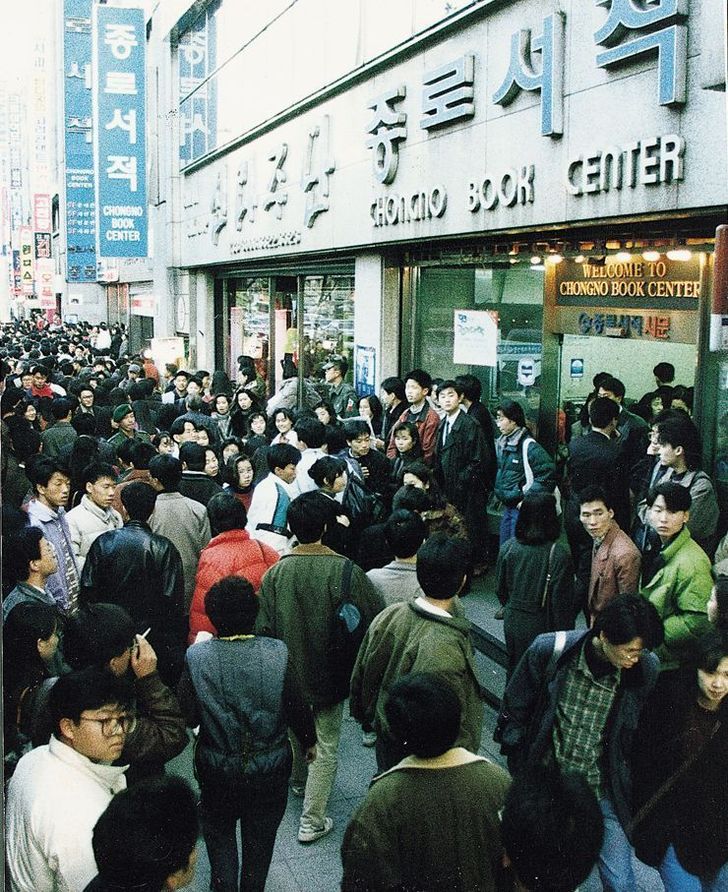
Chongno Book Center was a popular meet-up in the 1990s in downtown Seoul. / Korea Times file
Controversy of legitimacy
Though their English name is different, the two bookstores’ Korean names are the same, "Jongno Seojeok," and it sparked controversy over the new bookstore's legitimacy.
Jang Deok-yeon, president of the original Chongno Book Center, released a statement in January, soon after the opening of Jongno Books. He claimed that the new bookstore stole the name and history of the Chongno Book Center, the oldest bookstore with a 95-year history.
The Chongno Book Center was founded in 1907 by the Korean Religious Tract Society during the late Joseon Kingdom (1392-1910). It was one of the major bookstores in Korea and had become a popular meeting point in downtown Seoul in the 1980s and '90s. However, the rise of modern bookstore chains such as Kyobo Book Center and Youngpoong Bookstore and change of the book sales market amid the growth of the internet made the old-fashioned Chongno Book Center fall behind competition. The bookshop went out of business in 2002.
"The authentic Chongno Book Center has a long history with the pride of serving the country's publishing and reading culture," Jang said. "Jongno Books is deceiving the public as if it inherited the Chongno Book Center, appropriating the name, the logo and even the phone number. In fact, it has nothing to do with the historical store that people remember."
Seo Bun-do, the CEO of Jongno Books, is a former executive from the Youngpoong Bookstore. He said the new Jongno Books is restored to create the cultural sympathy bonded by books. "I didn't say we have a history of 95 years and tried to clarify that we are different from the original one," Seo said.