'Inca Woman' wins Yoon Dong-ju award
Reviewed by Jung Sun-hee
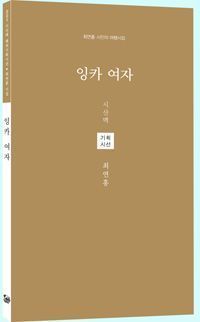
Cover of "Inca Woman"
Choi Yearn-Hong’s latest poetry book, “Inca Woman,” became the first recipient of the Yoon Dong-ju Poetry Award last month at Dongkuk University .
"Inca Woman is a collection of poems about Choi’s travels to Peru, Brazil, Alaska, England, Scotland, Ireland, Scandinavia, Spain, Morocco and China, as well as to Jeju, Ullungdo and Hansando Islands .
In the short prelude to this poetry book, Choi confessed that he has pursued travel after retiring from a long teaching career, and his travel experiences have been the inspiration for many of his poems. Visiting foreign countries and cities, meeting and seeing different people while listening to different languages made him live . While the language barrier prevented him from full comprehension, he experienced each native language akin to listening to a poetry reading.
Here is his poem “Inca Woman” in his own English translation.
“Inca Woman”
Two long braids
Hung on her back, and
A little baby was pouched like a kangaroo
Or embroidered sweaters were pouched
On her back
Virtuous eyes,
sun-tanned dark skin:
My cousin
She was walking all day on the streets of Cusco
in order to sell one or two sweaters made of Alpaca wool.
She was slowly walking all day
like a llama who used to carry the burden
over the Andes mountain years ago.
Choi believes in simplicity. However, I believe there is much more depth to his poems, if one used one’s imagination . I have read each one of his poetry books — “Chongupsa” (“Poetry of Chongup Woman”), “Hankook Haeng” (“Going to Korea”), “Young” (“Love Songs”), “Arumdaun Sumsori” (“Sound of Beautiful Breathing”) and “Hayan Mokwha Ggori Sasum” (“White Cotton-tailed Deer”) — and some of his poetry books in English published in India and the United States. He has been consistent in presenting aesthetic values in his poetry and his love of his home country. His mother, someone who sacrificed her life for his and whom he still misses dearly, has been the key theme in his poetry. Even in “Inca Woman,” I see a Peruvian mother who is sacrificing her life for her children, eking by trying to sell even just one Alpaca wool sweater all day.
Choi is a warm person. His eyes see life with tenderness. I discovered one short poem of his about a fellow Korean poet, Jeong Ho-seung, who visited him in the Washington area last year for a special lecture and poetry reading about the globalization of Korean literature at the Korean Cultural Center.
“Mr. Jeong Ho-seung- Seeing Him Off at the Dulles Airport”
Mr. Jeong Ho-seung may not need the title of a poet.
Mr. Jeong Ho-seung is a good human being without any title.
My friends in town wanted to shake hands with him.
My friends in town wanted to take a photo with him.
My friends in town wanted to take a long trip with him.
He was kind to them and to the woman who whispered to his ears,
“I am so lonely* and therefore I need you!”
I saw a saint from his back when he was heading to the airplane.
I saw pre-dawn darkness before the sunrise from his back.
He was walking to the airplane,
as if he was walking into the snow-covered Himalayan Mountains.
Mr. Jeong is a poet himself, who wrote, “Because you are lonely, you are a human being.”
“Inca Woman” is a book of 60 poems that makes his readers feel warm about the people and things around him, from “Copenhagen’s Bicycle” to “A Girl Washing My Feet.” In the former poem, he admired the eco-friendly lifestyle in Copenhagen, from the wind-powered energy, to the popularity of bicycles in Denmark’s capital city. In the latter, he was sympathetic to the Chinese girl who washed his feet after his long walk on the Great Wall in Beijing. He was ashamed of using a teenage girl’s labor, and he gave her a $10 tip. Sympathy, compassion and empathy are the key elements of this book, and that is why I love his poetry and recommend this book to all poetry lovers.
Choi has made significant strides as a Korean-American poet in Washington, D.C. Upon invitation from U.S. Poet Laureate Rita Dove, he has conducted readings at the U.S. Library of Congress in April 1994 and later on the centennial anniversary of Korean immigrants’ first landing in Hawaii in 2003. Furthermore, he has published four poetry books in English in the United States.
More than anything else, he is a long-time contributor to The Korea Times.
Dr. Jung is an English literature lecturer at Ewha Woman’s University.