'Wimpy Kid' author meets Korean children with 11th Diary
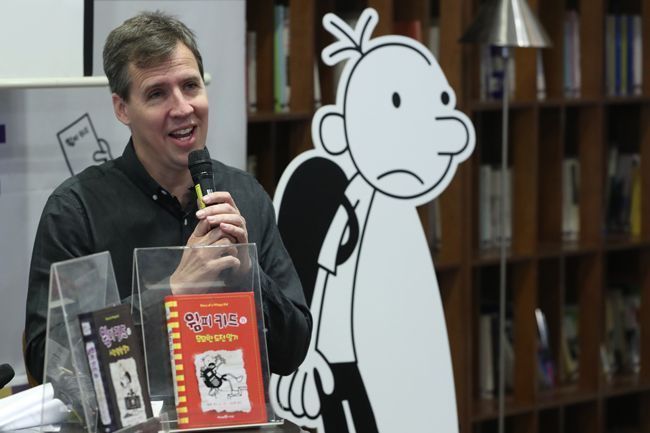
Jeff Kinney, author of “Diary of a Wimpy Kid,” speaks during a press conference at a cafe in central Seoul, Tuesday. / Yonhap
By Yun Suh-young
Jeff Kinney, author of the international children's bestseller, "Diary of a Wimpy Kid," visited Seoul to introduce his 11th book published in Korean and to meet with Korean children.
“I’m excited to be in Korea. For an American like myself, I never imagined I’d come so far,” he said during a press conference held at a cafe in central Seoul, Tuesday, a day after his arrival.
Kinney is the author of the 11 “Diary of a Wimpy Kid” series which have been published in 48 countries, 52 languages and have sold 180 million copies. It was first published online at Funbrain.com in daily installments which was read 20 million times and was later published as a hardcover book in 2007 after demands for an offline publication.
The book series has remained on the New York Times bestseller list for more than 450 weeks in total since the publication of the first book in 2007 and remains on the bestseller list on USA Today, Wall Street Journal, and Publishers Weekly. The series has received many awards, including two Children’s Choice Book Awards and six Nickelodeon Kids’ Choice Awards for Favorite Book. Kinney was also named one of Time magazine’s most influential people in the world.
The Diary of a Wimpy Kid is a book for young adults about an ordinary and timid boy named Greg Heffley who struggles to fit in as he begins middle school and writes about his daily life in a diary.
The 11th story of Diary of a Wimpy Kid was released Nov. 20 in Korea. This is Kinney's first time visiting Seoul to speak about the series, his success, and to meet with his young Korean readers.
“The Diary of a Wimpy Kid was translated into Korean very early on. I can't wait until I get to meet the actual kids and tell them how much I appreciate them,” he said. He has two meetings with school children scheduled during his tour ― the first to teach at an elementary school in Seoul as a one-day teacher, and the other to hold a lecture at another elementary school in Seoul. He also met with fans at a book-signing Tuesday.
"I have heard Korean school children go through a rigorous curriculum. Childhood only lasts once and goes by fast so I hope they find a balance between fun and work."
During the press conference, Kinney gave an overview of how he came up with the character Greg, his protagonist in the Wimpy Kid series.
"Greg was a lot like me when I was growing up; he has a lot of flaws like I did as a kid. When I was writing the Wimpy Kid, I was reading a lot of Harry Potter books. Harry is an underdog but he's brave, powerful and famous. I wasn't really good at anything as a kid. I wasn't like him at all. So I wanted to write about a kid that was authentic to my memories," said Kinney.
"At first I wanted a grown up to be reminded of what it was like being a kid. Once my publisher suggested that this should be a child story, I didn't have to change any of it, because my sensibilities were child sensibilities anyway.”
When asked what he thinks the book’s key success factors are, he said format, humor and authenticity.
"There’s interaction between cartoon and text. Also, it's funny. I think kids are responding to that. Third, I’m striving to write as a kid. My books aren’t filled with lessons, and they don’t feel like books written by an adult for a child,” he said.
“When I was writing, I decided to put illustrations in these key spots, illustrations interspersed with the text. I knew I needed those images as little icons to swim to, as little rewards to the text.”
Kinney's success didn't come with luck, but from much effort in writing spanning eight years. His childhood interest in comics led him to a passion for creation and the desire to pursue cartooning as a career.
"When I went to college, I tried to create my own comic strip and I created one called ‘Igdoof.’ I was studying computer science at the time, but I started to see comics as a possible career. So I got serious about comic strips and I read everything I could on how to become a professional cartoonist. After I graduated, I sent out submission packets to cartoon syndicates to get published. I thought I'd have immediate success, but instead I got lots of rejection letters," he said, showing one of the rejection letters.
"So I spent about three years trying to get published without any positive feedback or any feedback steering me in the right direction. I finally came to the conclusion that I didn't have the technical skill to become a good enough illustrator.
"So in 1998, I had the idea to actually draw as a kid, to pretend that I was a kid as a cartoonist and I came up with the idea of the Diary of a Wimpy Kid. So it ended up taking me four years to fill up my sketchbook with funny stories of when I was a kid. After eight years in total, I printed out a sample packet and took it to New York Comicon."
It was then that he met his current editor who accompanied him on the trip to Seoul and to most of his trips overseas. That year, the first diary of a wimpy kid was published.
"So that was nine years ago when the first book came out and now we're on a tour to celebrate the launch of the 11th," said Kinney.
The book has led him to quite unusual experiences including a visit to the White House several years ago to meet the Obama family.
"Because of these books, I was fortunate enough to travel the world, meet world leaders, including three U.S. presidents. One of the strangest things that happened to me was that the first copy of a Latin version was handed to the pope," he said.
"But most of my life isn't that exciting. It's centered around a bookstore that’s just been created in my town, Plainville in Massachusetts."
He runs a bookstore that he opened for the community to gather.
"My town doesn't have a place for the community to gather. I wanted to create a space for that. It's become a regional cultural center. We've had so many internationally famous authors come to the store. It's also selfish because it’s edifying for me. Every week somebody comes to me and I don’t have to go anywhere so it’s a lot of fun."
To parents, he urges them to help their children read about their interests.
"I have two sons, 11 and 14 years old. It is exciting to be able to influence so many kids and I feel a huge responsibility. Even if I write a terrible book, millions of kids will be reading so I take it very seriously," he said.
"As far as getting my kids to read, it's interest. One of my sons is only interested in sports so he only reads about sports like basketball, football, or baseball. I think as parents what we can do is associate reading with pleasure ― a feeling of success and having completed the book. I think that's the lesson we want them to take away, that reading is good and fun."