Translation work is creative rewriting
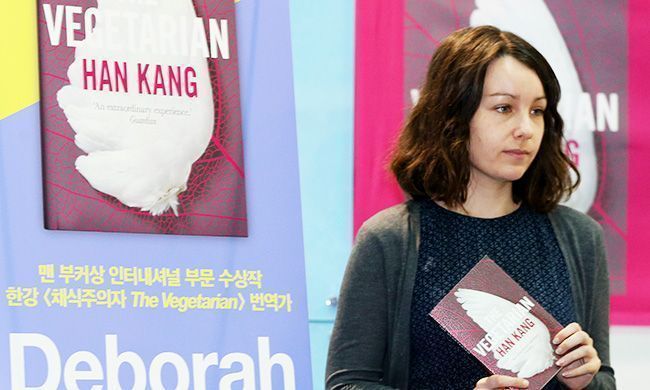
Deborah Smith, the English translator of the Korean novel “The Vegetarian” by Han Kang which won the 2016 Man Booker Prize, holds up the book at the Seoul International Book Fair at COEX in Samseong-dong, southern Seoul, Wednesday. / Yonhap
Deborah Smith says love of literature is crucial for translators
By Yun Suh-young
Deborah Smith, the British translator of the “The Vegetarian” by Han Kang which won the 2016 Man Booker Prize, said translation of a work of literature is rewriting it creatively in another language.
She was visiting Korea to participate in the Seoul International Book Fair which opened Wednesday and runs through Sunday.
“Translation is a process that needs varying degrees of interpretation and editorial decision,” said Smith during a press conference in Seoul, Wednesday.
“Translators know better than anyone that we don’t improve the original. I aim to be faithful to the spirit of the original work, to the letter, as much as I can without compromising the spirit.”
Smith said her Korean has improved much since translating The Vegetarian.
“I’m encouraged that my Korean language ability has improved since 2013 when I translated The Vegetarian, and encouraged even more that whatever flaws there are in my translation have not hampered the enjoyment and understanding of the readers,” she said.
She said she became a translator not out of a desire to enjoy fame but because she wanted to share with a wide audience the books she has come to love.
When asked whether much had changed in her life after receiving the Man Booker International Prize last month, Smith said life was the same as usual.
“I’m not famous, or at least not in England — maybe slightly in Korea. My daily life changed for a few days — I received a lot of emails — and then it went back to completely normal. Until I came here I didn’t notice any difference and I’m very happy with that,” she said.
During a speech she gave, she raised concerns on classing translators based on their background, quoting Ewha Womans University professor Jung Ha-yun who wrote in the Korea Times about the danger of “excluding or prioritizing certain types of translators based on their qualifications, especially their backgrounds.”
“I think a love of literature, patience and dedication are more important for translators. The spirit of humility and cooperation is what makes the translation community what it is and makes me proud to be a part of it,” she said.
She also pointed out that Koreans shouldn’t be obsessed with receiving the Nobel Prize.
“I don’t really understand the obsession with the Nobel prize. It’s quite baffling to me and maybe for many other people as well. Prizes are just prizes," she said. “Writers writing great books and readers appreciating them is enough of a reward in itself I think.”
Asked if she ever felt like writing her own book when she was translating other people’s works, she said, “No.”
“I never thought I wanted to become a writer myself. When you’re translating, you’re a writer of sentences and you’re creating rhythm and style which I enjoy and thought I could do well,” said Smith.
“I appreciated the fact that I didn’t have to think of the story, character and setting. And the nicest thing about translating is that you don’t get writer’s block.”
While translating, she paid particular attention to the cultural representations.
“I am sensitive to issues of representation because I realize that in the U.K., Korean culture is still very little known. People might be reading the translations and it might be their first encounter with Korean culture,” she said.
“When I first started translating, I would be using terms such as soju or manhwa and the editors would not know what this was although it was clear from the context.
“They would suggest ‘why don’t we call it Korean vodka, or Korean manga’ and I explained to them that it’s not a good thing to make one culture sound like it’s a derivative or a lesser version of another. But sometimes editors can be funny about foreign words putting readers off which I don’t think is right.”