'The Vegetarian' says life is just another dream

Han Kang, winner of the 2016 Man Booker International prize for fiction, speaks to the media after winning the award for her book “The Vegetarian” after the award ceremony in London, Tuesday. / AP-Yonhap
By Choi Yearn-hong
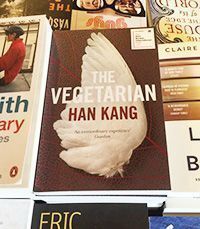
Han Kang’s “The Vegetarian” is seen at a bookstore in London. / Yonhap
Han Kang’s novel landed and shocked England as a bestseller. I purchased the novel in London before it was published in the United States. It was my special joy to read the British translation.
By now, Han has become famous as the first Korean writer to earn one of the world’s three highest literary prizes, the Booker Prize. I admire her work and share my review with The Korea Times.
Her novel is composed of three related stories of Yeong-hye by her husband, her brother-in-law and her older sister, so it is interesting as a serial story in one rather slim book. It is also interesting, because it starts with a bad dream of violence killing an innocent animal that persists in all three parts of the story. The author may conclude at the end that life is just another dream in a spring night.
Han’s story reminds me of “The Metamorphosis,” Franz Kafka’s famous short story.
Many critics have pointed out that The Vegetarian is beautifully poetic. Han’s writing style is poetic in that it is beautifully lyrical. I realized that her Korean is so beautiful that the translation should be equally beautiful. Much later, I realized that her translator’s work is also beautiful. The translator’s British English is new and strange to me, but pleasant to read. I have not yet read the American version of “The Vegetarian.” But I can guess that the original translator’s English is well preserved. Deborah Smith’s understanding of the Korean language is admirable. Her translation sticks matter-of-factly to the original prose without being sentimental.
The publisher made the decision to publish the book after reading the first page. The first page contains almost everything this three-part story is going to develop in the intriguing story of the strange woman’s dream, violence and sex, her dream to run away from her family and life. She becomes a vegetarian and then fantasizes about becoming a tree, not eating any food at all, and then dying. The second section is the most sensual part between the video-artist brother-in-law obsessed with his sister-in-law’s Mongolian spot on her lower body. He paints flowers on her naked body covering her Mongolian spot and then on his naked body. The director who adapted this as a film did not aim to make a pornographic film. Sexual interactions in flowering waves in filming are filmed tastefully as art, not pornography. The film depicts sexual intercourse between the man and the woman that ended in the couple’s separation. The woman as an adulterer is sent to a mental hospital. As a matter of fact, Han Kang was concerned about this part of the short novel, because it was controversial when some readers had pointed out this element is on the boundary of pornography and art. But I think this is legitimate art. Earlier, this section earned one of the coveted Korean literary prizes, the Yi Sang Award. In the third and last section of the novel, the vegetarian woman fantasizes to become a tree in flames.
The New York Times summarizes the novella:
Han’s novella-in-three-parts zigzags between domestic thriller, transformation parable and arborphiliac meditation, told from the points of view of her lousy husband, who works at an office (Part I); her obsessive brother-in-law, who is an artist (Part II); and her overburdened older sister, who manages a cosmetics store (Part III). The third narrator, her sister In-hye, is the only one in the family who cares about Yeong-hye. The structure of the novella masterfully progresses from one narrator to the next.
I found that the following paragraph in Part 3, “Flaming Trees,” summarizes the major thrust of the story.
Yeong-hye turned her head and stared blankly at In-hye, as though the latter were not her sister but a complete stranger. After a while, the question came.
“Why, is it such a bad thing to die?”
In-hye is the only person to visit Yeong-hye in the mental hospital outside Seoul as she tries to save her life. All her other family members had already lost interest in her recovery or given up.
Han Kang made it clear that she did not provide the answer to the question posed above.
She ends her 183-page novella without answering the question.
She may be a nihilist in my view of her story. She may be still attempting to raise questions about why we live. She is now a 46-year old writer.
Does she attempt to find the answer? I hope she does.
The world has now discovered one relatively young writer who has been producing meaningful stories continuously. I hope she becomes a Nobel Laureate soon, heralding Korea as a nation of poetry and literature. In composing her prose, Han Kang is a poet, and that is her best qualification to attract the world to her stories. Here is the last paragraph of “The Vegetarian”:
In-hye stares fiercely at the trees. As if waiting for an answer. As if protesting against something. The look in her eyes is dark and insistent.
Dr. Choi is a Washington-based poet and writer.