Book celebrates 100th anniversary of Yun Dong-ju
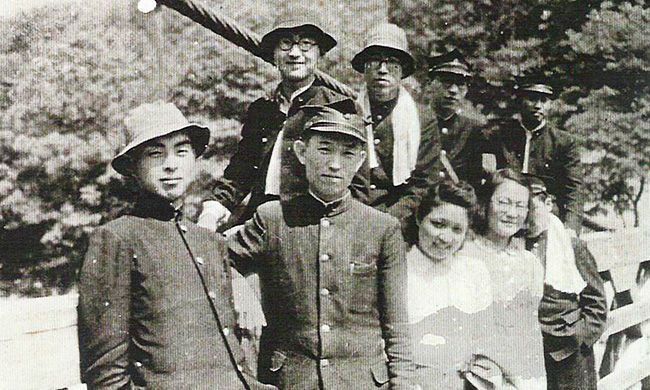
Yun Dong-ju, second from left in the front row, with his Japanese classmates from Doshisha University at the Uji River in Kyoto in this 1943 photo. This is known to be the last photo of Yun, taken on July 14, about a monthbefore the Japanese military arrested him for allegedly participating in the independence movement. / Yonhap
By Baek Byung-yeul
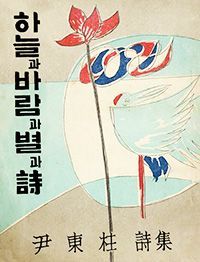
The cover of Yun Dong-ju’s anthology, “Sky, Wind, Star and Poem.” / Courtesy of Sowadari Publishing
One noticeable move on this month’s best-seller chart is patriotic poet Yun Dong-ju’s (1917-1945) posthumous poetry collection, “Sky, Wind, Star and Poem.”
The anthology, published on Jan. 14 by Sowadari Publishing, placed 15th on Yes24, one of Korea’s largest online booksellers, this week. The book is a reprint of the revised edition that was published in 1955 to commemorate the 10th anniversary of Yun’s death. The first edition was released three years after he died in 1945.
Yun’s collection of poetry soared onto the best-seller list in the first week of the year, though it was only sold by subscription. According to another online bookseller, Aladin, 10,000 copies of the book were ordered before it was released.
“Sky, Wind, Star and Poem” is his only anthology and features 31 poems. Born and raised in northern Manchuria, Yun joined Yonhi College, which later became Yonsei University, in 1938. After graduating in 1941, he left for Japan the following year to study literature. In 1943, however, Yun was imprisoned for allegedly participating in the independence movement and died in Fukuoka Prison on Feb. 16, 1945, at the age of 27.
In “Sky, Wind, Star and Poem,” Yun delicately describes his inner torment as a colonial man ruled by Japan and his lyric poems show why he is dubbed “one of the most beloved poets in Korea.”
Yun is thought to have begun writing poetry at the age of 15. Though his early poems were about his own thoughts, his later work, written in the 1940s, reflects the agony as he lived in his 20s when Japan fell into a stalemate in the long-running Pacific War with the United States.
While in his 20s, Koreans were forced to speak only Japanese, but the young literature student wrote poems in Korean, portraying through his poetry the agony about what could be done for his country.
On the 70th anniversary of his death last year and the 100th anniversary of Yun’s birth next year, a film shedding light on Yun’s last 10 years will also hit the big screen nationwide on Feb. 18.
Star director Lee Joon-ik directed the film, “DONGJU: The Portrait of a Poet.” It was shot in black and white because people are still reminded of Yun through the photographs of him in black and white, according to the director.