'One Economist's World View': A compilation of Dr. Hwang's weekly columns
By Choi Yearn-hong
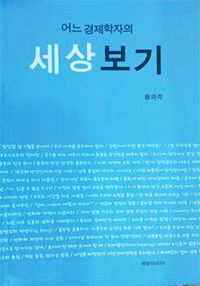
The cover of “One Economist’s World View”
Dr. Hwang Eui-gak, an economist, retired after a long teaching and research career in Korea, the United States, China and Japan. Also a columnist of the Mirae Hankook Weekly (Future Korea Journal) for the past 10 years, he has compiled his essays into “One Economist’s World View,” a 476-page book. Each of his essays reflect his ideas on various subjects in the changing times, so this book is a reflection of his views of Korea and the world in the past decade. The date of original publication appears at the end of each essay. In addition to being a renowned economist and faculty member at Korea University, he was an eloquent writer and essayist.
His economic essays were focused, so they were easy for the general public to read and comprehend. He wrote about South Korea’s economy in the framework of the world economy in many ways. For example, South Korea’s energy consumption patterns became worrisome with the dwindling energy resources and political and economic crises in the Middle East. Korea and the world are not separable. He warned that an energy crisis would emerge from the high energy consumption (in his columns dated April 22, 2011; March 25, 2013; and July 8, 2013). An energy crisis causes an economic crisis, and this is highly relevant to South Korea, which relies heavily on carbon energy and nuclear energy. Dr. Hwang suggested the development of new sustainable energy resources on the basis of energy conservation. In all of his economic essays, he advocated for a free market economy as the nation’s financial and monetary policies. He consistently advised politicians, including those on the left , and governmental leaders to stick to the free market economy principle. Working as a member of the Monetary Policy Committee of the Bank of Korea during his sabbatical leave from Korea University must have helped him better understand the Korean economy and world economy.
In addition to the economy, he also wrote a lot about North Korea. He predicted the collapse of the North Korean regime after three generations of dictatorial rule owing to rising democracy and Internet movements worldwide, and predicted a re-unification of the two Koreas with a post-Kim North Korea (see his columns dated Jan. 13, 2014; Dec. 7, 2013; Oct. 7, 2013; Dec. 21, 2012; and April 14, 2011). As a reviewer, he can be considered a naive optimist when he predicted the collapse of the regime, but his optimism about a unified Korea was right in terms of reducing the enormous military spending in the two Koreas, and on the free market economy in one Korea. In 1990-1991, he was a research scholar at the Brookings Institution, working on a comparative analysis of the two Korean economies. The project’s findings were published by Clarendon Press of Oxford University as “The Korean Economies: A Comparison of North and South He was fair in his evaluation of the North Korean economy during his work at the Brookings Institution in the 1980s, but he was critical of the South’s generous economic aids to the communist North, which squandered financial aid by funneling most of it to the military.
His major concern, as reflected in this book, was the political conflicts between the right and left in South Korea. He criticized both sides; he said right-wing politicians were not principled to their economic and political bases, and left-wing politicians were not principled to preserve democracy and the free market economy. He said both sides should protect the middle class and foster competitiveness in education and in the market, in order to support and maintain national interests. It seems to me that South Korea is seriously divided — some care, and some don’t . Dr. Hwang predicted a growing social crisis from this senseless division. In a turbulent society, law and order would be missing, education at all levels would deteriorate, generational conflicts and tensions would intensify and trust in authority and between individuals would disappear. He concluded that we all should advocate social and political reforms (see his columns dated Jan. 13, 2014; Feb. 28, 2014; May 29, 2013; March 11, 2013; Dec. 3, 2012; Dec. 31, 2012; March 29, 2012; and May 2, 2011).
He has also written many essays on Korea’s relationships with the United States, Japan and China. His foreign policy stance is based on principles of peace, equality and compassion. Some important questions that he addressed were about unequal international relations and more importantly, the pursuit of national interests rather than international peace. However, he cited many good examples in the United States, Japan and China and wrote that Korea can look to these examples in its formulation of its foreign policies. Among the examples in China is the Pearl Buck Museum in Jensiang City . Nobel Prize-winning writer Pearl Buck was the daughter of Christian missionary parents; she was born in China and lived most of her life there. The Communist Chinese government built the museum to commemorate her (Oct. 20, 2011) . All of his essays on the United States, China and Japan drew from his scholarly careers in those nations during and after his teaching career at Korea University.
I recommend “One Economist’s World View” as a valuable resource that will help the general public understand current issues.
The writer is a retired political scientist and professor who enjoyed a long career in the United States and Korea.