'Poets must reach out to young people'
By Ko Dong-hwan
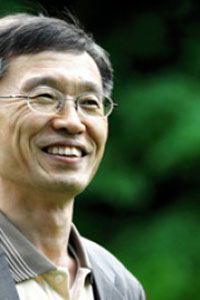
Children's poetry critic Kim I-goo
Authors must do more to reflect the modern realities of young people, and breathe new life into children’s literature, a noted critic said.
Kim I-goo, 56, a critic focused on children’s poetry, believes that authors – particularly poets ― have reverted back to a standardized approach that was common when the nation was controlled by authoritarian regimes.
“The driving force behind children’s poetry should be the depiction of reality, regardless of whether this is done in a direct or indirect manner,” Kim said during a recent interview near Hapjeong, western Seoul.
“Poems don’t do that these days. Rather, they are superficial and avoid the aspects of modern life that go beyond the superficial, such as violence or demoralization such as bullying and isolation.”
Kim, who gained attention in 2007 for his scathing critique of children’s poetry, “Let’s Discard Old Poems,” said that in the aftermath of the Korean War (1950-53), poets stuck to a “cookie-cutter” approach.
“Literary works were all conservative because writers had to avoid the state watchdog’s monitor. Those caught with works that smacked of anarchistic views were tortured or had to escape to the North,” said Kim, who is a literary editor at Changbi Publishers.
As a result, Kim said children were only depicted as cute and docile.

Cover of "Let’s Discard Old Poems"
A sea change took place in the late 1970s, when writers such as Lee Oh-deok worked to make children’s fiction more relevant.
Children’s poetry, however, lagged behind, with only a few authors writing poems that went beyond the superficial, according to Kim.
Examples of poetry with deeper meaning include “Barefoot” by Kwak Hae-ryong (2008), which tells about the struggles of a homeless man living near Seoul Station. The poem “Mother Forgives Everything” tells the tale of a South Korean man who sends corn to his mother, who lives in North Korea.
Kim began his career writing children’s fiction but took an interest in poetry as an editor at Changbi. He emerged as a prominent editor with “Let’s Discard Old Poems” and recently reemerged with a collection of critiques packaged under the same name.
For Kim, the goal of criticism is to improve the “ecosystem” surrounding children’s poetry. He believes there are some good signs, including the creation of a new children’s poetry showcase in Yeonhui-dong, western Seoul, held each spring. Another gathering related to the genre is held each summer in Chungju, North Chungcheong Province.
In the end, children’s poetry is all about bringing parents and children closer and helping young people understand the world around them.
“Poems express the world in a pure, concise and intuitive fashion,” said Kim. “Which means parents and children can have a shared interest in them.”