Quack doctors abound
By Baek Byung-yeul
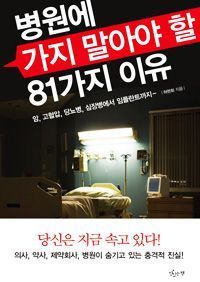
“81 Reasons You Must Not to Go to Hospital”
A 57-year-old woman with the surname Kim, recently underwent a mastectomy to remove cancer in one of her breasts. Her doctor is angry that she didn’t visit him sooner.
She initially found a lump in the right hand side of her chest after performing a breast self-examination. Kim is a manager at a large-sized restaurant in western Seoul, so she was able to pay for cancer treatment.
As strange as sounds, Kim was hesitant about going to a hospital because she was unsure this would be in the best interests of her health. This was despite common knowledge that early diagnosis and treatment is critical in a successful fight against cancer.
Regrettably, Kim gave unnecessary weight to quack theories described in a slew of books written by self-appointed health experts.
These opportunistic authors claim to be exposing flaws in modern medicine without medical expertise. This causes some people to make tragic decisions. Just ask Kim, who actually was more worried about the small level of radioactivity transmitted by hospital equipment than the cancer itself.
Fortunately, Kim made a full recovery, but had to spend more than a year in hospital because her delayed decision allowed the cancer to spread to her right leg.
"It seemed that everybody else was talking about the additional harm I would expose myself to with all the radiography involved with cancer treatment," said Kim.
"Of course, I regret that I didn’t see a doctor earlier."
Kim’s story is dramatic, but it’s not uncommon in a country where the public’s obsession with health is paired with a shocking lack of knowledge about it.
Korea is a country where practitioners of traditional herbal medicine ("haneuihak") and other alternative treatments openly claim to be able to cure cancer and Parkinson’s disease and even deny the existence of viruses.
It’s also a nation where the stock value of a beverage company skyrocketed because scientists discovered that "makgeolli" (traditional farmer’s wine) contains more of the cancer-suppressing substance, farnesol, than beer or wine. Of course, for the farnesol in makgeolli to have even a microscopic cancer-suppressing effect, a person would need to consume about 10-liters of it every day. They would probably die of liver cancer first.
Authors and publishing companies continue to shamelessly exploit the gap between interest and knowledge. The worst among them appears to be Hur Hyun-hoe, a former employee of the Hankyoreh Newspaper, whose "81 Reasons You Must Not Go to the Hospital" has been a best-seller here since it was published last year. To put it bluntly, it’s advisable to do the opposite of what Hur’s title suggests.
Hur’s theories, which he shared in a number of books before condensing them in his profitable best-seller, are based purely on his personal experiences. To summarize, he had been in bad health, then felt better after he stopped taking the drugs prescribed by his doctor. And that was enough for him to devote himself to a crusade against modern medicine.
For those who are curious, he studied law at Sungkyunkwan University, not medicine.
"I suffered from all kinds of disease since I was young. My nose was always sore due to rhinitis. I had a brain operation after a car accident when I was 14 years old. I had an appendectomy at the age of 22. I was also treated for diabetes after I reached 40," writes Hur, describing himself as a "walking general hospital list."
Hur said that he stopped going to the hospital sometime after he was diagnosed with liver cancer in its early stages. He stopped taking the drugs prescribed to him. He claims he successfully combated the condition himself by studying independently, instead of relying on doctors.
"Doctors never try to take any responsibility… They are just technicians who can’t do anything without their machines," Hur writes in his book.
"Doctors let their patients have a CT scan first and they depend on the decisions made by the machine. What they conceal is how harmful radiography is to the human body."
Hur, essentially a ruthless marketer masquerading as a health expert, gets loose with facts in supporting his flawed theories.
One sentence reads: "According to three studies conducted between 1998 and 1999 in the United States, the rate of misdiagnosis in hospitals went up by as much as 40 percent year-on-year in some states.’’ It’s unclear where this information came from because Hur doesn’t mention the source, despite devoting almost 20 pages to what the results of those "studies" imply.
However, "81" is not as ridiculous as Hur’s second book, "72 Reasons Why You Should Stop Believing in Doctors," which was also published last April.
From the very first chapter, he suggests that smokers shouldn’t quit, but instead light up more cigarettes. This is because tobacco leaves are "human-friendly natural ingredients," he says, reminding his readers that American Indians used them for folk remedies. The danger of second-hand smoke is, according to Hur, absolute nonsense too.
The book goes on to say that his readers shouldn’t stop drinking because alcohol naturally can have a "favorable influence on our body."
"(Alcoholic beverages) can lower the risk of hypertension and prevent heart disease," he wrote.
For some reason he argues that distilled alcoholic beverages such as "soju" are bad for your health because they somehow aren’t purely alcoholic enough. We have no idea what that means either.
Hur also regards dentists with contempt. He claims that they convince patients to have implants just to squeeze more money out of them.
It’s hard to explain why Hur’s books continue to be so popular. "81," which was published last September, still ranks sixth among the "medical" books at Bandi & Luni’s Bookstore, a major book store franchises in Korea.
"(The popularity of Hur’s books) are troublesome. Of course, doctors use machines, simply because the advancement in technology could save more lives. In not one paragraph is he able make a scientific argument on how the level of radioactive exposure at hospitals affects the health of patients," said Park, an Incheon-based doctor, who didn’t want to be named.
"I guess the picture Hur is trying to draw is that hospitals are just buildings painted in white full of overpaid swindlers calling themselves as doctors."
Lee, a dentist in Seoul, quipped: "Well, I guess Hur must at least have good teeth."
Hur is already controversial presence on the Internet. He has about 6,000 followers on Twitter. Online message boards are heated with debates on whether Hur’s arguments have value or not.
In the book, "Hippocrates' shadow,” American doctor David Newman writes that patients distrust doctors because doctors don't admit that they don't know everything about their patients.
Park said: "there are some doctors who regard their patients only as a means to a paycheck, forgetting their duties as professional healers. And competition is always becoming fiercer because there are so many doctors who run their own private hospitals."
"But it is more important to believe that the majority of doctors are dedicated to treating patients more effectively."