Taxidermy of memory

The National Museum of Korean Contemporary History has been a target of criticism since its opening last December. / Korea Times photo by Shin Sang-soon
An ‘anti-guide’ for the new contemporary history museum
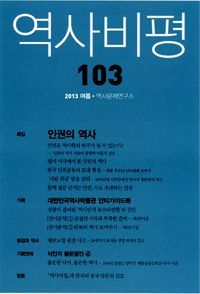
The latest edition of “Historical Criticism,” apeer-review journal of historians
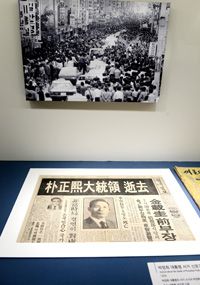
A copy of an extra version of the Hankook Ilbo, a sister paper of The Korea Times, published on Oct. 28, 1979, to report the assassination of late President Park Chung-hee, is one of the items displayed at the National Museum of Korean Contemporary History. / Korea Times
By Kim Tong-hyung
Just six months into its existence, the National Museum of Korean Contemporary History has been all but declared a monumental failure.
I must confess that at least some part of the institution’s shortcomings, sloppiness and the massive intellectual vacuum it fills its massive central Seoul building with had something to do with me.
It was in late September when the museum’s organizing officials approached me to take part in a reviewing process of intended content as they rushed frantically to open the museum within December.
The museum was originally planned to open in 2014 before politicians got involved. The new deadline meant that organizers had less than four years to prepare since the preparation committee was set up in April, 2009.
The quality of the end-product was certainly not as much a concern as ensuring that then-President Lee Myung-bak got to inaugurate the museum before he leaves Cheong Wa Dae. People such as me don’t often get to become involved in government-financed scholastic projects unless there is a serious level of desperation. So I accepted the request.
I regretted the decision immediately after finding out that my job was to review more than 4,000 historical events over a couple of weeks, including checking the facts, reviewing the objectivity of the descriptions and polishing the English translations. The work was both painstaking and mind-numbingly tedious.
It was on a Saturday in October when the museum’s organizing committee called in its hired hands to cross-check our texts and agree on things that needed agreement.
So I then found myself in a conference room, tucked safely away, but still in earshot of the metallic sound of hammers and electric tools from the lobby that was still being built. I was joined by a group of historians, social science professors and a translator.
One of the frustrations about writing English professionally in Korea is that your words and sentences are evaluated not only on basis of their ability to accurately describe people, places, things and events, but also high expectations of expressing uniquely Korean sentiments in English words. This became an annoyance again as I spent the next 10 hours being beaten down emotionally and intellectually in a room full of Ph. Ds.
My responsibility was to make the English descriptions accurate and comprehensible to foreigners. This caused friction with some of my scholar colleagues who seemed more concerned about the reactions of their peers.
It was their instinct to avoid controversy as much as they could over the painful events that shaped Korea’s contemporary history.
They passionately argued against calling the 1980 Gwangju Massacre ― Chun Doo-hwan’s brutal crackdown on demonstrations against his military junta that proved to be a turning point in Korea’s democracy movement ― an "uprising,’’ let alone a "massacre,’’ and preferred "movement’’ or ``incident.’’.
Every post-20th century event that involved civilian resistance, from the Jeju Uprising of 1948 (the Korean army’s brutal suppression of a civilian revolt at the island) to the April Revolution of 1960 (the popular uprising that overthrew the autocratic First Republic of Korea under Syngman Rhee), was being labeled a "movement’’ or "incident.’’ I was outnumbered and rendered irrelevant as a source of opinion.
At one point, I was able to summon enough energy to throw up my hands and ask, ``why don’t we just decide to rename every meaningful event that happened in the past 100 years an `incident’ and call it a day?’’
After a brief moment of awkwardness, the professor sitting to my left replied, ``there will be no need for us to jump into fire with a live grenade in our hands.’’
That remark drained whatever fight I had in me, so I locked myself into mental asylum for the rest of the meeting, which I must say, was irresponsible on my part.
Perhaps, I wouldn’t have been as dejected had I knew then that Mr. Live Grenade, or Myongji University professor Kang Gyoo-hyoung, was a central figure for the Association for Contemporary History, a group of historians and social science professors associated with the conservative "New Right’’ movement.
This is the same group that has created a national controversy by its attempt to rewrite the state-approved history books used in middle and high schools to accommodate right-wing viewpoints.
My brief involvement in the preparation process dramatically lowered my personal expectations for the museum, which I now find as a 45 billion won (about $40 million) temple dedicated to the country’s industrialization myth. Predictably, the descriptions of Korea’s rapid, export-led economic growth were cloying and overdone, and the painful democratization process and working-class struggles subdued and reduced.
If this should be called as history at all, then it is history compressed in a linear path. The republic is founded; policies are executed; economic prosperity follows; democracy finds room to stand. The depiction of a straight line to happiness doubles as an insult to intelligence.
This intellectual lapse may have been inevitable: there were only four historians in the museum’s initial 29-member preparation committee and none of them specialized in Korean contemporary history. The panel was dominated by government officials and academics tied to the New Right, a loose association of people from different backgrounds close to the Lee administration.
Historians speaking out
Historians, after being excluded from the process of making the museum, have been compensating by dressing down the institution with passion once it opened to the public.
The latest shot at the museum comes from a trio of scholars ― Mokpo University’s Lee Ki-hoon, Korea University’s Yang Jeong-shim and Yonsei University’s Kim Seong-bo ― who offer to make a ``guidebook’’ for the museum, but only for its haters.
Their arguments, which appear in the latest edition of peer review journal, Historical Criticism, don’t have the depth and expository texture capable of adding another dimension to existing historical discussions. But this seemed to be more of a reflection of the subject they had to work with.
Kim offers biting but predictable criticism on the way the museum attempts to justify the Park Chung-hee’s May 16 coup of 1961, which was described as an inevitable development after the economic troubles and political chaos that followed the years after Rhee’s exit.
Lee displays an inability to take seriously a museum he finds so intellectually vapid. In a snarky language rarely found in the pages of Korean scholastic journals, Lee has penned an easy-to-read roundup on the museum’s half-baked preparation process and some eye-opening mistakes found after its opening. To him, the museum’s problem is not as much about viewpoints that as clumsiness.
The museum experienced much trouble in collecting enough artifacts to fill its three-floor exhibition halls as all the good stuff had been already under the care of preceding institutions like the Kyujanggak Institute for Korean Studies, National Museum of Korea and Independence Hall of Korea.
The brand new museum became over-dependent on replicas and digital media (say goodbye to special exhibitions) and therefore lacks ability to function as an archive for historical material, Lee quips.
The gaffes pointed out by Lee include the description of the Japan-Korea Treaty signed in Ganghwa Island in 1876. The museum explains that it was an unequal treaty that forced Joseon Kingdom (1392-1910) to accept conventional duties on Japanese imports, among other unfavorable terms.
However, the treaty actually states that Joseon to lift all tariffs on Japanese products, and it wasn’t until 1883 that the kingdom was to negotiate on import duties with Japan again.
There were many artifacts with their names or dates stated wrong, including Rhee’s book "Independence Spirit,’’ which was actually published in 1910, but described as a 1946 work.
A display intending to portray the strengthening social role of women contains only a copy of the "Madame Freedom,’’ an early-20th century novel about the extramarital dalliances of a professor and his wife. It’s ironic that, in a country that just voted in its first female president, its newest history museum limits the description of the modern woman to sexual liberation.
"English is not my profession, so I probably shouldn’t comment on the English descriptions, but even in my eyes, some of the sentences looked awkward,’’ Lee wrote. And he can take my word for it.