Rhyu explores the death question
By Jung Min-ho
.jpg)
Rhyu Si-min says "How to Live,” released after his retirement from politics in February, is his first book in a long time he didn’t self-censor for political reasons. / Korea Times
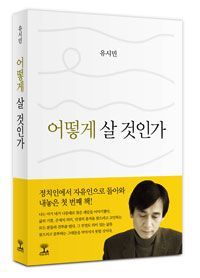
“How to Live,” Rhyu Si-min, Aporia Publishing
Rhyu Si-min, who was one of the most influential liberal politicians of the past decade, has a talent for provoking both the right and left.
Conservatives hated his "manners,’’ while those in the progressive camp grew weary of their opinionated spokesman who was a magnet for controversy.
Rhyu, a two-term lawmaker and a former health minister in the Roh Mu-hyun administration, presented himself as one of the last defenders of liberal values in a political landscape shaped by unpredictable elections and dirty compromises.
It appears that the past 10 years has irrevocably altered how Rhyu, who entered the political arena as an influential journalist and civic activist, remembers his past and his expectations of the life ahead of him.
Death is the main subject of Rhyu’s book, "How to Live,’’ published following his surprise retirement from politics in February. He describes the book as his first writing that wasn’t "self-censored for political reasons in a long while.’’
“Living is death; dying is life. It is not like death comes after living; in every moment of living, we are dying. Death is just the other side of life,” Rhyu wrote. “Let’s not say life is meaningless because we all eventually die. That is wrong; in fact, the opposite is true ― life is meaningful because of death.”
In the first chapter, Rhyu says he felt bound by his “job identity” in which his every move was noted and analyzed based on political calculations.
“I broke off the habit of pretending and hiding things for political righteousness. I listened to my inner voice, and I took one step towards becoming the real me I want to be,” he wrote.
Fundamental questions about how to live may have already been oversold in many forms. But Rhyu tries to find the answers by looking back to his college years when he was conscripted into the Army and sent to prison twice while fighting for democracy against Chun Doo-hwan’s dictatorship in the 80s. Seen through the lens of a witness who lived at the center of the political storm, the book raises interesting questions that are worth thinking about.
Rhyu’s tone is soft, mature and sometimes disinterested. And yet, the book conveys his burning enthusiasm for democratic progress as well as compassion for the main opposition Democratic United Party (DUP) that has long locked horns with him over realizing progressive ideas.
“As a voter, I have always supported progressive parties. The DUP is one of them,” he wrote. “The DUP, however, became a party in which politicians’ personal desires dominate the political cause. The party can be reborn as a genuine progressive one by admitting this fact.”
The most devastating event of Rhyu’s political career was the death of former president and friend Roh Moo-hyun, who jumped off a cliff amid a bribery investigation that tarnished the reputations of Roh and his family.
“I became afraid of the world. Words such as democracy, freedom, liberalism and motherland no longer made my heart flutter,” Rhyu wrote in a book, “Destiny,” a year after Roh’s death.
The incident compelled Rhyu, who cut himself off from the political scene after retiring as a minister in 2007, to fight for what he believes one last time. And when Moon Jae-in decided to run for president, he perhaps knew helping him to win the election would be his final political challenge.
When Park Geun-hye won last year’s election, half of the sharply divided nation fell into despair. But in a composed tone, Rhyu, who was perhaps the most desperate for Moon to win, consoles those who are despondent.
“Supporting a candidate means you have to also embrace the possibility of him losing,” he wrote. “The result of the election is just one of thousands of progressive losses in history.”
Referring to the fact that conservative Park’s pledges were nonetheless more liberal even than those made by the liberal camp five years ago, Rhyu said progressives only lost the election, not their historical contribution.
Despite plenty of things to complain about, Rhyu is neither whiny nor defensive, and stays on track answering his first question rather than spewing out long-suppressed emotions.
Citing philosopher Albert Camus’ question, “Why not just commit suicide?,” Rhyu tries to find answers, providing logical and philosophical stimulus to the readers.
His sentences are short and clear, but the book seems more emotional than rational with personal stories and confessions about his 53-year whirlwind life.
According to communications theory, any relationship that lacks conflict is defined as “unhealthy” because conflict is necessary for effective problem solving. This especially applies to politics where different opinions should be actively shared and discussed. Indeed, what is far worse than meaningless fighting is collusion.
Now Rhyu, who was willing and able to disagree with powerful conservatives in trenchant and logical ways, has left politics for good, and the big portion of Korean liberalism is left in the hands of the beleaguered DUP that currently lacks star players. For many progressives, political leadership and direction, that is an answer for “How to Live.”