Gatsby of the developing world
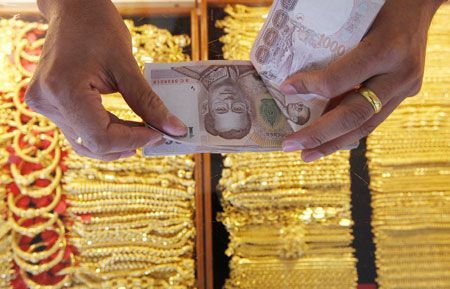
A shopkeeper counts Thai baht banknotes as he buys gold from a customer in Bangkok’s Chinatown. / AP-Yonhap
Hamid brilliantly illustrates how ‘rising Asia’ goes deeper than wealth, politics
By Kim Young-jin
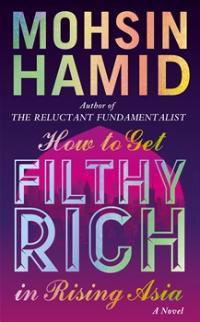
“How to Get Filthy Rich in Rising Asia,” Mohsin Hamid, Penguin
Books that tackle the theme of “rising Asia” are prone to focus on the big – the geopolitics, for instance, of the world’s most populous country increasing its economic and political might; or the “miracle” of one that quickly rises from poverty to prominence.
It is refreshing then, that renowned Pakistani author Mohsin Hamid’s new novel, “How to Get Filthy Rich in Rising Asia,” focuses on a smaller scale. Written under the guise of a business self-help book – a genre voraciously read in Asia – it chronicles the life of an impoverished rural boy who seeks and finds wealth despite crippling social immobility.
While the story takes place, presumably, in South Asia (the exact location is never revealed) and not East Asia, the narrator’s crossing of a daunting wealth divide resonates to an extent with the Korean experience. Moreover, it uses that journey to illustrate, in a globalized context, a yearning for something greater than the wealth accrued from rapid modernization and the trappings that come with it.
What immediately grabs the attention, however, is the guise of self-help, which forces the author (whose “Reluctant Fundamentalist” was an international bestseller) to employ a second person narrative for the duration of the novel.
“This book is a self-help book,” it announces early on, setting a forthright tone that is maintained throughout. “Its objective … is to show you how to get filthy rich in rising Asia. And to do so it has to find you huddling, shivering, on the packed earth beneath your mother’s cot.”
The artifice fosters a sense of intimacy, freeing Hamid to zoom in and out of the protagonist’s life as he climbs a precarious ladder to success. It also lends to a quirky narration in which characters don’t have names, including the protagonist’s lifelong love interest – who is simply described as the “pretty girl.”
In chapters such as “Get an Education,” “Avoid Idealists,” and “Work for Yourself,” the narrator presents a map to avoid the pitfalls of “rising Asia,” such as rampant corruption and problems posed by rapid urbanization. Ultimately, however, it is the slowly developing love story that grabs the reader.
In a country resembling Pakistan, the narrative follows the protagonist from his sickly days in a rural village to a sprawling metropolis. Here, he watches as his brother and father are crushed by the weight of labor in a society of strict castes. His one glimmer of hope, besides his own proclivity for business, is the “pretty girl” who herself is rising from poverty.
He begins to gain a foothold when he learns from a “master” businessman, who makes his money by selling expired goods at market price. The young man starts his own business selling water, a precious commodity in his poverty-stricken city.
Meanwhile, his path crosses over the years with the “pretty girl.” She becomes a friend and, importantly to the story, a symbol of the humanity he is ultimately chasing.
Hamid describes poverty in details that remind us that despite being in the throes of globalization, there are millions who toil in the shadows of the wealth it generates. When the child moves with his family to the city, he observes how urbanization has made its mark on society.
“Excessive fertility (in the city) is here a liability, not an asset as historically it has been in the countryside, where food was for the most part grown rather than brought, and work could be found even for unskilled pairs of hands, though now there too that time is coming to an end.”
As the man approaches his twilight years, the self-help approach begins to take a surprising tone as the story becomes more reflective. Here, the examination of wealth in a rising part of the world, and how humans relate to such a phenomenon, proves to be a valuable accompaniment to the study of the bigger, geopolitical implications.